➡️ PART 3 — THE HOUSE WAS MINE, BUT THE MARRIAGE WAS OURS
For a few seconds after Diane left, Mark and I stood in the driveway without speaking.
The police cruiser was already turning at the end of the street.
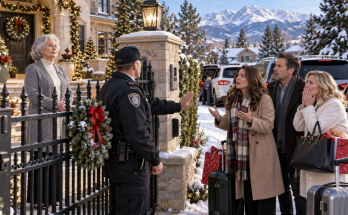
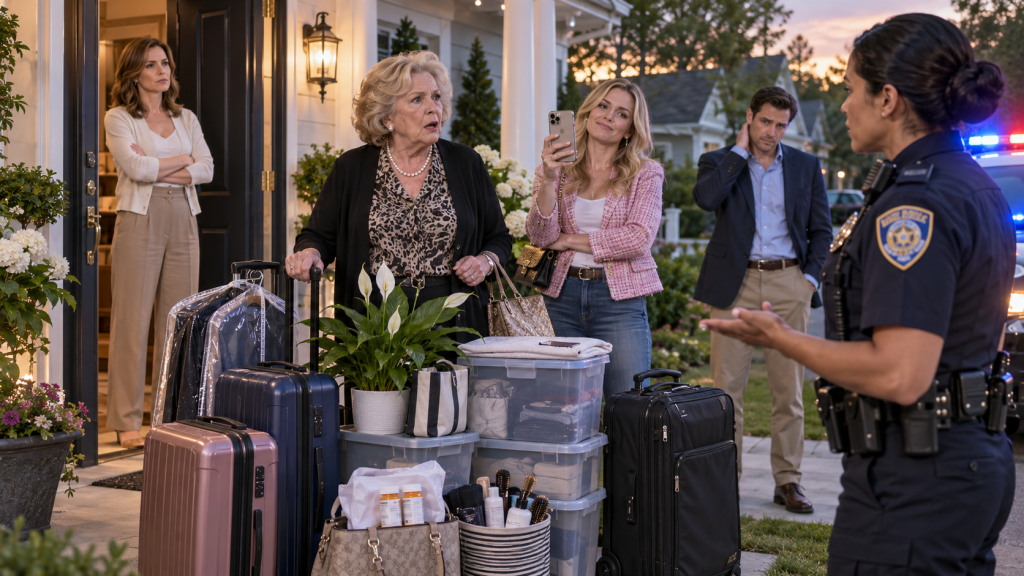
Lisa’s SUV had disappeared around the corner with three suitcases, two storage bins, a garment bag, a bag of prescriptions, and the peace lily that had somehow survived the entire humiliation.
The evening should have become quiet.
Instead, I could still hear Diane’s voice in my head.
My son owns this house.
And then Mark’s.
Claire, can we please stop embarrassing everybody?
That was the sentence that stayed.
Not because it had been the cruelest.
Because it had revealed the hierarchy.
His mother had arrived uninvited.
His sister had recorded me.
Police had been called to my home.
And somehow Mark’s first instinct had been to ask me to stop making the situation uncomfortable.
Not them.
Me.
Mark walked toward the porch.
I moved in front of the door.
He stopped.
His face changed.
“Claire.”
“We need to talk before you come in.”
He stared.
“This is my home too.”
“Yes.”
I said.
“And unlike your mother, you actually live here.”
His jaw tightened.
“Then let me inside.”
“Not yet.”
“Are you seriously locking me out?”
“No.”
I held up one hand.
“I am standing on the porch asking my husband to have one conversation before we walk back into our house and pretend tonight was only about your mother’s luggage.”
Mark looked exhausted.
So did I.
He glanced toward the neighbors’ houses.
Curtains moved.
Of course they did.
“Can we at least do this inside?”
The old version of me would have said yes because he was embarrassed.
That evening, embarrassment had lost voting rights.
“No.”
He rubbed both hands over his face.
“What do you want me to say?”
There it was again.
Not:
What did I do?
Not:
What do you need?
What do you want me to say?
As if this were a test and I held the answer key.
“I want you to tell me why your mother thought you owned this house.”
“She assumed.”
“Lisa just said you told her.”
Mark looked away.
“Mark.”
“I may have said something years ago.”
“What?”
“I don’t remember exactly.”
I laughed.
“You remember enough to be vague.”
“That’s not fair.”
“Then be specific.”
He stared at the porch railing.
Finally:
“When we first moved in together, Mom asked how we afforded it.”
“And?”
“I told her I had handled the house.”
My body went still.
“You handled it.”
“I didn’t say I bought it.”
“What did you expect her to think?”
He said nothing.
I stepped closer.
“You moved into the house my grandparents left me.”
“Yes.”
“I had already spent almost two years renovating it.”
“I know.”
“I paid the contractor.”
“I know.”
“I refinanced part of the renovation cost myself before we were married.”
“I know.”
“And when your mother asked where the house came from, you told her you ‘handled it.’”
His shoulders sank.
“Yes.”
“Why?”
He hesitated.
That hesitation mattered.
Not because he lacked an answer.
Because he disliked it.
“Because she always thought I was behind.”
I frowned.
“Behind who?”
“Lisa.”
Of course.
Sibling competition.
The quiet engine underneath half of family dysfunction.
“Mom always thought Lisa was more stable.”
“Better job.”
“Bought her condo first.”
“Had savings.”
“I was still renting.”
He laughed bitterly.
“Then I met you.”
“Moved here.”
“Got promoted.”
“And suddenly Mom thought I had figured everything out.”
I stared.
“So you let her think the house was proof.”
He looked at me.
“Yes.”
“Proof of what?”
“That I was doing well.”
I almost admired the ugliness of it.
Not because it excused anything.
Because at last it had shape.
My house had become his evidence.
Not legally.
Emotionally.
He had borrowed the image of ownership because it made him look successful to his mother.
Then years passed.
One small lie hardened into family mythology.
Mark bought that place.
Mark provides well.
Claire is lucky.
I had heard versions of those phrases at Christmas dinners.
Birthdays.
Thanksgiving.
Once, Diane had stood in my own kitchen and told me:
“You landed on your feet when you married my son.”
I had laughed because correcting her felt petty.
My silence had helped the story survive.
That realization did not make me responsible for his lie.
But it did make me angry with myself.
“Why didn’t you correct her?”
I asked.
“I should have.”
“That isn’t an answer.”
“I liked that she was proud of me.”
There.
Finally.
He looked miserable saying it.
Good.
Truth should sometimes be uncomfortable.
I crossed my arms.
“And tonight?”
“What about tonight?”
“When she said, ‘My son owns this house,’ why didn’t you correct her?”
“I panicked.”
“No.”
I shook my head.
“You had almost twenty minutes between your arrival and Officer Ruiz asking.”
“I panicked for twenty minutes?”
Mark looked away.
“I knew Mom would feel humiliated.”
“And me?”
He looked back.
“What?”
“Were you worried about humiliating me?”
“Of course.”
“When?”
“I was standing on the porch while your mother told a police dispatcher I was illegally keeping her out of my own house.”
“Lisa was recording.”
“You drove up and said nothing.”
“Then when the officer asked who owned the property, you asked me to stop embarrassing everybody.”
I waited.
“Which everybody were you protecting?”
Mark’s face changed.
Because he knew.
His mother.
His sister.
Himself.
Not me.
“I handled it badly.”
he whispered.
“Badly is forgetting dinner reservations.”
“I know.”
“No.”
I stepped closer.
“You decided your mother would move into my office.”
“I thought we could make it work.”
“You did not think we could make it work.”
“You decided I would make it work.”
He flinched.
“That’s different.”
He tried to interrupt.
I continued.
“You knew Lisa refused because she wanted her spare room.”
“She works there.”
“So do I.”
“I know.”
“Do you?”
I pointed toward the upstairs window.
“That office is where I spend three days a week earning part of our household income.”
“I know.”
“Then why was her workspace non-negotiable and mine available?”
Mark opened his mouth.
Nothing came.
I answered.
“Because Lisa said no before you asked.”
Silence.
“And you assumed I would eventually say yes.”
His face told me I was right.
That hurt more than the house.
More than Diane.
Because it meant Mark had not forgotten to ask.
He had chosen not to ask because he believed my resistance could be managed after the decision was made.
Consent delayed until after commitment is not consent.
It is pressure.
“I need space tonight.”
I said.
His face went pale.
“Claire.”
“I’m not saying divorce.”
He exhaled.
Too quickly.
I noticed.
“I’m saying I need you to understand that tonight changed how I see something.”
“What?”
“Our marriage.”
His face tightened again.
“Because of my mother?”
“No.”
I said.
“Because of you.”
Mark slept at a hotel.
Not because I threw him out.
Because he agreed we should not continue the conversation while both of us were angry enough to turn every sentence into a weapon.
That was one of the few mature things we did that night.
Before he left, he stood beside the car.
“I’m sorry.”
I looked at him.
“For what?”
He swallowed.
“For telling Mom she could move in.”
“Okay.”
“And for not correcting her about the house.”
“Okay.”
“And for asking you to protect me from embarrassment.”
Better.
I nodded.
Then:
“What else?”
His eyes narrowed.
“What do you mean?”
“Exactly.”
I closed the door.
I did not sleep.
I walked through the house instead.
The house.
My grandparents’ house first.
Then mine.
Then ours in practice.
The distinction had never mattered until that evening.
My grandfather built the back deck.
My grandmother planted hydrangeas beside the kitchen window.
When they died, they left the property to me because I had spent more time there than anyone else in the family.
At twenty-nine, I moved in.
The place was dated and half broken.
Leaking upstairs bathroom.
Ancient wiring.
Kitchen cabinets the color of mustard.
I worked.
Saved.
Renovated slowly.
Then met Mark.
He moved in two years later.
We married one year after that.
He contributed to later improvements.
The new roof.
Part of the HVAC.
Landscaping.
Furniture.
Life.
It had become our home.
I had never held the deed over him.
Never said:
My house, my rules.
Never asked him to feel temporary.
And somehow, because I had been generous with the idea of ours, he had decided ours gave him authority to override me.
That was the betrayal.
Not that he lived in my house.
That he confused belonging with unilateral power.
Around midnight, my phone buzzed.
Lisa.
Mom is hysterical.
I stared.
Then another.
I hope you’re happy.
There it was.
I almost replied.
Then stopped.
No.
I had spent enough of the evening inside other people’s emotions.
I silenced her.
Five minutes later:
She’s staying with me tonight but this cannot be permanent.
I laughed out loud.
So the spare room office had survived exactly until consequences required sacrifice.
Interesting.
The next morning, I woke to sixteen missed calls.
Diane.
Three voicemails.
I listened to one.
“Claire, I cannot believe you let me stand there looking like a fool in front of an officer when you knew the truth. You could have corrected me at any point. Whatever issues you have with Mark, humiliating a seventy-four-year-old woman is not acceptable. I hope you’re proud of yourself.”
I deleted it.
Then listened to the second.
“I have nowhere to go because of you.”
Deleted.
Third.
“Mark is my son. You cannot expect him to choose you over his mother.”
I stopped.
Not because it hurt.
Because the framework was finally visible.
Choose.
Everything in Diane’s world was a competition.
Son versus wife.
Sister versus sister.
Office versus mother.
My house versus her status.
No wonder Mark had lied about ownership to impress her.
He had grown up inside scorekeeping.
That explained him.
Did not excuse him.
At ten, Mark called.
I answered.
“Hi.”
His voice sounded rough.
“Can I come home?”
“Are you ready to talk?”
“Yes.”
“Then yes.”
He arrived carrying coffee.
Mine exactly right.
Old reflex.
I almost smiled.
Then remembered coffee is not accountability.
Still drank it.
I am not foolish.
We sat at the kitchen table.
The same table where his text had arrived twenty hours earlier.
Mom’s moving in. It’s already decided.
Mark placed both hands flat on the wood.
“I called a therapist.”
I blinked.
“What?”
“For us.”
“That was fast.”
“I barely slept.”
Neither did I.
“I found someone who can see us Monday.”
I nodded.
Not agreement yet.
Appreciation.
Then:
“Why?”
He looked confused.
“For counseling.”
“No.”
“Why did you call?”
He understood.
“Because last night I realized I did something I’ve been doing for years.”
I waited.
“I make decisions based on which person will be harder to disappoint.”
That sentence landed cleanly.
He continued.
“You’re easier.”
I almost laughed.
“Thank you?”
“No.”
He shook his head.
“That sounded terrible.”
“It was accurate.”
He looked down.
“You’ll be angry.”
“You’ll argue.”
“But eventually you listen.”
“Mom doesn’t.”
“If I tell her no, she calls five times.”
“Then Lisa calls.”
“Then she gets sick.”
“Or says I don’t care.”
“So I keep solving problems by asking you to bend.”
I stared.
There.
The pattern.
“Because I’m safer to disappoint.”
I said.
His eyes filled.
“Yes.”
That sentence hurt in a completely different way.
Not because he loved me less.
Perhaps because he trusted my love more.
And then abused the safety of it.
People sometimes mistreat the dependable person because they believe the relationship can absorb it.
That does not make the damage less real.
“I’m sorry.”
he said.
I nodded.
“Keep going.”
He almost smiled despite himself.
“Terrifying.”
“Continue.”
“I also liked letting Mom think I owned the house.”
I appreciated that he brought it up himself.
“I liked being the successful son.”
“I let her believe you benefited more from marrying me than I benefited from marrying you.”
My throat tightened.
“Yes.”
“That was disrespectful.”
“Yes.”
“And cowardly.”
“Yes.”
“And stupid.”
“Deeply.”
He nodded.
“Fair.”
Then he looked at me.
“I need to tell her the whole truth.”
“About what?”
“The house.”
“Our finances.”
“Not details you don’t want shared.”
“But enough.”
“That you owned it before we married.”
“That you paid for the renovation.”
“That I moved in.”
“That later expenses were joint.”
“That I lied by omission because I liked the image.”
I stared.
“You want to confess to your mother?”
“I need to stop making you carry a lie I created.”
That mattered.
“Do it without me.”
I said.
He nodded.
“I know.”
“Do not invite her here.”
“I won’t.”
“Do not tell her I demanded it.”
“I won’t.”
“If you say, ‘Claire made me tell you,’ then you have learned nothing.”
He almost laughed.
“I know.”
Good.
The therapy appointment happened Monday.
Dr. Patel.
Mid-fifties.
Calm.
Impossible to charm.
I liked her immediately.
She listened to the story.
Then asked Mark one question.
“What gave you the authority to decide another adult would move into the marital home without your wife’s agreement?”
Mark began:
“My mother needed—”
Dr. Patel interrupted.
“That is why you wanted it.”
“What gave you authority to decide?”
He stopped.
Nothing.
Then she asked me:
“What made you let the property misunderstanding continue for years?”
That annoyed me.
Useful question.
“Because correcting Diane felt petty.”
“Why?”
“She would have treated it like bragging.”
“So?”
I frowned.
“So I didn’t want conflict.”
Dr. Patel nodded.
Then looked at both of us.
“Interesting.”
I already disliked where this was going.
“You avoided conflict differently.”
she said.
“Mark avoided conflict with his mother by spending Claire’s flexibility.”
I nearly applauded.
“Claire avoided conflict with Diane by allowing an inaccurate story to remain socially convenient.”
I stopped applauding internally.
Then she said:
“One of those behaviors had more power and more direct consequences.”
Good.
“Do not confuse them.”
Also good.
“But both of you built a marriage around Claire being the person expected to absorb discomfort.”
Silence.
She was right.
That became the work.
Not:
Should Diane move in?
Absolutely not.
Solved.
The question became:
How many decisions in our marriage had been shaped by Mark anticipating his mother’s reaction before considering mine?
Too many.
Holiday schedules.
Diane wanted Christmas morning.
We went.
Diane disliked dogs, so ours stayed boarded during visits even when she was only there two hours.
Diane thought my family’s Thanksgiving was “too far,” so we alternated less often than I remembered agreeing to.
Diane complained when Mark spent our anniversary weekend away, so one year he invited her to brunch on Sunday morning.
I had laughed then.
Why had I laughed?
Because I thought being easygoing made me generous.
Sometimes it made me absent from my own life.
Mark began saying no.
At first, badly.
Very badly.
Diane called asking him to drive across town because her internet was not working.
He said:
“Mom, I can’t tonight.”
She answered:
“So your wife won’t let you?”
I could hear through the speaker.
Mark’s whole face tightened.
Old reflex.
Defend me.
Then avoid conflict.
Instead:
“No.”
Pause.
“This is my decision.”
Another pause.
“I can come Saturday.”
Diane hung up.
Mark stared at the phone.
“I feel like I committed a crime.”
I laughed.
“Welcome.”
Saturday, he fixed the router.
Boundary did not mean abandonment.
Important.
He still helped.
Just not on command.
Lisa hated the changes.
She called me one afternoon.
“Mark is acting weird.”
“What does that mean?”
“He keeps saying no.”
I nearly laughed.
“Terrifying.”
“I’m serious.”
“So am I.”
“He used to help Mom.”
“He still does.”
“Not like before.”
“No.”
She lowered her voice.
“I think counseling is making him selfish.”
Of course.
People who benefit from someone having no boundaries often experience boundaries as selfishness.
I said:
“Lisa, if you’re concerned about Diane’s support, you’re welcome to discuss what you can contribute.”
Silence.
Then:
“I have work.”
“So do I.”
She hung up.
Progress.
Diane stayed with Lisa for twelve days.
The home office mysteriously relocated.
I never mentioned it.
Okay.
I mentioned it to Mark.
Repeatedly.
I am human.
Eventually, Diane found a senior apartment ten minutes away.
Smaller than her old place.
Cheaper.
Nice building.
Community room.
Elevator.
She hated it.
At first.
Then began attending card nights.
Made a friend named Joan who apparently had stronger opinions than Diane.
Nature provides balance.
Diane did not speak to me for three months.
Mark continued visiting her weekly.
Without me.
That was healthy.
Their relationship did not require my participation.
Mine with her was paused.
No one died.
The family survived.
Another myth broken.
Then one afternoon, Diane appeared on the porch.
Alone.
No luggage.
No Lisa.
No police.
She held the peace lily.
The same one.
I stared.
She looked embarrassed.
“Can I come in?”
Important question.
I considered.
“Yes.”
She stepped inside.
Placed the plant on the kitchen table.
“I thought this belonged here.”
I almost laughed.
“You brought it to move in.”
“Yes.”
“And now?”
“I have too many plants in the apartment.”
Fair.
We sat.
Diane looked around the kitchen.
Different expression now.
Not ownership.
Recognition.
“I owe you an apology.”
I waited.
She inhaled.
“I called the police on you.”
“Yes.”
“I believed my son had the right to decide who lived here.”
“Yes.”
“I believed it was his house.”
“You were encouraged to.”
She winced.
“Yes.”
Then:
“But even if it had been his name on the deed…”
I looked at her.
She continued.
“I still should not have assumed that meant you had no say.”
There.
That was the apology I actually needed.
Not merely:
Sorry the property records embarrassed me.
Understanding.
“I treated marriage like ownership flowed through the husband.”
she said.
“My mother would have agreed.”
“I grew up hearing the house belonged to the man even if the wife scrubbed every floor in it.”
She shook her head.
“That doesn’t make it right.”
“No.”
“I know.”
Good.
Then she added:
“I also blamed you because blaming my son would have meant admitting he lied to me.”
That surprised me.
She looked down.
“He let me praise him for this house.”
“He let me tell people how well he provided.”
“I bragged.”
“I looked foolish.”
“For a while, I was more angry about looking foolish than about why.”
Honest.
Painfully.
“I am sorry.”
I looked at the peace lily.
Then at her.
“I accept the apology.”
Her shoulders lowered.
“But.”
She almost smiled.
“There’s always a but.”
“Yes.”
“You cannot move in.”
She laughed.
Actually laughed.
“No.”
“I have gathered that.”
“And if there is ever a future emergency where you truly need temporary help, Mark and I discuss it first.”
“Of course.”
“Before luggage.”
“Yes.”
“Before Lisa.”
“Yes.”
“Before police.”
She covered her face.
“Claire.”
“Just making sure.”
We both laughed.
Unexpectedly.
Not reconciliation.
A door opening one inch.
Enough.
Mark came home and found us drinking coffee.
He froze.
Diane looked at him.
“Don’t ruin it.”
I laughed.
He looked at me.
I shrugged.
“Your mother apologized.”
He stared.
“To you?”
Diane’s eyes narrowed.
“I am capable of personal growth.”
Mark muttered:
“This is terrifying.”
For once, we were all on the same side of the joke.
Our marriage did not heal instantly.
That would have been dishonest.
For months, I questioned decisions differently.
When Mark suggested something, I asked:
“Did we decide this, or did you decide and tell me?”
Annoying.
Necessary.
Sometimes unfair.
I was hypersensitive for a while.
Trauma is too large a word for what happened, perhaps.
But betrayal of consent creates echoes.
He had to prove not merely that he regretted the one incident.
He had to show the underlying behavior was changing.
He did.
He stopped volunteering my time.
Huge.
Before, family texts often contained:
Claire can make the cake.
Claire knows spreadsheets.
Claire can host.
I discovered how many obligations I had inherited because my husband answered on my behalf.
After therapy, he began writing:
I’ll ask her.
Beautiful sentence.
Romantic, even.
Permission.
One Thanksgiving, Diane asked:
“Can Claire bring her sweet potatoes?”
Mark said:
“Ask Claire.”
Diane looked at me.
“Can you?”
I almost cried over root vegetables.
“Yes.”
Simple.
The dish tasted exactly the same.
The relationship did not.
Mark also told his family the truth about the house.
At Sunday dinner.
I did not attend.
He told me later.
He said:
“Mom, Lisa, I need to correct something I let you believe.”
Then explained.
The inheritance.
Renovation.
Ownership.
His contributions later.
His dishonesty.
Lisa apparently said:
“So Claire really owned it before you?”
“Yes.”
“How did I not know?”
Mark answered:
“Because I didn’t want you to.”
That impressed me.
No blaming me.
No:
It just never came up.
Ownership of the lie.
Diane cried.
Lisa got angry.
Then asked whether I had a prenup.
Of course she did.
Mark told her that was private.
Another boundary.
Look at him.
The legal ownership became less important to me with time.
We updated estate documents.
Not because of the driveway.
Because adults should.
If I died, Mark would have housing security.
If we divorced, state law and our financial records would govern various contributions and claims.
We spoke with an attorney instead of building our future on assumptions.
Nothing romantic.
Very loving.
Clarity is underrated intimacy.
Two years later, we refinanced part of the property for a major addition.
This time, every document sat between us.
Every dollar discussed.
Every signature understood.
Mark once joked:
“Can I tell Mom I own the new bathroom?”
I stared.
He raised both hands.
“Too soon.”
“Forever too soon.”
Fair.
Diane grew happier in the senior apartment.
She would deny that sentence.
Still true.
Joan became her best friend.
They played cards.
Complained about management.
Attended exercise classes they both claimed were stupid while never missing one.
Diane’s loneliness had been real.
That mattered.
Her chosen solution had simply been wrong.
Once we stopped arguing about moving in, we could actually address what she needed.
Company.
Routine.
Support.
Not ownership of my office.
Mark visited on Wednesdays.
Lisa took Sundays twice a month.
I joined sometimes.
Not always.
Diane learned not to interpret my absence as rejection.
I learned not to interpret every request as invasion.
Both of us had overcorrected for a while.
Families need calibration.
One evening, Diane admitted:
“I thought moving in with you would solve everything.”
“What everything?”
“Getting older.”
That silenced me.
She looked at her hands.
“My rent was going up.”
“Lisa was busy.”
“Mark was busy.”
“Friends were moving.”
“Some were dying.”
“I thought if I moved into my son’s house, I would stop feeling like my life was getting smaller.”
There.
The fear beneath the entitlement.
I understood it.
Did not surrender to it.
Important distinction.
“I’m sorry you were scared.”
I said.
She nodded.
“Thank you.”
Then:
“I still wouldn’t let you move in permanently.”
She laughed.
“I know.”
Compassion with boundary.
That became our language.
Lisa took longer.
Much longer.
She believed I had “changed Mark.”
Correct, in one sense.
Marriage changes people.
So does therapy.
So do consequences.
But she meant controlled.
One Christmas, she said:
“You never used to care what we did before Claire.”
Mark answered:
“I did care.”
“I just didn’t say no.”
She stared.
He continued.
“Those are not the same.”
I loved him slightly more in that moment.
Lisa eventually divorced.
Her husband left after years of conflict neither of them had addressed.
I did not gloat.
Not even internally.
Well.
Not for long.
During the separation, Diane assumed Lisa would move in with her.
Lisa said no.
Diane was hurt.
Then remembered.
Called me.
“You’re going to enjoy this.”
“What?”
“Apparently daughters also believe they get to decide where they live.”
I laughed.
Growth with sarcasm.
Best kind.
Years passed.
The 911 story became family legend only after it stopped hurting.
At first, no jokes.
Then small ones.
One birthday, Diane handed me a framed copy of a fake document.
OFFICIAL NOTICE: DIANE BENNETT DOES NOT LIVE HERE
I stared.
She smiled nervously.
Too soon?
I burst out laughing.
Mark nearly fell off the couch.
Lisa groaned.
That was the moment I knew enough had healed for humor.
Not because the incident no longer mattered.
Because it no longer controlled us.
Officer Ruiz never knew he became part of family mythology.
I sometimes thought about him.
Calm.
Professional.
One simple question.
“Do you own the property?”
People imagine power comes from dramatic confrontation.
Sometimes it comes from boring precision.
Who lives here?
Who owns it?
What permission exists?
Facts can be wonderfully unsentimental.
That evening had also taught me something uncomfortable about myself.
I had enjoyed the reveal.
For a minute.
When Mark admitted the house was mine and Diane’s face changed, some part of me felt vindicated.
I am not ashamed of that.
Only honest.
I had spent years hearing her frame me as the lucky woman her son provided for.
Watching that story collapse felt good.
But if I had stayed inside that feeling, I would have missed the deeper problem.
The deed was a distraction.
Even if Mark and I had purchased the house fifty-fifty after marriage, he still would have been wrong to move someone in without asking.
Ownership made the police question easy.
Consent made the marriage question harder.
That became the sentence I repeated whenever friends heard the story and said:
“Well, obviously you won because the house was yours.”
No.
I did not win because my name was on a deed.
I protected a boundary that would have mattered even if both names were there.
Marriage is not majority rule with one voter.
Major household decisions require two yeses.
A permanent—or indefinite—resident is one.
Children.
Massive debt.
Relocation.
Major caregiving.
These are not:
I informed you, therefore we decided.
That lesson saved us from future disasters.
When Mark’s father became ill years later, the question returned in another form.
He needed help after surgery.
Not permanent housing.
Three weeks.
Mark looked at me.
Really looked.
“Can we talk about Dad staying here?”
Not:
Dad is staying.
Not:
It’s only three weeks.
A question.
I almost said yes immediately.
Then stopped.
Because process mattered.
“What does he need?”
“Mostly someone nearby at night.”
“Can he use stairs?”
“No.”
“Then upstairs guest room won’t work.”
We discussed.
Work schedules.
Bathroom access.
My office.
The living room.
Home health.
Alternatives.
We eventually agreed his father could stay twelve days, then transition to his own home with hired support.
Not because I had become anti-family.
Because support works better when the people giving it have actually consented.
During those twelve days, Diane joked:
“Should I bring my suitcases too?”
I pointed at the door.
She laughed.
Frank looked confused.
No one explained.
Some family history should remain specialized knowledge.
Frank recovered.
The arrangement ended on schedule.
That alone felt miraculous.
No “just one more week” imposed through guilt.
No surprise permanence.
Mark had learned.
So had I.
Our marriage lasted.
Not because of the house.
Not because divorce would have been too dramatic.
Because Mark changed in ways I could observe.
That mattered more than promises.
He learned to tolerate his mother being disappointed.
He learned that my calm did not mean consent.
He learned not to use my flexibility as a family resource.
He learned that being a good son and a good husband were not opposing roles unless he treated women as competing claims on him.
I learned too.
I stopped saying yes before checking whether I meant it.
Stopped measuring kindness by how little inconvenience I caused.
Stopped confusing conflict avoidance with emotional maturity.
Sometimes maturity sounds like:
“No.”
Sometimes:
“I need a day to think.”
Sometimes:
“That doesn’t work for me.”
Romantic language, apparently.
On our fifteenth anniversary, Mark gave me an envelope.
I stared.
“If this is property-related, I’m leaving.”
He laughed.
“Open it.”
Inside was not a deed.
A photograph.
The house before renovation.
Mustard cabinets visible through the window.
Overgrown shrubs.
Peeling porch paint.
My grandfather’s old mailbox leaning sideways.
I had forgotten the picture existed.
On the back, Mark had written:
You built a home before I arrived. Thank you for letting me belong to it. I’m sorry it took me too long to understand that belonging is not the same as owning.
I cried.
Annoying man.
I framed it.
Not because the house was the hero.
Because the sentence was.
Belonging is not ownership.
That applies to property.
Marriage.
Children.
Parents.
Love itself.
People are not possessions simply because they make room for us.
Diane died at eighty-six.
Peacefully.
In the senior apartment she once claimed she would hate forever.
Joan had died two years before.
Diane kept their card deck.
On her last night, Mark and Lisa sat beside her.
I was there too.
Not because duty required it.
Because I wanted to be.
That distinction contained our whole relationship.
At one point, she opened her eyes and looked at me.
“Claire.”
“I’m here.”
“Do you still have that plant?”
I laughed softly.
“The peace lily?”
She nodded.
“Somehow.”
It had nearly died twice.
I kept reviving it out of spite.
She smiled.
“Good.”
Then whispered:
“I really thought I was moving in.”
I covered my mouth.
Mark laughed through tears.
“So did the police.”
Diane squeezed my hand weakly.
“I’m glad you didn’t let me.”
That sentence broke me.
“Why?”
She closed her eyes.
“Because I would’ve taken over.”
Accurate to the end.
We laughed.
Then cried.
After she died, Lisa asked if I wanted the peace lily’s original ceramic pot back.
I said yes.
Why?
No idea.
Memory attaches itself to ridiculous objects.
I replanted the surviving peace lily in it.
Placed it by my office window.
My office.
Still mine.
Not because nobody else could enter.
Because entry required invitation.
Mark retired before I did.
For the first six months, he wandered through the house like a confused golden retriever.
He kept appearing in my office.
“Do you need something?”
“No.”
“Then why are you here?”
“I live here.”
“Not between nine and five.”
He laughed.
Then learned.
Boundaries continue into retirement.
We grew old in that house.
Not because I needed to prove anything about ownership.
Because we loved it.
The deck was rebuilt.
Hydrangeas replaced twice.
Mustard kitchen long gone.
My grandparents existed mostly in photographs and habits.
Mark installed a bench beneath the maple tree.
I read there.
He complained about leaves.
Marriage.
One spring afternoon, decades after the police visit, our niece called.
Lisa’s daughter.
She was newly married.
Upset.
Her husband had told her his brother would be staying “for a while.”
Without asking.
I almost laughed at the family symmetry.
She said:
“Aunt Claire, am I being selfish?”
“No.”
Then I told her:
“Do not make it about whether his brother is a good person.”
“Make it about the decision.”
“Two adults share a home.”
“One cannot unilaterally add a third and call the conversation finished.”
She went quiet.
Then:
“Mom told me to ask you.”
I smiled.
Lisa.
Look at us.
Generational progress.
Her husband and she worked it out.
The brother stayed ten days while finding another place.
No police.
We were improving as a species.
People sometimes ask what happened to Mark and me after the 911 incident.
They expect one of two endings.
I threw him out because the house was mine.
Or:
I forgave him immediately because marriage means compromise.
Neither.
Real life was slower.
He slept at a hotel.
We argued.
We went to therapy.
He apologized badly.
Then better.
His mother apologized late.
Then sincerely.
I learned to say no.
He learned to hear it.
We rebuilt trust through boring repetition.
That is usually how trust returns.
Not speeches.
Patterns.
I also stopped telling the story as:
“My mother-in-law called the police because I wouldn’t let her move into my house.”
Technically true.
Incomplete.
The real story was:
My husband made a decision that should have required my consent because he feared disappointing his mother more than he feared disrespecting me.
Then a police officer asked one factual question that forced a much larger emotional truth into daylight.
Who owns the house?
Me.
Who owns the marriage?
Neither of us.
That was the part we needed years to understand.
The house was never supposed to belong to Mark.
But the marriage did belong to both of us.
Which meant neither person had the right to behave like owner and occupant.
Not me because my name was on the deed.
Not him because he was the husband.
Partnership is not ownership divided equally.
It is consent renewed repeatedly.
In rooms.
Schedules.
Money.
Family.
Space.
Promises.
Who gets a key.
Who gets a room.
Who gets told before a suitcase appears on the porch.
I kept Officer Ruiz’s business card for years.
Not intentionally.
It stayed in a kitchen drawer beside dead batteries and takeout menus.
One day, during a cleanout, I found it.
I stared at his name.
Then laughed.
Mark looked over.
“What?”
I held it up.
He groaned.
“No.”
“Should we frame it?”
“Absolutely not.”
“Maybe above the deed?”
“Claire.”
“Fine.”
I threw it away.
We did not need it anymore.
The peace lily outlived Diane.
Then, finally, it died.
Completely.
No revival.
Mark found me cutting away the last brown leaves.
“You okay?”
“Yes.”
I looked at the empty pot.
Then smiled.
“I think it’s time.”
We put the pot in the shed.
Not the trash.
Sentimental weakness.
Later that year, our granddaughter gave me a little plant for my birthday.
A pothos.
Nearly impossible to kill.
Smart child.
I placed it in the same window.
New plant.
Same light.
That felt right.
Homes survive by changing what grows inside them.
So do marriages.
If I could return to that Thursday at 4:17, I would sit beside the woman reading:
Mom’s moving in. It’s already decided.
I would tell her not to panic.
Not because everything would be easy.
Because the text had accidentally revealed the problem clearly.
The issue was not Diane’s age.
Not rent.
Not Lisa’s office.
Not even the deed.
It was the phrase:
Already decided.
Two words that removed me from a decision about my own life.
Everything after that was consequence.
The luggage.
The recording.
The 911 call.
The cruiser.
The question.
The silence.
All because one spouse believed informing the other after the fact counted as partnership.
I would tell that version of myself:
Stay calm.
Do not drag the suitcases inside out of guilt.
Do not scream.
Do not let Lisa’s camera turn you into a performance.
Let the facts stand.
Then, after everyone leaves, ask the harder question.
Not:
Who owns the house?
Ask:
How did we become a marriage where one person thought “already decided” was an acceptable sentence?
That question saved us.
The deed only exposed it.
Diane once thought my house belonged to her son because that story made the world feel familiar.
Mark once let her believe it because admiration felt easier than honesty.
I once stayed quiet because correcting people felt less important than keeping peace.
Each of us had a comfortable fiction.
Then one police officer asked for reality.
It was inconvenient.
Embarrassing.
Necessary.
Years later, when Mark and I updated our wills again, the attorney asked:
“Who should inherit the house if you both pass?”
Mark looked at me.
I looked at him.
Then we laughed.
The attorney frowned.
Inside joke.
We named beneficiaries.
Signed.
Went for lunch.
Ordinary.
That was the beauty.
The house had stopped being a symbol of power.
It was simply where we lived.
Where Diane apologized.
Where Mark learned to ask.
Where I learned that saying no did not make me unloving.
Where family still came for holidays.
Where nobody moved in without a conversation.
A very low bar.
Apparently life-changing.
And if anyone ever asks who owned the house?
I still answer:
“I did.”
Because facts are facts.
But if they ask what mattered more, my answer changed.
The house was mine.
The marriage was ours.
And the day Mark finally learned the difference was the day we stopped treating love like permission and started treating it like partnership.
That was what saved us.
Not the deed.
Not the police.
Not being right.
Being willing to change after the truth made hiding impossible.
THE END STORIES! THANK YOU FOR READING GOOD LUCK !❤️
Related Posts

I married a lonely elderly woman for her money and a roof over my head. But after her funeral, her attorney gave me a box…
Source: storygemusa.com