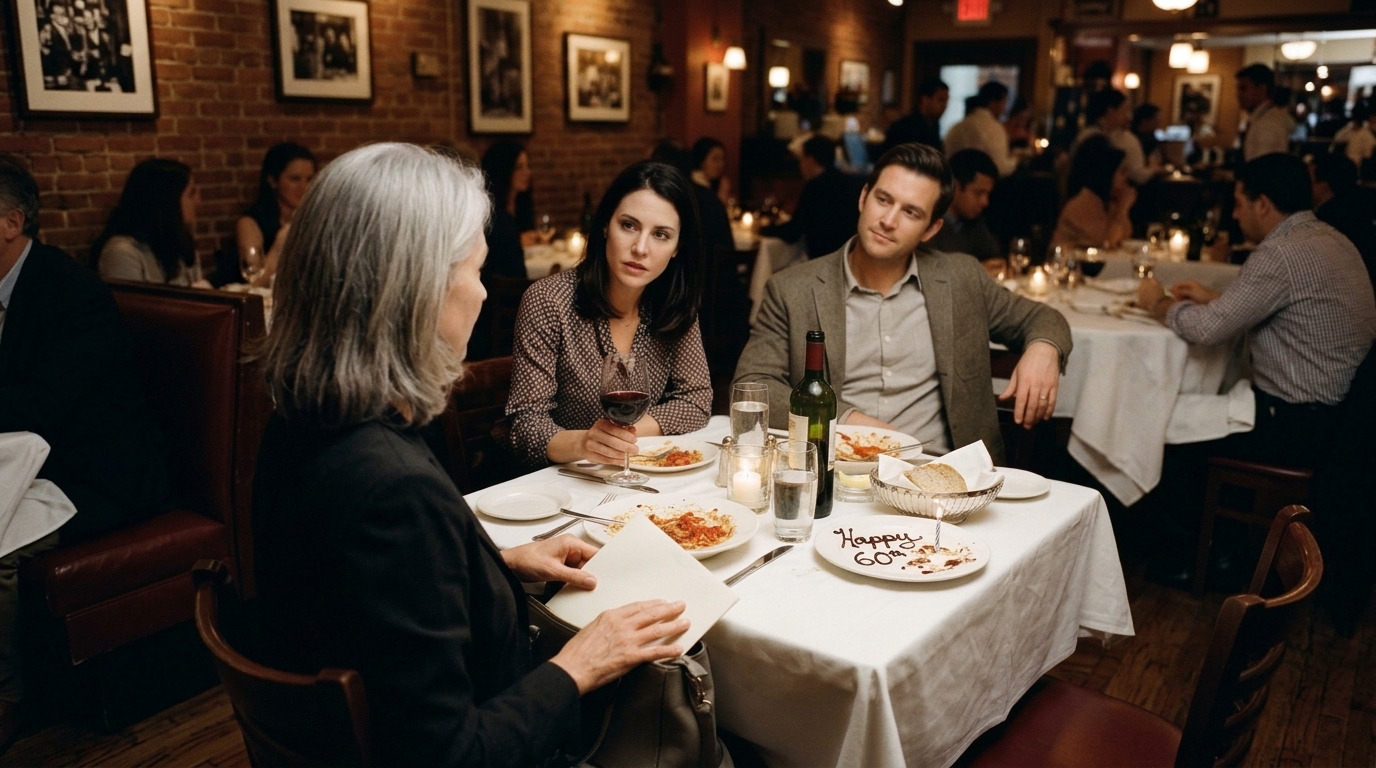
On my sixtieth birthday, my daughter ordered an expensive bottle of Chianti, lifted her glass to me, and told me I was no longer welcome in my own home. The strangest part was that I wasn’t surprised. I had been waiting three years for her to say it. “Honestly, Mom,” Sarah said, lowering her voice as though kindness could soften cruelty, “we only let you live with us because of your pension. But now… you’re becoming a burden.”
For several seconds, all I heard was the soft clatter of silverware from nearby tables.
Greg, my son-in-law, leaned back in his chair.
He looked relieved.
That hurt more than Sarah’s words.
Not because I expected loyalty from Greg.
I had stopped expecting much from him years ago.
But because his expression told me this conversation had been rehearsed.
Perhaps in my living room.
Perhaps in my kitchen.
Perhaps in the master bedroom that had once belonged to my husband and me.
“We need the room,” Sarah continued. “Greg needs a proper office. His new position is getting more serious.”
Greg nodded.
“I can’t keep taking calls from the dining room.”
The dining room.
My dining room.
The room where my late husband, Robert, had carved Sarah’s initials beneath the table after she scratched them there at age nine.
Sarah reached across the table, but I kept my hands in my lap.
“There are beautiful senior communities now,” she said. “Swimming pools. Activities. Transportation. You might actually enjoy having people your own age around.”
“I see.”
“And we’ll keep the house, obviously.”
I almost smiled.
“Obviously?”
Sarah’s expression tightened.
“Well, yes. It makes the most sense.”
“For whom?”
Greg exhaled sharply.
“Margaret, let’s not turn this into a fight.”
My name is Margaret Bennett.
And at sixty years old, I had learned that when someone tells you not to make something a fight, it usually means they expect you to surrender.
So I did not fight.
I reached into my purse instead.
The white envelope felt cool beneath my fingers.
I placed it on the table.
“Funny you should mention the house.”
Sarah frowned.
“What is that?”
“Open it.”
Greg sat forward.
His comfortable expression disappeared.
Sarah pulled the envelope toward herself.
She removed the first sheet.
I watched her eyes move across the page.
Then stop.
“What is this?”
“A copy of the deed.”
Her eyes lifted to mine.
The deed contained only one owner’s name.
Mine.
Greg reached for it.
Sarah handed it to him.
He read it twice.
“I don’t understand,” he said.
“That doesn’t surprise me.”
His jaw tightened.
Sarah pulled out the second document.
Her face changed.
“Notice of termination of occupancy?”
“Yes.”
Her voice rose.
“You’re evicting us?”
Several people nearby glanced toward our table.
I remained calm.
“No. I am formally ending the arrangement under which I allowed you to live in my house. Thomas made certain everything complies with the local requirements.”
“Who is Thomas?”
“My attorney.”
Greg actually laughed.
It was short and nervous.
“You hired an attorney?”
“Three years ago.”
That silenced him.
Sarah stared at me.
“Three years?”
“The first consultation was three years ago.”
“Why?”
I looked at my daughter.
Because you moved me out of my bedroom.
Because your husband took over my garage.
Because you threw away your grandmother’s things.
Because you told me to hide upstairs when Greg’s boss visited.
Because one morning you looked me in the eyes and informed me that I was living under a roof you provided.
But I said none of those things.
Instead I answered, “Because I needed to understand my options.”
Sarah’s fingers trembled slightly.
She pulled out the third document.
This one took longer.
“What does ‘listing authorization’ mean?”
“It means the house will be placed on the market after you leave.”
Greg’s chair scraped backward.
“You’re selling the house?”
“Yes.”
“You can’t do that.”
I looked at him.
There are moments in life when somebody says something so absurd that anger becomes unnecessary.
“Greg,” I said quietly, “I can sell my toaster if I want to. I can sell my car. I can sell my wedding ring. And I can sell the house Robert and I bought with our money forty years ago.”
Sarah’s face had gone pale.
“But that house is supposed to be mine someday.”
There it was.
Not love.
Not grief.
Not even fear.
Ownership.
“You were never promised that house.”
“Dad would have wanted me to have it.”
“Your father wanted you to become a good person.”
Sarah recoiled as though I had struck her.
I hated myself for the satisfaction I felt.
Only briefly.
Then sadness replaced it.
Greg pushed the papers toward me.
“You’re overreacting.”
“Am I?”
“We asked you to consider another living arrangement. That’s all.”
“No. Sarah told me I was a burden. She said you allowed me to live with you because of my pension. Then she announced that you intended to keep my property.”
Sarah whispered, “Mom—”
“I’m not finished.”
For once, she stopped.
“For three years, I paid the property taxes. I paid for groceries when Greg was unemployed. I paid the electric bill, the homeowners insurance, the plumbing repair, the new refrigerator and half the cost of that furnace you insisted we needed.”
Greg’s face reddened.
“We contributed.”
“Yes. You paid utilities for four months when you first arrived.”
“That’s not fair.”
I looked directly at him.
“Then show me your records.”
He said nothing.
Because I had records.
Every check.
Every bank statement.
Every receipt.
Thomas had taught me to save everything.
Sarah looked down at the papers again.
“When do we have to leave?”
“The date is printed there.”
Her eyes found it.
Six weeks.
She looked up sharply.
“Six weeks?”
“That is more notice than Thomas said was necessary under our circumstances. I chose six weeks because you’re my daughter.”
“And where are you going?”
I smiled.
It was the first genuine smile I had given them all night.
“That is no longer something you need to worry about.”
Greg’s expression changed.
He had finally understood why my bedroom was almost empty.
“You already have somewhere else.”
“Yes.”
Sarah stared at me.
“You planned all this?”
“I prepared for it.”
“That’s the same thing.”
“No, sweetheart. Planning is what you and Greg did before bringing me here tonight.”
Her face colored.
I continued.
“You planned to tell me I was unwanted, send me somewhere else, and remain in my house. I prepared so that when you finally did, I would not be helpless.”
For the first time that evening, shame flickered across her face.
It vanished quickly.
“You tricked us.”
I almost laughed.
“I lived quietly in my own home. I paid my own bills. I allowed you to stay there. I did not trick anyone.”
“You let us think—”
“That the house was yours?”
Sarah stopped.
She had almost said it.
I leaned slightly toward her.
“How did I let you think that, Sarah?”
Her mouth opened.
Nothing came out.
“I never transferred the deed. I never promised you the property. I never charged you rent. I never asked you to support me.”
Greg looked away.
“So tell me,” I continued. “Exactly what did I do that convinced you my house had somehow become yours?”
Neither answered.
The waiter approached uncertainly with a small chocolate cake bearing a single candle.
“Happy birthday,” he said.
The poor young man looked from Sarah’s devastated expression to Greg’s furious one.
Then to me.
“Thank you,” I said.
He lit the candle.
I looked at the tiny flame.
For years, I had confused keeping peace with preserving family.
They were not the same thing.
Sometimes peace was only silence created by the person willing to absorb everyone else’s selfishness.
I closed my eyes.
I did not wish for revenge.
I did not wish for Sarah to suffer.
I wished for courage.
Then I blew out the candle.
Sarah wiped a tear from her cheek.
“Mom,” she whispered, “please don’t do this.”
I slid the documents back toward her.
“I’m not doing this tonight, Sarah.”
I stood and lifted my purse.
“You did.”
Then I walked out of the restaurant alone.
I had nearly reached the parking lot when my phone rang.
Thomas.
I answered.
“Happy birthday, Margaret,” he said.
“Thank you.”
“I’m sorry to call tonight, but something happened this afternoon.”
The calmness in his voice frightened me.
“What happened?”
There was a pause.
“Greg contacted a title company yesterday.”
I stopped walking.
“Why?”
“He told them you intended to transfer the house to Sarah.”
The restaurant door opened behind me.
I heard footsteps.
Sarah calling my name.
But Thomas’s next words made everything else disappear.
“He also told them you had already agreed to sign the papers.”
I slept in my locked bedroom that night.
Not because I feared Sarah.
I feared what desperation could make ordinary people justify.
When I returned from the restaurant, Greg was already home.
He had driven separately after Sarah insisted she needed “time to think.”
He stood in the kitchen with both palms on the counter.
“You humiliated us.”
I placed my purse on the chair.
“No.”
“You dropped eviction papers on your daughter during her mother’s birthday dinner.”
“My birthday dinner.”
He blinked.
That small correction seemed to irritate him more than anything else.
“You knew what I meant.”
“Yes. That has been the problem for years. I always knew what everyone meant, so nobody had to say the ugly part aloud.”
Greg stepped closer.
“You’re destroying Sarah.”
“If Sarah’s well-being depends upon owning my house, then something was already wrong.”
“You don’t understand our finances.”
“No, Greg. I understand mine.”
I walked upstairs.
Before closing my door, I turned.
“And tomorrow morning, Thomas is coming here.”
Greg’s face changed.
“Why?”
“To discuss the title company you contacted.”
He went very still.
That told me Thomas had not been mistaken.
Sarah came home twenty minutes later.
Their voices moved through the house long after midnight.
At first they whispered.
Then Sarah began shouting.
I heard Greg say, “I was protecting us.”
Then Sarah said something I could not understand.
A door slammed.
At seven the next morning, I made coffee.
Sarah appeared in the kitchen looking as though she had not slept.
“Did Greg really call a title company?”
I studied her.
“You didn’t know?”
Her silence answered me.
A strange thing happened then.
Some of my anger shifted.
Not away from Sarah.
She had done too much for innocence.
But suddenly I saw a crack between my daughter and the man beside whom she had sat so confidently the night before.
“He told me we needed paperwork,” she finally said.
“What paperwork?”
“For later.”
“Later when?”
She rubbed her forehead.
“When you moved.”
There it was.
I waited.
Sarah stared at the countertop.
“He said it would be easier if everything was transferred now. You were going to leave the house to me eventually anyway.”
“You don’t know that.”
“I’m your only child.”
“That is a relationship, Sarah. Not a real-estate contract.”
Her eyes filled.
“Why are you being so cold?”
That question almost broke something inside me.
Cold.
I thought about the winter Greg was unemployed and I paid their health insurance for three months without telling him.
I thought about the birthday when Sarah wanted a new refrigerator and I handed her my emergency credit card.
I thought about moving out of the bedroom where Robert died because Sarah said she and Greg needed more closet space.
Cold.
“I am not being cold,” I said. “I am finally refusing to set myself on fire so you can call yourself warm.”
She looked away.
At nine, Thomas arrived.
He was sixty-four, gray-haired, calm and meticulous.
He carried a leather portfolio and spoke to everyone with the same measured courtesy.
Greg came downstairs only after Thomas asked to speak with him.
“What exactly did you tell the title company?” Thomas asked.
Greg crossed his arms.
“That Margaret planned to transfer the property.”
“Did Margaret tell you that?”
“We had discussed the future.”
“No, we had not,” I said.
Greg ignored me.
Thomas continued.
“Did you tell the title company Margaret had agreed to execute a deed?”
“I made an inquiry.”
“That wasn’t my question.”
Sarah looked at her husband.
“Greg.”
He exhaled.
“I was trying to find out what needed to happen.”
Thomas opened his portfolio.
“The employee documented the conversation. You asked whether a mobile notary could be sent to this address.”
My stomach tightened.
Sarah stared at Greg.
“A notary?”
“It was preliminary.”
“For what?”
“For Mom to sign everything!”
The sentence burst out of him.
Then silence.
Greg ran both hands through his hair.
“We need stability, Sarah.”
“We?”
“I lost money.”
Sarah froze.
“How much?”
Greg did not answer.
“How much?”
“Eighty-seven thousand.”
The color drained from my daughter’s face.
My own heart began pounding.
“When?” she whispered.
“Over the last year.”
“You told me those accounts recovered.”
“They didn’t.”
Sarah sank into a chair.
Greg began talking faster.
A failed investment.
Credit cards.
A personal loan.
Another investment intended to recover the first loss.
Every sentence sounded like a man laying boards over quicksand.
“I was going to fix it,” he insisted.
Thomas looked at him.
“With Margaret’s property?”
“I wasn’t stealing anything.”
“You were arranging a transfer she never agreed to.”
“I would have explained it.”
“When?”
Greg said nothing.
Sarah began crying.
Not delicately.
Not the controlled tears she used when she wanted sympathy.
She folded over herself and covered her mouth.
I remembered her at seven years old after falling from her bicycle.
I had knelt in the driveway and cleaned blood from her knee while she sobbed against my shoulder.
The mother inside me moved instinctively.
I almost touched her.
Then I remembered the restaurant.
Burden.
Senior living.
We’ll keep the house.
I remained where I was.
Thomas closed the portfolio.
“No transfer occurred. No document was signed. The title remains solely Margaret’s. As far as the property is concerned, the matter is straightforward.”
Sarah looked up.
“What happens now?”
Thomas glanced at me.
“That is Margaret’s decision.”
Everyone turned toward me.
For years, I had wanted my daughter to see me again.
Now she was looking at me as though I were the only solid object left in a collapsing room.
I hated that it took disaster to accomplish it.
“The notice stands,” I said.
Sarah flinched.
“Mom.”
“Six weeks.”
“After what you just heard?”
“Especially after what I just heard.”
She stared at me.
“What am I supposed to do?”
“Find somewhere to live.”
“With what money?”
“You both work.”
“Greg’s debt—”
“Is Greg’s responsibility.”
“You would really make your own daughter leave?”
The old guilt rose immediately.
It had been trained well.
For decades motherhood had taught me that Sarah’s pain demanded my action.
I looked at Thomas.
Then at Greg.
Then back at my daughter.
“Yes.”
She stood abruptly.
“I don’t know who you are anymore.”
My voice almost broke when I answered.
“That makes two of us.”
She left the room.
Thomas waited until we heard the bedroom door close upstairs.
Then he placed another document in front of me.
“What is this?” I asked.
“The purchase agreement for the condominium.”
Greg stared at me.
“Condominium?”
I ignored him.
Thomas tapped the signature line.
“The seller accepted your offer yesterday.”
I felt something inside me loosen.
My new home was small.
Two bedrooms.
A balcony overlooking a community garden.
No garage gym.
No golf clubs in my closet.
No one telling me to disappear upstairs.
“When can I move?”
“Ten days.”
Greg laughed bitterly.
“You really planned everything.”
I looked at him.
“No, Greg.”
I picked up the pen.
“I planned my escape.”
And I signed.
Ten days later, I carried the final box out of my bedroom.
Sarah stood in the hallway.
For the first time since she was a child, she looked small.
Not physically.
In certainty.
The confidence she had worn for years had begun to fracture.
“Is that everything?” she asked.
“Everything I’m taking today.”
She looked past me into the room.
The bed remained because it belonged to the house.
So did the dresser.
The walls were bare except for pale rectangles where family photographs once hung.
Sarah touched the doorframe.
“I remember sleeping in here after Dad died.”
“So do I.”
“You let me stay beside you for almost a month.”
“Yes.”
Her eyes filled.
“I miss him.”
“So do I.”
For one dangerous moment, grief made us mother and daughter again.
Then she said, “He wouldn’t want us doing this to each other.”
I closed my eyes.
There it was.
Even now.
“He wouldn’t want me treated the way I’ve been treated either.”
“I made mistakes.”
“You made choices.”
“Is there a difference?”
“Yes. A mistake is forgetting my birthday. A choice is telling me I’m unwanted in the house I paid for.”
She pressed her lips together.
“I was angry.”
“You rehearsed it with your husband.”
Her eyes dropped.
That silence hurt because it confirmed what I already knew.
“You actually planned what you would say.”
“Greg said we needed to be firm.”
“And you agreed.”
She nodded.
Very slightly.
I picked up the box.
Sarah whispered, “I’m sorry.”
I stopped.
There had been a time when those words would have fixed almost anything.
But apologies change when they arrive after consequences.
“I believe you’re sorry,” I said.
Hope flashed across her face.
“But I don’t know yet what you’re sorry for.”
Her hope disappeared.
“There’s a difference between regretting what you did and regretting what happened because of it.”
I carried the box downstairs.
My new condominium felt impossibly quiet the first night.
I sat on the floor because my furniture had not arrived.
I ate Chinese food from the carton and watched rain slide down the balcony doors.
Then I cried.
Not because I wanted the old house back.
Because freedom did not feel the way movies promised.
There was no triumphant music.
No instant joy.
Freedom felt like grief with the door unlocked.
I missed Sarah.
I missed the version of her I kept insisting must still exist beneath the woman she had become.
And, against my will, I wondered whether I had failed her somewhere.
Had I helped too much?
Fixed too much?
Made sacrifice look so effortless that she had stopped recognizing it as sacrifice?
Robert used to warn me.
“You solve everything before she learns she can survive it herself.”
I would laugh.
“She’s our baby.”
“She won’t always be.”
Standing alone in my new kitchen, I finally understood what he meant.
Three weeks passed.
The old house went on the market.
Thomas recommended a realtor named Denise, who treated the property like a business transaction rather than a family battlefield.
That helped.
Sarah and Greg were still there during the notice period, but showings were scheduled around them.
They hated it.
Greg especially.
He complained that strangers were invading his privacy.
When Denise repeated that the owner had authorized the showings according to the agreement and notice terms, he stopped arguing with her.
He saved his anger for Sarah.
I knew because Sarah called me one evening.
She said nothing for almost ten seconds after I answered.
Then: “Can I come over?”
I hesitated.
“Are you alone?”
“Yes.”
“Come.”
She arrived carrying a grocery bag.
“I brought that tea you like.”
I nearly laughed.
For years she had forgotten which tea I drank.
Now she remembered.
We sat across from each other at my small dining table.
Sarah looked around.
“It’s nice here.”
“It is.”
“Small.”
“Exactly as large as I need.”
She winced.
“I didn’t mean—”
“I know.”
She wrapped her fingers around the mug.
“Greg and I are separating.”
I did not pretend surprise.
She told me the rest in pieces.
There were more debts.
More lies.
Greg had opened a credit card Sarah knew nothing about.
He had borrowed money from his brother.
He had told coworkers the old house belonged to him and Sarah.
He had even described renovations he intended to make “after the transfer.”
“I believed him,” she whispered.
“You wanted to.”
She looked at me.
“That’s worse, isn’t it?”
“It’s more honest.”
Her mouth trembled.
“He kept saying you’d be fine. That senior living would actually be better for you. That keeping the house in the family was practical.”
“And what did you say?”
She cried then.
Quietly.
“I said he was right.”
I let the silence remain.
No rescue.
No reassurance.
She needed to sit beside what she had done.
“I think I wanted the house,” she said eventually. “But I also wanted to stop feeling like my life wasn’t working.”
That was the first honest thing she had said in months.
Maybe years.
She continued.
“Every time I walked into that house, I remembered being a kid. Dad was alive. Everything felt safe. Then I became an adult and nothing felt safe anymore.”
Her eyes met mine.
“I think somewhere along the way, I decided owning the house would give me that feeling back.”
My anger softened.
Not disappeared.
Softened.
“Sarah, your childhood felt safe because your father and I made it safe. The bricks didn’t do that.”
She began crying harder.
“I know.”
“No. I don’t think you did.”
She wiped her face.
“Can you forgive me?”
I looked at my daughter.
“I hope so.”
Her expression fell.
“But forgiveness isn’t a switch.”
“I understand.”
“And even if I forgive you, things may not go back to what they were.”
She nodded.
“I know.”
This time I thought she might actually mean it.
The following Monday, Denise called.
“We have an offer.”
My heart jumped.
“Good?”
“Very good. Above asking.”
I walked toward the balcony.
Rain had stopped, and sunlight was touching the wet leaves below.
“There’s something unusual, though,” Denise said.
“What?”
“The buyer wants a fast closing.”
“How fast?”
“Three weeks.”
I thought about the old living room.
Robert’s garden.
Sarah’s height marks inside the pantry door.
Forty years of Christmas mornings.
Then Denise added, “They’re a young couple. First baby on the way.”
I closed my eyes.
A new family.
New birthdays.
New scratches beneath the dining table.
Maybe that house deserved to become a home again.
“Accept it.”
There was a pause.
“Are you sure?”
“Yes.”
I was.
Until Sarah called that night screaming.
“You sold it?”
“Yes.”
“You actually sold Dad’s house?”
“My house.”
“How could you?”
I held the phone away from my ear.
“We talked about this.”
“No, Mom. You threatened it. I didn’t think you would actually do it.”
Something inside me hardened.
“Then you still haven’t learned anything.”
“What about me?”
I almost hung up.
Instead I asked the question I should have asked years earlier.
“What about you, Sarah?”
Silence.
“I have to start over.”
“Yes.”
“My marriage is falling apart.”
“I’m sorry.”
“I have nowhere permanent to live.”
“You will find somewhere.”
“You have money now!”
There it was again.
Not quite the same.
But close enough.
I closed my eyes.
“Good night, Sarah.”
“Mom—”
I ended the call.
Then I stood alone on my balcony, trembling.
Because the hardest part of changing your life is discovering how often people will invite the old you to come back.
The night before Sarah had to leave, she asked me to meet her at the house.
Greg had already moved out.
Apparently he had taken his gym equipment, clothing, electronics and nearly everything else he believed belonged to him.
He left Sarah the dining table.
Mine.
I arrived at six.
Sarah was sitting on the kitchen floor surrounded by boxes.
For a moment, I saw her as a little girl again, building forts from cardboard after we bought our first washing machine.
“Hi,” she said.
“Hi.”
The house echoed.
Without furniture, every footstep sounded unfamiliar.
“I found something.”
She reached into a box and handed me a small wooden case.
My breath caught.
Robert’s watch.
I had searched everywhere after he died.
“I thought this was lost.”
“So did I. It was behind the built-in drawer in the bedroom.”
I opened the box.
The leather strap was cracked.
The hands had stopped at 4:17.
I remembered buying it for our twentieth anniversary.
“He wore this every day.”
Sarah nodded.
“I remember.”
We sat together on the kitchen floor.
Neither spoke for a while.
Finally Sarah said, “Greg admitted something else.”
I waited.
“He knew the house was legally yours.”
I turned toward her.
“What?”
“He always knew.”
My stomach tightened.
“He looked up the property records before we moved in.”
“Why?”
“He said he wanted to know whether there were liens.”
Cold spread through me.
Sarah continued.
“He told me you and Dad had probably arranged things so the house would come to me automatically someday. I believed him.”
“But he knew.”
“Yes.”
The restaurant returned to me.
Greg’s smirk.
We’ll keep the house, of course.
He had not been confused.
He had been counting on pressure.
Counting on me giving in.
Counting on the old Margaret.
“Did he ever intend to move out?” I asked.
Sarah shook her head.
“I don’t think so.”
I stared at Robert’s watch.
My daughter began crying.
“I let him turn me into someone I hate.”
“No.”
She looked at me.
“Don’t give him all the credit.”
The words hurt her.
They were supposed to.
Not cruelly.
Truthfully.
“You were influenced,” I said. “You were manipulated in some ways. But you still made choices. If you blame everything on Greg, you’ll learn nothing.”
She nodded slowly.
“I know.”
“Do you?”
“I told you to hide upstairs.”
My throat tightened.
“I remember.”
“I threw away Grandma’s baking sheets.”
“Yes.”
“I took your bedroom.”
“Yes.”
“I told you that you lived under our roof.”
Her voice broke.
“I don’t even know how I became someone who could say that.”
I looked around the empty kitchen.
“It happened a little at a time.”
She wiped her face.
“You gave. I took. Then you gave more. And after a while, I stopped seeing it as giving.”
“Yes.”
“I saw it as what I deserved.”
“Yes.”
She covered her face.
This time I moved closer.
I placed my hand on her back.
Not because everything was forgiven.
Because she was my daughter.
Boundaries did not require cruelty.
Love did not require surrender.
Both could exist in the same room.
“I’m sorry, Mom.”
“I know.”
“I’m really sorry.”
“I know.”
She lowered her hands.
“I rented an apartment.”
I smiled faintly.
“Good.”
“It’s tiny.”
“Tiny can be wonderful.”
That made her laugh through her tears.
“I found a job too.”
“You have a job.”
“A second one. Weekend bookkeeping for a small business. I want to pay off the debt that’s in my name.”
I nodded.
“That sounds responsible.”
She seemed almost disappointed that I did not praise her more.
Maybe that was part of growing up too.
Doing what needed to be done without expecting applause.
Then she reached into another box.
“There’s something else.”
She handed me a folder.
Inside were copies of the papers Greg had prepared.
A proposed deed.
A cover letter.
And a set of notes in his handwriting.
One line had been underlined twice.
M needs to sign before facility intake.
I stared at it.
Sarah began crying again.
“He planned to take you to a senior community the next week.”
My hands went cold.
“He told me we could present the papers with the other enrollment documents so everything would be handled at once.”
“You knew?”
“I knew he had paperwork. I swear I didn’t understand what all of it was.”
“But you knew there were property papers.”
She nodded.
There are truths that arrive like explosions.
And truths that arrive like doors quietly closing.
This was the second kind.
I stood.
“Mom?”
“I need some air.”
I walked onto the back porch.
Robert and I had spent hundreds of evenings there.
I could almost hear him complaining about mosquitoes.
Almost see him watering tomatoes in sandals.
Sarah followed me.
“Are you okay?”
“No.”
It was liberating to say it.
She stopped beside me.
“I don’t expect you to forgive this.”
“Good.”
“I mean it.”
I looked at her.
“What did you think would happen after I signed?”
She began trembling.
“I thought the house would become mine. I thought you’d move somewhere comfortable. I thought we’d visit you.”
Visit me.
As though I were a piece of furniture placed into storage.
“You thought taking my home could be made kind if you visited afterward.”
Sarah closed her eyes.
“Yes.”
My anger came then.
Hotter than it had in the restaurant.
“You stood in this house and watched me become smaller every month.”
“I know.”
“You let your husband speak to me as though I were inconvenient.”
“I know.”
“You watched me pay bills while telling yourself you were supporting me.”
“I know.”
“And then you sat across from me on my birthday and told me I was a burden.”
She sobbed.
“I know.”
“Stop saying that!”
My voice echoed across the empty yard.
She flinched.
I had almost never shouted at my daughter.
Perhaps that was part of the problem.
“I need you to understand it,” I said. “Not know it. Understand it.”
She nodded.
I touched Robert’s watch in my pocket.
Tomorrow the buyers would do their final inspection.
Two days later, the sale would close.
This chapter of my life would end whether I felt ready or not.
Sarah whispered, “What happens to us?”
I looked at her.
That was the question underneath everything.
Not the house.
Us.
“I don’t know.”
Her face crumpled.
“I love you.”
“I love you too.”
“Then why don’t you know?”
“Because love tells me I want a relationship with you. Trust determines what kind.”
She cried silently.
I continued.
“You don’t rebuild trust by crying in an empty kitchen one night. You rebuild it in hundreds of small decisions afterward.”
She nodded.
“Then I’ll do that.”
“Don’t promise me.”
I looked toward the backyard where Robert’s old maple tree moved gently in the evening wind.
“Show me.”
The sale closed on a Thursday morning.
I expected to cry.
I didn’t.
Thomas sat beside me while I signed the final documents.
Denise slid the keys into a small envelope for the buyers.
Forty years reduced to signatures, initials and a set of brass keys.
“Any regrets?” Thomas asked afterward.
I thought carefully.
“Memories aren’t included in the sale, are they?”
He smiled.
“No.”
“Then no.”
The money from the house changed my finances considerably, but I did not become reckless.
I paid off my condominium.
I invested part of the proceeds.
I created a modest education fund for any future grandchildren, controlled by a trustee rather than Sarah.
Then I did something that would once have been unimaginable.
I spent some money on myself.
I booked a ten-day trip to Italy.
When Sarah heard, she stared at me.
“You’re going alone?”
“No.”
Her expression changed.
“With Thomas?”
I laughed so hard I nearly spilled my coffee.
“Thomas has a wife named Evelyn. They’ve been married thirty-seven years.”
“Oh.”
“I’m going with a travel group.”
Sarah smiled.
“That sounds fun.”
“It sounds terrifying.”
“Then why go?”
I considered the question.
“Because I’ve spent most of my life choosing things that made everyone else comfortable.”
She nodded slowly.
“I think you should go.”
Six months passed.
Sarah kept her promise without repeating it.
She did not ask me for money.
She did not ask to move into my condominium.
She did not ask me to rescue her from the financial mess she and Greg had created.
She worked.
She moved into a one-bedroom apartment.
She sold her luxury SUV and bought a used sedan.
She started therapy.
That surprised me most.
“I need to understand why I let my marriage become what it became,” she told me.
Greg moved two states away.
Their divorce became official eight months after my birthday.
I never celebrated it.
A failed marriage is still a grief, even when the ending is necessary.
Sarah grieved.
I let her.
That was different from fixing it.
One Sunday she invited me to lunch.
When I arrived at her apartment, I found her standing in the kitchen covered in flour.
“What happened?”
“I tried Grandma’s biscuit recipe.”
I looked at the tray.
The biscuits were flat enough to use as coasters.
I laughed.
Sarah stared at me indignantly.
“They taste better than they look.”
“That would be difficult not to.”
She threw a dish towel at me.
For the first time in years, we laughed together without tension hiding beneath it.
Then Sarah opened a cabinet.
“I bought you something.”
Inside were two heavy baking sheets.
Not expensive.
Not fancy.
Just solid metal pans.
My laughter faded.
“I know they can’t replace Grandma’s,” she said. “I know that.”
She looked embarrassed.
“I just wanted you to have some here when we cook.”
We.
Not me cooking for her.
Not me cleaning for her.
We.
I touched one of the pans.
“Thank you.”
Her eyes filled.
Mine did too.
Healing, I discovered, rarely announces itself.
It enters quietly through ordinary moments.
A phone call returned.
A boundary respected.
A cup of tea remembered.
An apology that does not demand forgiveness.
A baking sheet.
On my sixty-first birthday, Sarah took me back to the same Italian restaurant.
When she invited me, I nearly refused.
Then I understood why she had chosen it.
We sat at a different table.
No Greg.
No white envelope.
No speeches.
Sarah ordered the Chianti.
When the waiter poured our glasses, she lifted hers.
“To you,” she said.
I smiled.
“That’s a dangerous beginning in this restaurant.”
She laughed nervously.
“No eviction speech. I promise.”
“Good.”
Her expression became serious.
“I wanted to say something.”
I waited.
“A year ago, I thought losing that house was the worst thing that could happen to me.”
She looked down at her wine.
“Now I think keeping it would have been.”
I said nothing.
“If you had surrendered, I would have learned that what I did worked. That cruelty worked. That entitlement worked.”
Her voice trembled.
“You losing your home might have kept me from ever finding out who I had become.”
I felt tears sting my eyes.
Sarah reached across the table.
She stopped before touching my hand.
That tiny pause mattered.
She was asking permission now.
I turned my palm upward.
She took it.
“I’m sorry, Mom.”
“I know.”
“I’ll probably be sorry for the rest of my life.”
“I hope not.”
She frowned.
“I want you to remember it,” I said. “I don’t want you to live inside it.”
She squeezed my hand.
“Do you forgive me?”
A year earlier, I had said I hoped I would.
Now I understood forgiveness better.
It did not erase memory.
It did not restore access.
It did not pretend harm had never happened.
Forgiveness simply meant I no longer wanted yesterday to control tomorrow.
“Yes,” I said.
Sarah cried.
So did I.
Then she laughed at herself and wiped her face.
“Great. Now my mascara’s ruined.”
“Your grandmother would say vanity is expensive.”
“She’d also say I overbaked those biscuits.”
“She would.”
The waiter brought out a cake.
One candle.
Sarah looked embarrassed.
“I told them you were sixty.”
I stared at her.
“You did not.”
“You look fantastic for sixty.”
“I am sixty-one.”
“Details.”
I laughed.
The candle flickered between us.
I thought about the woman who had sat in that restaurant one year earlier.
She had arrived with documents in her purse and fear hidden beneath her calm.
She believed she was preparing to lose her daughter.
Instead, she had saved herself.
And perhaps, in a strange way, she had saved Sarah too.
I blew out the candle.
Later that night, I returned to my condominium.
The balcony door was open.
A warm breeze moved through the curtains.
My photographs were exactly where I wanted them.
Robert’s repaired watch sat on the dresser.
My car rested safely in the garage.
My closet held only my clothes.
No golf clubs.
No boxes belonging to people waiting for me to disappear.
I made tea and stepped onto the balcony.
Below me, lights glowed in apartment windows.
Somewhere a child laughed.
Someone played piano badly.
Someone was cooking with garlic.
Life continued in hundreds of ordinary rooms.
I used to believe home was the place where your history lived.
The brick house had held forty years of mine, so I had mistaken leaving it for losing part of myself.
I knew better now.
A house could be sold.
Furniture could be moved.
Keys could be surrendered.
But home was something deeper.
Home was where you were allowed to exist fully.
Where kindness was offered rather than exploited.
Where love did not require you to disappear so somebody else could become larger.
I lifted my tea toward the night sky.
“Happy birthday, Robert,” I whispered, though his birthday was still months away.
Then I laughed at myself.
He would have teased me for that.
In the quiet, I could almost hear his answer.
I went inside and locked the balcony door.
Not because I was afraid.
Because the home behind that door belonged to me.
And this time, so did my life.
❤️ THE END! THANK YOU FOR READING!