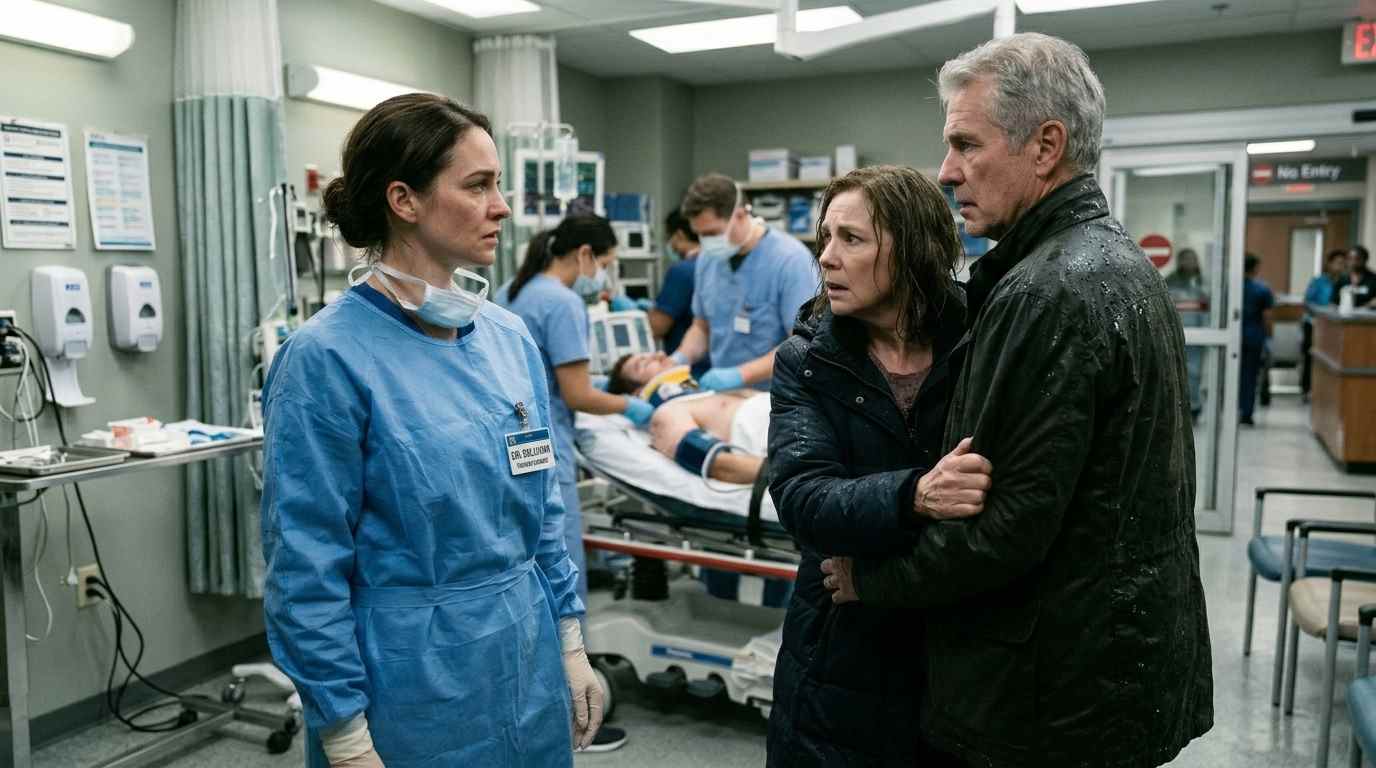
My Brother Lied About Me Quitting Medical School—Five Years Later, I Saved His Life, And My Surgeon Badge Exposed Everything…“Tell you what, Mom?” My mother’s lips trembled “That you became a doctor.” For a moment, I could only stare at her. Five years. Five years of birthdays without a phone call.
Five Christmases when I had looked at my phone, wondering whether someone might finally remember I existed. Five years of imagining my mother standing in the kitchen where I grew up, making Sunday dinner, setting out three plates instead of four.
And now she was asking why I hadn’t told her.
I looked at the woman who had taught me to tie my shoes, who had kissed my scraped knees, who used to call me her little miracle because I had been born six weeks premature.
“Mom,” I said quietly, “I tried.”
She shook her head.
“No, Arthur. If you had really tried—”
“Don’t.”
The word came out sharper than I intended.
My father straightened.
“Watch your tone when you speak to your mother.”
There it was.
The same voice.
The same authority.
The same expectation that I would lower my head and apologize simply because he had spoken.
Only this time, I wasn’t twenty-eight years old, standing in a rented apartment with a dying friend in the next room.
I was thirty-three.
I had just spent four hours keeping a critically injured man alive.
And I was no longer afraid of disappointing people who had made disappointment their favorite weapon.
“Mr. Vance,” I said, “I have been awake for nearly twenty hours. I have another patient waiting for me upstairs, and your son is in intensive care. I am not having this conversation if you intend to speak to me that way.”
My father’s mouth opened.
Then closed.
He glanced at the badge on my chest.
For the first time in my life, I saw something unfamiliar in his eyes.
Uncertainty.
My mother reached toward me.
“Arthur, please.”
I stepped back.
Her hand froze in the air.
That small movement hurt her.
I could see it.
But she had no idea how many times I had reached for her and found nothing.
“I sent you letters,” I said.
My father frowned.
“What letters?”
“Twenty-three, Dad.”
The number seemed to hit him harder than my title.
“Twenty-three letters. Six certified packages. Copies of my university paperwork. My transcripts. My graduation invitation. My wedding invitation.”
My mother covered her mouth.
“I never received—”
“I know.”
She blinked.
“What?”
“I know you never opened them.”
My father’s expression changed.
“Arthur, that’s not possible.”
I looked directly at him.
“The first envelope came back with your handwriting on it.”
He went still.
“Return to sender,” I continued. “Remember?”
His face drained of color.
And then my mother whispered something that made the exhaustion disappear from my body.
“Robert… you told me Arthur stopped writing.”
I turned toward her.
My father stared at the floor.
“Robert?”
Her voice rose.
“You told me he didn’t want anything to do with us.”
My father said nothing.
And suddenly I understood something terrible.
The lie had not remained one lie.
It had grown.
It had changed hands.
It had become a family tradition.
My mother looked from my father to me.
“Arthur,” she whispered, “what happened to those letters?”
Before I could answer, the ICU doors opened.
A nurse hurried toward us.
“Dr. Vance?”
I turned immediately.
“What’s wrong?”
“Your brother is awake.”
My mother gasped.
The nurse hesitated.
“He’s agitated. His blood pressure is climbing, and he’s asking for you.”
I glanced at my parents.
Then back at the nurse.
“Has the ICU attending been notified?”
“Yes, Doctor.”
“Good. I’ll come.”
My father stepped forward.
“We’re coming too.”
I looked at him.
“No.”
His face hardened.
“He’s my son.”
“And right now, he is a critically ill patient. The ICU team will decide when visitors are appropriate.”
My mother began crying again.
“Please, Arthur. We almost lost him.”
I looked at her for a long moment.
Then I said the words I had been carrying for five years.
“You lost one son already, Mom.”
Her crying stopped.
“You just never noticed.”
And I walked away.
The intensive care unit was dim except for the blue glow of monitors.
Machines hummed softly.
Somewhere down the corridor, a ventilator gave its familiar mechanical sigh.
Julian lay in bed surrounded by tubes, dressings, and wires.
His face was swollen.
A deep bruise stretched from his temple to his jaw.
His left arm was immobilized, and the oxygen tubing beneath his nose made him look strangely fragile.
I had never seen my brother look fragile.
Not when he broke his arm at thirteen and insisted he didn’t need pain medication.
Not when he lost his first job and convinced our parents the company had been poorly managed.
Not when his marriage ended and he somehow persuaded everyone that his wife had been unreasonable.
Julian had always been the person who controlled the story.
Even when the truth was standing in the room.
But now he could barely lift his head.
His eyes moved toward me.
“Art?”
His voice was little more than a rasp.
I stopped beside the bed.
“Don’t try to sit up.”
He stared at me.
For several seconds, confusion flickered across his face.
Then recognition.
Then fear.
Not fear of dying.
Something else.
“You?”
I checked the monitor.
“Your surgery went well enough to stabilize you. You had significant internal bleeding and a serious abdominal injury. You’re not out of danger, but you’re alive.”
His lips moved.
“You’re… here?”
“I work here.”
He swallowed painfully.
“As a doctor?”
I almost smiled.
“As a surgeon.”
His eyes widened.
He looked at the badge clipped to my chest.
And then he whispered something I would remember for the rest of my life.
“They weren’t supposed to find out.”
My hand stopped on the bed rail.
“What?”
Julian closed his eyes.
“Nothing.”
“Julian.”
His breathing quickened.
“I said nothing.”
I studied him.
The monitors were beginning to register his agitation.
I knew better than to interrogate a man recovering from major surgery.
I also knew that whatever had escaped his mouth had not been meaningless.
“Rest,” I said. “Your ICU team will take care of you.”
I started to leave.
Then his fingers moved.
He caught the sleeve of my scrubs.
Weakly.
Desperately.
“Arthur.”
I turned.
His eyes were wet.
“Don’t let them look in my car.”
I stared at him.
“What?”
His grip tightened.
“Please.”
A monitor began beeping faster.
“Julian, calm down.”
He shook his head.
“The bag.”
“What bag?”
His mouth trembled.
“The black bag.”
Then his blood pressure dropped.
The monitor alarm sounded.
And whatever he had been about to tell me disappeared beneath the urgent voices of the ICU team.
By six-thirty that morning, I had transferred Julian’s immediate care entirely to colleagues.
My presence in his operating room had been necessary during a life-threatening emergency.
But now that he was stabilized, the conflict was obvious.
He was my brother.
A brother who had betrayed me.
And I wasn’t going to let anyone question whether my personal history had influenced his treatment.
Dr. Maya Chen, one of our most experienced trauma surgeons, met me outside the ICU.
“You look terrible,” she said.
“Thank you.”
“I mean it.”
“So do I.”
She studied my face.
“You knew the patient?”
I gave a tired laugh.
“Unfortunately.”
Maya folded her arms.
“Arthur.”
“He’s my brother.”
Her expression changed.
“The brother?”
I nodded.
Maya knew pieces of my history.
Not everything.
But enough.
She had attended my wedding.
She had met Clara.
She had watched me stand outside the hospital chapel one Christmas Eve, staring at a photograph of my family before finally deleting it from my phone.
“Oh, Arthur.”
“Please don’t.”
She nodded.
“Okay.”
I rubbed my face.
“He said something strange before his blood pressure dropped.”
“What did he say?”
“He didn’t want anyone looking in his car. Mentioned a black bag.”
Maya’s expression became serious.
“Did you tell the team?”
“Yes. I documented the relevant statement and passed it on to the ICU attending. I don’t know what it means.”
“Then leave it there for now.”
I nodded.
She touched my shoulder.
“Go home.”
“I can’t.”
“Yes, you can.”
“Maya—”
“Your brother is alive. Your patients are covered. And you are about three seconds away from collapsing in a supply closet.”
I wanted to argue.
Instead, I looked through the glass toward Julian’s room.
“Do you think people can change?”
Maya followed my gaze.
“Sometimes.”
“And if they don’t?”
“Then you change how much access they have to your life.”
I looked at her.
She gave my shoulder one final squeeze.
“Go home to your wife, Arthur.”
For the first time that morning, I felt the exhaustion reach my bones.
So I went.
Clara was awake when I opened our front door.
Of course she was.
My wife had an extraordinary ability to know when something was wrong before I said a word.
She was sitting at the kitchen island in one of my old college sweatshirts, holding a mug of tea.
Our golden retriever, Winston, lifted his head from the rug.
Clara looked at me.
And immediately put down her mug.
“Arthur?”
I tried to smile.
It didn’t work.
She crossed the kitchen.
“What happened?”
I opened my mouth.
Nothing came out.
Then I said, “Julian.”
She froze.
“What about him?”
“He was in a crash.”
“Oh my God.”
“He’s alive.”
Her shoulders dropped with relief.
Then she looked at my scrubs.
“Were you there?”
I nodded.
“I operated on him.”
Clara covered her mouth.
For a long moment, she said nothing.
Then she wrapped her arms around me.
And something inside me broke.
I had stood in an operating room for four hours without shaking.
I had faced my parents without crying.
I had heard my brother whisper words that suggested he had deliberately kept my success hidden.
But when Clara held me, I finally stopped pretending I was made of steel.
I buried my face against her shoulder.
And cried.
Not loudly.
Not dramatically.
Just the exhausted, helpless crying of a man who had carried something heavy for too long.
Clara held me without asking questions.
When I finally pulled away, she wiped my face with her sleeve.
“Come sit down.”
I followed her to the kitchen.
She poured me water.
Then waited.
I told her everything.
The crash.
The surgery.
My parents.
The letters.
Julian’s strange warning.
When I finished, Clara stared at the table.
Then she asked one question.
“Did your mother apologize?”
I shook my head.
“She asked why I hadn’t told her I became a doctor.”
Clara closed her eyes.
“Oh, Arthur.”
“She looked genuinely confused.”
“Confusion doesn’t erase what she did.”
“I know.”
“Do you?”
I looked up.
She wasn’t angry with me.
She was worried.
Clara had spent years watching me make excuses for people who had never offered me the same kindness.
“They’re still your parents,” she said softly. “And you can love them. But you don’t have to hand them your heart just because they’ve finally realized they dropped it.”
I stared at her.
Then I reached for her hand.
“Have I ever told you how lucky I am?”
“Frequently.”
“Not enough.”
She smiled sadly.
“Then tell me after you’ve slept.”
But before I could stand, my phone rang.
An unfamiliar number.
Connecticut area code.
I almost ignored it.
Then something made me answer.
“Hello?”
A woman’s voice came through.
“Dr. Arthur Vance?”
“Yes.”
“My name is Evelyn Brooks. I used to work for your brother.”
I sat down again.
Clara watched my face.
“What can I do for you?”
The woman hesitated.
“I saw the accident reported this morning. I heard Julian was taken to your hospital.”
I waited.
Then she said, “Doctor, I think there’s something you need to know about why your family stopped speaking to you.”
My stomach tightened.
“What do you mean?”
“I worked for Julian for seven years. I handled his correspondence, appointments, and sometimes his personal mail.”
I looked at Clara.
Evelyn continued.
“Three years ago, he asked me to destroy a folder.”
“What folder?”
Her voice became unsteady.
“A folder with your name on it.”
I didn’t move.
“He told me it contained old family documents that needed shredding.”
“And?”
“I opened it first.”
The kitchen seemed to grow silent.
Inside that folder, she said, were copies of my medical school records.
Photographs from my graduation.
Printed announcements from my residency program.
And one wedding invitation.
My wedding invitation.
The one I had mailed to my parents.
I could hear my own breathing.
“Why are you telling me this now?”
“Because I should have told you then.”
Her voice cracked.
“And because that wasn’t the only thing in the folder.”
Evelyn Brooks arrived at our house two hours later.
She was in her late forties, with tired eyes and a dark blue coat buttoned all the way to her throat.
She carried a worn leather briefcase.
Clara made coffee.
I sat across from Evelyn at our dining table.
For several moments, the woman seemed unable to look at me.
Then she opened her briefcase.
“I brought copies.”
She slid a stack of papers toward me.
The first was a photograph.
Me.
Standing outside the medical school auditorium in my graduation gown.
Clara beside me.
Maya on the other side.
I remembered that afternoon.
The heat.
The flowers.
The way Clara had kissed my cheek and whispered, “You did it.”
And the way I had looked toward the crowd even though I knew my parents wouldn’t be there.
Across the bottom of the photograph was a handwritten note.
He actually finished.
I recognized Julian’s handwriting immediately.
My fingers tightened around the paper.
Evelyn placed another document beside it.
A printed email.
The sender was Julian.
The recipient was an address I recognized as my father’s old business account.
The subject line read:
Arthur — update.
I began reading.
Dad, I checked on Arthur again. Unfortunately, he’s still telling people he’s in medical training. I think he’s having trouble accepting what happened. Please don’t encourage the fantasy by contacting him.
My chest went cold.
The date was three weeks after my graduation.
Three weeks.
My father had been told I was pretending to be a doctor while my diploma was hanging in my apartment.
I looked at Evelyn.
“Where did you get this?”
“Julian printed it. He used to keep records of important family conversations.”
“Why?”
She hesitated.
“Because he liked being able to prove what he’d told people.”
Clara moved closer to me.
I turned the page.
Another email.
This one addressed to my mother.
Mom, Arthur has been contacting relatives again. Please don’t respond. He needs to understand that actions have consequences.
I remembered that week.
I had called my aunt.
She had answered once.
When I told her I was graduating, she had gone silent.
Then she’d said, “Arthur, your mother told me you’re not well.”
I hadn’t understood.
Now I did.
I kept reading.
Every document was another piece of my life being rewritten by someone else.
My residency match became a fabricated story.
My wedding became an imaginary event.
My medical license became something Julian claimed I had invented.
Then I reached the final page.
A handwritten note.
Not from Julian.
From my father.
If Arthur is still lying, we need to stop enabling him. No more contact until he admits the truth.
Below that was another sentence.
Julian, please handle any correspondence that arrives.
I stared at those words.
For five years, I had believed my parents were simply refusing to listen.
But now I realized Julian had been appointed the gatekeeper.
He hadn’t merely told the lie.
He had been given permission to control the truth.
I looked up.
“Did my parents know he was intercepting my mail?”
Evelyn shook her head.
“I don’t know.”
“Did he destroy everything?”
“Most of it.”
“Most?”
She opened a smaller envelope.
Inside was a cream-colored card.
I recognized it immediately.
Our wedding invitation.
The edges were slightly bent.
Clara took a sharp breath.
I lifted the card.
Together with their loved ones, Arthur James Vance and Clara Elizabeth Morgan request the pleasure of your company…
I couldn’t finish reading.
Evelyn wiped her eyes.
“I kept it because I couldn’t bring myself to destroy it.”
I looked at her.
“Why didn’t you contact me?”
She swallowed.
“Julian told me you had been harassing your parents. That you were unstable. I believed him.”
Her voice shook.
“Then I found your hospital profile online last year.”
She looked down.
“And I realized he’d lied.”
I stared at her.
“You knew for a year?”
She nodded.
Shame filled her face.
“I was afraid of losing my job.”
The words hurt.
But they were honest.
And after five years of lies, honesty felt almost unfamiliar.
“Why now?” I asked.
Evelyn looked toward the window.
“Because I left his company six weeks ago.”
“Why?”
She hesitated.
Then she said something I hadn’t expected.
“Because Julian was stealing from your parents.”
I stared at her.
“What?”
Evelyn opened another folder.
“Your father gave Julian authority to manage some of his retirement investments three years ago. He trusted him completely.”
I knew my father had sold his manufacturing business shortly before my estrangement.
He had always been careful with money.
Conservative.
Meticulous.
The kind of man who checked restaurant bills twice.
“What does that have to do with me?”
Evelyn took a breath.
“Your brother’s business has been struggling for years. He borrowed against company assets, made bad investments, and covered losses with money from accounts your father allowed him to manage.”
I felt my pulse quicken.
“Are you saying he committed fraud?”
“I’m saying I found transfers I couldn’t reconcile. I confronted him. He told me to stop asking questions.”
She slid a printed ledger toward me.
There were dates.
Account references.
Large withdrawals.
But I was a surgeon, not a forensic accountant.
I wasn’t going to pretend I could determine what those documents proved.
“Have you taken this to the police?” I asked.
“Not yet.”
“Why not?”
“Because I was scared.”
I looked at the papers.
Then at her.
“Evelyn, if you believe a crime has been committed, you need to speak to an attorney and the appropriate authorities. I’m not qualified to investigate financial records.”
She nodded.
“I know.”
“Then why bring them here?”
Her eyes filled.
“Because I think Julian lied about you for a reason.”
I waited.
She leaned forward.
“Your father had planned to bring you into the family investment structure after medical school. He wanted both sons involved in long-term planning.”
I frowned.
“That doesn’t make sense. Dad never mentioned it.”
“He discussed it with Julian.”
Of course he did.
Evelyn continued.
“When your father believed you’d dropped out, he changed his plans. Julian became the only son he trusted with the accounts.”
I sat back.
Clara’s hand found mine.
“So you’re saying Julian made me look irresponsible so Dad would trust him instead?”
“I can’t prove his original motive,” Evelyn said. “But I heard him say something once.”
“What?”
She looked directly at me.
“He said, ‘Arthur always gets applause for doing the right thing. I had to make sure Dad finally saw which son was dependable.’”
The words settled over the table like ash.
I remembered Julian at my high school graduation.
How he had barely clapped when I received a scholarship.
I remembered the day I got into medical school.
He had smiled and said, “Let’s see if you can actually finish.”
I remembered every family dinner where my achievements somehow became his opportunity to explain why his career was more practical.
For years, I had thought it was sibling rivalry.
Petty.
Unpleasant.
But harmless.
Now I wondered how long he’d been building the version of me that my parents eventually believed.
Clara squeezed my hand.
I looked down at the wedding invitation.
Then I asked Evelyn one final question.
“Did Julian know I was chief of trauma surgery?”
She nodded.
“He found out about your promotion months ago.”
My stomach turned.
“What did he say?”
Evelyn hesitated.
“He said your parents could never be allowed to know.”
That afternoon, my mother called.
I watched the unfamiliar number glow on my phone.
Clara sat beside me on the couch.
“Do you want to answer?”
I didn’t know.
For five years, I had imagined this moment.
I had pictured my mother calling to apologize.
I had imagined her saying she was proud of me.
I had imagined hearing my father’s voice crack as he admitted he’d been wrong.
But now that the call was actually coming, I felt nothing like the joy I had expected.
Only dread.
I answered.
“Hello?”
“Arthur?”
My mother’s voice was small.
“Yes.”
“It’s Mom.”
“I know.”
Silence.
Then she began crying.
“I don’t know what to say.”
I closed my eyes.
“Then maybe start with the truth.”
She sniffed.
“I’ve been thinking about what you said. About the letters.”
I waited.
“Your father admitted he sent some back.”
Some.
The word scraped against me.
“He said he thought he was helping you.”
I laughed once.
A bitter, exhausted sound.
“Helping me do what?”
“Accept responsibility.”
“For something I didn’t do?”
She began crying harder.
“Arthur, we didn’t know.”
I sat forward.
“Mom, you didn’t want to know.”
She went quiet.
“You didn’t ask the university. You didn’t speak to my professors. You didn’t look at my paperwork. You didn’t even open the envelope I sent you.”
“We trusted Julian.”
“I know.”
“He’s your brother.”
“I know that too.”
Her voice cracked.
“We never thought he would lie about something like that.”
I stared at the wall.
“Why not?”
She didn’t answer.
“Mom, why was it easier to believe I had failed than to believe Julian might be wrong?”
Silence.
A long, terrible silence.
Then she whispered, “Because Julian was always the responsible one.”
I closed my eyes.
There it was.
The sentence that had shaped our entire childhood.
Julian was responsible.
Julian was mature.
Julian was dependable.
And I was the dreamer.
The sensitive one.
The boy who spent too much time reading.
The boy who wanted to become a doctor when nobody in our family had ever worked in medicine.
I had spent my childhood trying to prove that my dreams were serious.
Julian had spent his childhood being believed.
“Mom,” I said, “do you remember Sarah?”
She hesitated.
“Your friend?”
“My best friend.”
“Yes.”
“Do you remember why I took that leave?”
She said nothing.
“She had stage-four cancer. She was dying. She didn’t have parents or siblings who could help her. I was the only person she had.”
My voice began to shake.
“I spent months watching her disappear. I helped her shower when she was too weak to stand. I slept in a chair beside her bed. I held her hand when she was afraid.”
My mother began sobbing.
“And when I called my family because I was exhausted and needed someone to tell me I was doing the right thing, you told me I was a disgrace.”
“Arthur—”
“Sarah died holding my hand, Mom.”
The room blurred.
“She asked me the night before whether my parents were proud of me for helping her.”
I stopped.
Clara moved closer.
My mother was crying openly now.
“What did you tell her?” she whispered.
I swallowed.
“I lied.”
Silence.
“I told her you were.”
For a long time, neither of us spoke.
Then my mother whispered, “I’m sorry.”
Two words.
Words I had wanted for five years.
But they didn’t feel the way I had imagined.
They didn’t repair the empty chairs.
They didn’t return Sarah.
They didn’t give Clara the wedding day she’d deserved, with both sides of the family celebrating us.
They didn’t erase the nights I had sat in my car outside the hospital after a difficult shift, wondering why saving strangers was easier than being loved by my own parents.
“Thank you for saying that,” I replied.
She sniffed.
“Can we see you?”
I looked at Clara.
She didn’t answer for me.
She never did.
“I don’t know,” I said.
“Arthur, please.”
“Mom, I need time.”
“But Julian—”
I felt something tighten in my chest.
“Julian is receiving excellent care. You don’t need me to be your family liaison.”
“No, sweetheart. I mean Julian wants to talk to you.”
I went still.
“He’s awake?”
“Yes. He spoke to us briefly.”
“What did he say?”
My mother hesitated.
“He asked whether you’d told us.”
I stared at the phone.
“Told you what?”
“He wouldn’t say.”
A chill moved through me.
Then she added, “Your father asked him about medical school.”
“And?”
“He became very upset.”
I stood.
“What exactly did Julian say?”
My mother’s voice dropped.
“He said, ‘You weren’t supposed to find out this way.’”
I closed my eyes.
The same words.
The same fear.
Only now my parents had heard it too.
“Mom,” I said carefully, “I need you to listen.”
“Yes?”
“If Julian tells you something about me, don’t automatically believe it.”
She began crying again.
“I won’t.”
“Check it.”
“I will.”
“Ask questions.”
“Yes.”
“And if the truth makes you uncomfortable, don’t turn away from it.”
Her voice was barely audible.
“I promise.”
I ended the call.
Clara watched me.
“What happened?”
I looked at her.
“For the first time in five years, my mother might actually be willing to listen.”
Clara nodded.
“That’s something.”
“Yes.”
Then I looked toward the folder Evelyn had left on the table.
“But I think we’re about to find out why Julian worked so hard to keep us apart.”
Two days later, my father appeared at our front door.
I was in the backyard throwing a tennis ball for Winston when Clara came outside.
“Arthur?”
I looked up.
“What’s wrong?”
“Your father’s here.”
The ball slipped from my hand.
Winston looked offended.
I stared at Clara.
“Did you invite him?”
“No.”
“Did he call?”
“No.”
I took a breath.
Then walked inside.
My father stood in the entryway holding a small cardboard box.
He looked older than he had in the hospital.
His shoulders were bent.
His face was gray with exhaustion.
For the first time, I noticed how much white had appeared in his hair.
“Arthur.”
“Dad.”
He glanced around our house.
At the photographs.
The bookshelves.
The framed wedding picture above the fireplace.
His eyes stopped there.
I watched him look at the image of Clara and me standing beneath a canopy of white flowers.
Smiling.
Happy.
Surrounded by friends.
Without him.
He swallowed.
“You have a beautiful home.”
“Thank you.”
Clara appeared beside me.
“Mr. Vance.”
My father looked at her.
His expression changed.
“Clara?”
“Yes.”
He stared at her.
“I remember seeing your photograph years ago.”
Clara’s face remained composed.
“We’ve been married for three years.”
He lowered his eyes.
“I know that now.”
I looked at the box.
“What’s that?”
My father held it out.
“Your letters.”
My heart stopped.
I stared at him.
“What?”
He swallowed.
“I found them in the basement.”
I didn’t move.
“Some were unopened. Some had been opened and put back in their envelopes.”
My voice came out flat.
“How many?”
“Seventeen.”
Seventeen.
I looked at the box as though it contained something dangerous.
“Where were they?”
“In a storage cabinet.”
“Who put them there?”
He looked down.
“I did.”
The words hung between us.
Clara stepped closer to me.
My father rubbed his face.
“I thought… I thought if I kept them, one day you’d come home and we’d talk about everything.”
I stared at him.
“You returned six.”
He nodded.
“And kept seventeen.”
“Yes.”
“Why?”
He swallowed.
“Because I was angry.”
I felt a strange calm settle over me.
“At what?”
“At you.”
“For what?”
He opened his mouth.
Then closed it.
I waited.
Finally, he whispered, “For not being the son I thought you were.”
I looked at him for a long time.
Then I asked, “Did you ever wonder whether the son you thought I was had been invented by someone else?”
My father’s eyes filled.
“Yes.”
I stepped back.
“When?”
He looked at me.
“Yesterday.”
I don’t know why that answer hurt more than anything else.
Perhaps because it was honest.
Perhaps because it confirmed that for five years, my father had never seriously questioned the story he’d been told.
Not once.
Not when my letters arrived.
Not when my phone calls stopped.
Not when my wedding invitation came.
Not when my name appeared in the hospital’s public announcements.
Only yesterday.
Only when Julian lay in a hospital bed and the truth was standing in front of him wearing surgical scrubs.
My father placed the box on the entryway table.
“I read them last night.”
I felt my throat tighten.
“All of them?”
He nodded.
“The university approval letter. Your transcripts. The photograph from graduation. The letter about Sarah.”
He wiped his eyes.
“I didn’t know she died.”
I looked away.
“You would have if you’d opened the first envelope.”
“I know.”
“You would have known I returned to school.”
“I know.”
“You would have known I got married.”
His voice cracked.
“I know.”
I stared at him.
“Then why are you here?”
He looked at me.
“Because I want to apologize.”
I waited.
He took a breath.
“Arthur, I was wrong.”
The words seemed physically difficult for him to say.
“I believed Julian because I wanted to believe him. He was successful. Confident. He always had an answer for everything.”
He shook his head.
“And when he told me you had quit medical school, I was disappointed. Angry. Embarrassed.”
I said nothing.
“But I should have called you. I should have listened. I should have opened every letter. I should have been your father.”
His voice broke.
“And I wasn’t.”
For the first time, I saw my father cry.
Not at a funeral.
Not at a hospital.
Not because someone had died.
But because he finally understood what he’d done.
I wanted to hug him.
That was the terrible part.
Somewhere inside me, the little boy who had waited for his father’s approval was still alive.
He wanted to run forward.
He wanted to hear that everything would be okay.
He wanted five years to disappear.
But the man I had become knew better.
“Dad,” I said quietly, “I appreciate the apology.”
He nodded quickly.
“Thank you.”
“But I don’t know what to do with it yet.”
His face fell.
I continued.
“I can’t pretend we’re a family again because you finally opened a box.”
He closed his eyes.
“I understand.”
“Do you?”
He nodded.
“I think I’m beginning to.”
Then he reached into his coat.
And removed a folded sheet of paper.
“There’s something else.”
I stared at it.
“What?”
He unfolded the page.
“My attorney sent me this yesterday.”
He handed it over.
I looked down.
It was a summary of financial transfers from one of his investment accounts.
Large amounts.
Repeated withdrawals.
Several unfamiliar entities.
And one name appearing again and again.
Julian Vance.
My father watched my face.
“I think your brother has been stealing from me.”
I looked at the paper.
Then at my father.
“How much?”
He swallowed.
“We don’t know yet.”
“Dad.”
His eyes filled.
“My attorney believes it could be more than eight hundred thousand dollars.”
Clara drew a sharp breath.
I stared at him.
Eight hundred thousand.
My father had spent his life building a manufacturing business from a rented workshop.
He had worked weekends.
Missed vacations.
Saved carefully.
And now the son he had trusted with everything might have been taking it.
“Have you contacted the authorities?” I asked.
“My attorney is reviewing the records and preparing to report what the evidence supports.”
I nodded.
“Good.”
My father looked at me strangely.
“That’s all you have to say?”
“What do you want me to say?”
He rubbed his forehead.
“I don’t know.”
I looked at the paper again.
“Dad, I didn’t know about these accounts. I don’t know what Julian did with the money. You need professionals to handle this.”
He nodded.
Then he whispered, “I thought you might be angry.”
I looked at him.
“I’m not happy.”
“No, I mean… I thought you might enjoy seeing him fall.”
The question surprised me.
I looked toward the wedding photograph.
Then back at my father.
“Do you know what I wanted from this family?”
He shook his head.
“I wanted you to come to my graduation.”
His face crumpled.
“I wanted Mom to help Clara choose flowers for our wedding. I wanted Julian to stand beside me when I got married.”
My voice shook.
“I wanted to call you after my first successful emergency surgery and hear you say you were proud.”
Tears spilled down his face.
“I never wanted his money. I never wanted his place in the family.”
I took a breath.
“I just wanted my own.”
My father covered his mouth.
And for the first time in thirty-three years, he had no answer.
Julian’s condition improved slowly over the next week.
He remained hospitalized.
His injuries were serious, and recovery would take months.
But the immediate danger had passed.
I kept my distance.
Maya managed his surgical follow-up.
The ICU team handled his care.
I received only the updates appropriate to my role as family, when Julian consented to share them.
My mother called twice.
Both times, she asked about my day before mentioning Julian.
It was a small change.
But I noticed.
She asked whether I had eaten.
Whether Clara was well.
Whether I was sleeping enough.
Questions she hadn’t asked in five years.
I answered politely.
Carefully.
Like a man testing a bridge that had once collapsed beneath him.
Then, on the ninth day after the accident, I received a message from Maya.
Julian has requested to speak with you. As family, not as his doctor. He says it’s important.
I stared at the screen.
Clara was beside me at breakfast.
“What is it?”
“Julian wants to talk.”
She put down her coffee.
“Do you want to?”
I thought about the letters.
The emails.
The years of silence.
The financial records.
The way Julian had looked at me in the ICU and whispered that my parents weren’t supposed to find out.
“No,” I said.
Clara nodded.
Then I added, “But I think I need to hear what he has to say.”
Julian was sitting upright when I entered his hospital room.
He looked thinner.
Paler.
The bruising around his face had begun turning yellow.
He was wearing a hospital gown and staring at the television without really watching it.
When he saw me, he reached for the remote.
Turned it off.
“Arthur.”
“Julian.”
For a moment, we simply looked at each other.
Two brothers.
Raised in the same house.
Taught the same prayers.
Fed at the same table.
And somehow separated by a distance no map could measure.
He looked toward the chair.
“Sit?”
I remained standing.
“What do you want?”
He swallowed.
“I wanted to thank you.”
I said nothing.
“For saving my life.”
“You needed emergency surgery. My team did its job.”
He looked down.
“I know.”
Silence.
Then he said, “I didn’t think you’d do it.”
I stared at him.
“What?”
He rubbed his hands together.
“When I realized it was you, I thought…”
He stopped.
“You thought what?”
He looked up.
“That you’d let me die.”
For several seconds, I couldn’t speak.
Then I shook my head.
“You really don’t know me at all.”
His eyes filled.
“I know.”
“No, Julian. You don’t.”
I moved closer.
“You spent five years telling everyone I was a failure. You told Mom and Dad I was unstable. You kept them away from my graduation and wedding. You made sure they never knew what happened to Sarah.”
He flinched.
“And after all that, you genuinely believed I would stand in an operating room and let you die?”
His lips trembled.
“I was scared.”
I stared at him.
“Of me?”
He shook his head.
“Of what I’d done.”
The room became quiet.
I pulled the chair closer.
And sat.
“Then tell me.”
Julian looked toward the window.
Rain streaked the glass.
For a long moment, I thought he wouldn’t speak.
Then he whispered, “It started before Sarah.”
My chest tightened.
“How long before?”
He closed his eyes.
“Your first year of medical school.”
I felt the room tilt.
“What?”
Julian rubbed his forehead.
“Dad was so proud when you got accepted.”
I stared at him.
“Dad barely congratulated me.”
Julian gave a bitter little laugh.
“He didn’t tell you what he said to me.”
“What did he say?”
“He said you were going to do something important. That you were going to save lives.”
I didn’t move.
Julian continued.
“He said he’d always known you were special.”
Something tightened in my throat.
My father had never said those words to me.
Not once.
Julian looked at his hands.
“I had just lost a major client. My business was struggling. I was thirty, and I felt like everything I touched was falling apart.”
He swallowed.
“Then there you were. The little brother. Getting scholarships. Getting into medical school. Making everyone proud.”
I stared at him.
“So you hated me?”
He shook his head.
“I hated how I felt around you.”
“That’s not the same thing.”
“No.”
He wiped his eyes.
“When you called me about Sarah, you were crying. You said you were scared you couldn’t keep up with school and take care of her.”
I remembered that call.
I had been sitting on Sarah’s kitchen floor.
She had just come home from chemotherapy.
I was exhausted.
I had called my brother because I needed advice.
Julian’s voice had been gentle.
He had told me to take care of myself.
He had said he would speak to our parents.
I had thanked him.
I had trusted him.
Julian looked at me.
“I told Dad you’d quit.”
My hands curled into fists.
“I know.”
“I told him you were drinking. That you weren’t going to classes. That you were making excuses.”
I stared at him.
“Why?”
He began crying.
“Because for once, I wanted him to look at me like I was the successful one.”
I shook my head.
“You already had everything.”
“No,” he whispered. “I had the appearance of everything.”
He looked up.
“And I thought if Dad stopped being proud of you, maybe he’d finally be proud of me.”
The words were so small.
So pathetic.
So devastating.
I felt no satisfaction hearing them.
Only grief.
Because the truth was worse than I had imagined.
My brother hadn’t destroyed our relationship for money at first.
He had done it because he couldn’t bear the possibility that our father had enough pride for both of us.
I leaned forward.
“Julian, you could have told the truth the next day.”
He nodded.
“You could have called Mom.”
“I know.”
“You could have told Dad I was caring for a dying woman.”
“I know.”
“You could have stopped them from cutting me off.”
His face crumpled.
“I know.”
My voice rose.
“But you didn’t.”
He covered his face.
“No.”
I stood.
“And when I graduated, you knew.”
He nodded.
“When I got married, you knew.”
Another nod.
“When I became a surgeon, you knew.”
He began sobbing.
“Yes.”
I stared at him.
“Then why did you keep lying?”
Julian lowered his hands.
And gave me the answer that finally made everything clear.
“Because every year that passed made the truth harder to tell.”
I walked toward the window.
Outside, the hospital parking lot shimmered beneath a gray sky.
I could see an ambulance pulling into the emergency entrance.
Somewhere in that building, another family was about to receive terrible news.
Another surgeon was about to stand beneath bright lights and fight for someone’s life.
And here I was, listening to the man who had turned my family into strangers.
“You didn’t just lie once,” I said.
Julian shook his head.
“No.”
“You made a decision every day for five years.”
He began crying harder.
“Arthur, please.”
I turned.
“Please what?”
“Forgive me.”
The words hung between us.
I looked at him.
At the tubes.
The bandages.
The bruises.
The weakness.
A week earlier, I had fought to keep his heart beating.
But keeping him alive had been easier than deciding what to do with the person he was.
“I don’t know if I can,” I said.
He closed his eyes.
“I understand.”
“No, I don’t think you do.”
He looked up.
“Forgiveness isn’t something you get because you’re sorry now.”
His face crumpled.
“You don’t get to take five years from me and then ask me to erase them because you’re uncomfortable with what you did.”
He nodded.
“I know.”
“And if you’re truly sorry, you’ll tell Mom and Dad everything.”
His eyes widened.
“Arthur—”
“Everything.”
He looked away.
“The letters. The lies. The emails. The wedding invitation. All of it.”
His breathing quickened.
“And the money,” I added.
Julian froze.
The color drained from his face.
“What money?”
I stared at him.
“Don’t.”
He swallowed.
“Arthur, you don’t understand.”
“Then explain.”
He looked toward the door.
Then whispered, “It wasn’t supposed to happen like this.”
I felt something cold move through me.
“What wasn’t?”
He stared at his hands.
“The business.”
I waited.
“I made bad investments. I thought I could recover the losses. I borrowed money from Dad’s accounts, and I kept thinking I’d put it back.”
I looked at him.
“Without his knowledge?”
Julian nodded.
“Some of it.”
“How much?”
He closed his eyes.
“I don’t know anymore.”
I stared at him.
Then I asked, “What was in the black bag?”
His eyes snapped open.
For a moment, he looked terrified.
“What?”
“The night of the accident, you told me not to let anyone look in your car. You mentioned a black bag.”
Julian’s face turned gray.
He gripped the blanket.
Then he whispered, “I was going to leave.”
I stared at him.
“Leave where?”
He swallowed.
“Out of state.”
“Why?”
He looked toward the door.
“Dad had started asking questions about the accounts.”
My stomach tightened.
“When?”
“Two days before the accident.”
I sat down again.
Julian’s voice trembled.
“He wanted statements. I told him the accountant was preparing them. He said he was going to call the bank himself.”
I stared at him.
“So you were running.”
He nodded.
“I had documents in the car. Financial records. My passport. Cash.”
The room seemed suddenly colder.
“Were you planning to tell anyone?”
He shook his head.
I stared at my brother.
The golden child.
The responsible son.
The man who had convinced our parents I was too unstable to trust.
He had been preparing to disappear while they were left to deal with the consequences.
“Julian,” I whispered, “what happened in that crash?”
He looked at me.
For a moment, I saw something shift in his expression.
Shame.
Fear.
And something else.
“I was driving too fast,” he said.
I waited.
“I was angry. Scared. I hadn’t slept.”
His voice broke.
“I looked down at my phone.”
I closed my eyes.
“And I missed the curve.”
He nodded.
Silence filled the room.
Then he said, “I wasn’t trying to hurt myself, Arthur. I just wasn’t paying attention.”
I looked at him.
“Were you drinking?”
“No.”
“Were you trying to get away from someone?”
“No.”
I studied his face.
I didn’t know whether every word was true.
The crash investigators would determine what the evidence showed.
But one thing was painfully clear.
Julian’s lies had finally become too heavy for him to carry.
And in trying to escape them, he had nearly lost his life.
He began crying again.
“I don’t know what to do.”
I looked at him.
Then said, “For once, tell the truth.”
Three days later, my parents came to the hospital together.
Julian had agreed to speak with them.
He had also retained an attorney to advise him about the financial investigation.
I wasn’t part of those discussions.
I didn’t want to be.
But Julian asked whether I would be present when he told our parents the truth about me.
At first, I refused.
Then my mother called.
“Arthur,” she whispered, “please. I need to hear it with you there.”
I thought about saying no.
I thought about every holiday I’d spent without them.
Every milestone.
Every unanswered call.
Then I looked at Clara.
She was sitting beside me at the kitchen table.
She took my hand.
“You don’t owe them this,” she said.
“I know.”
“But if you want to go, I’ll go with you.”
I looked at her.
“Will you?”
She smiled sadly.
“Always.”
So we went.
The hospital family conference room was small.
A round table.
Six chairs.
A box of tissues.
A window overlooking the parking garage.
My parents sat together on one side.
Clara and I sat opposite them.
Julian arrived in a wheelchair, accompanied by a nurse who helped him settle comfortably before leaving.
He looked nervous.
My father looked exhausted.
My mother had been crying before we arrived.
For several moments, nobody spoke.
Then Julian cleared his throat.
“Mom. Dad.”
My mother leaned forward.
“Sweetheart, you don’t have to upset yourself.”
I felt Clara’s hand tighten around mine.
Even now.
Even after everything.
My mother’s first instinct was to protect Julian from discomfort.
But Julian shook his head.
“No, Mom. I do.”
My father stared at him.
“Your attorney told me you’re prepared to cooperate with the financial investigation.”
Julian nodded.
“Yes.”
My father swallowed.
“We’ll deal with that separately.”
Julian looked toward me.
Then back at our parents.
“There’s something else.”
My mother wiped her eyes.
“What?”
Julian took a shaking breath.
“Arthur never quit medical school.”
Silence.
My father closed his eyes.
My mother stared at Julian.
“What?”
“He took an approved leave of absence. He was taking care of Sarah.”
My mother’s lips parted.
Julian continued.
“I knew that.”
The room became completely still.
“I knew he was going back. I knew he had permission from the university. I knew he hadn’t failed.”
My father opened his eyes.
“Then why did you tell us otherwise?”
Julian began crying.
“Because I was jealous.”
My mother shook her head.
“No.”
“Mom—”
“No, Julian. You wouldn’t do that.”
I stared at her.
There it was again.
The reflex.
The refusal.
The instinct to reject anything that threatened the image she had built of her eldest son.
Julian looked at her.
“Mom, I did.”
She covered her mouth.
“I lied. I told you Arthur was unstable. I told you he was pretending to be in school. I intercepted messages. I kept things from you.”
My father stared at him.
“What things?”
Julian looked at me.
Then whispered, “Everything.”
My father leaned back.
His face was white.
Julian began listing the truth.
The graduation announcement.
The residency match.
The wedding invitation.
The photographs.
The emails.
The hospital promotion.
Each admission landed like another stone dropped into deep water.
My mother cried quietly.
My father sat motionless.
Then Julian said, “I knew Arthur was getting married.”
My mother’s head snapped up.
“You knew?”
He nodded.
“I saw the invitation.”
She looked at me.
Then back at Julian.
“You told me it was another one of his stories.”
Julian began crying.
“I know.”
My mother pressed both hands against her chest.
“I bought a dress.”
The words were so quiet that I almost missed them.
I stared at her.
“What?”
She looked at me.
Tears streamed down her face.
“When your aunt mentioned she’d heard you were getting married, I didn’t know what to believe. But I went shopping anyway.”
Her voice cracked.
“I bought a blue dress. I thought maybe… maybe there was a chance.”
I couldn’t speak.
She looked at Julian.
“You told me there was no wedding.”
Julian lowered his head.
My mother began sobbing.
“I hung that dress in my closet for six months.”
Clara’s eyes filled.
My father turned toward Julian.
His voice was barely audible.
“Why?”
Julian stared at the table.
“I was afraid if you saw Arthur happy, you’d realize I’d lied.”
My father shook his head.
“You let us miss his wedding.”
Julian nodded.
“Yes.”
“You let us believe he was sick.”
“Yes.”
“You let us think he was lying to everyone.”
“Yes.”
My father’s hands began shaking.
“And you watched your mother cry over him.”
Julian covered his face.
“Yes.”
My father stood.
For one terrible second, I thought he might strike him.
Instead, he walked to the window.
Placed both hands against the sill.
And bowed his head.
His shoulders began shaking.
I had never seen my father look so defeated.
Not when his business nearly failed.
Not when his own father died.
Not even in the emergency waiting room after Julian’s crash.
Because this time, the damage wasn’t something money or determination could repair.
It was the knowledge that he had helped destroy his own family.
My mother turned toward me.
“Arthur.”
I looked at her.
She reached across the table.
“Sweetheart.”
The word hit me unexpectedly.
She hadn’t called me that in five years.
“I am so sorry.”
I swallowed.
She looked at Clara.
“And you.”
Clara sat very still.
My mother began crying harder.
“I missed your wedding. I missed the day my son became a doctor. I missed everything.”
Clara’s voice was gentle.
“Yes, you did.”
My mother flinched.
But Clara continued.
“Arthur looked for you at our wedding.”
I closed my eyes.
“Clara—”
She squeezed my hand.
“He didn’t tell me until afterward. But during the ceremony, when the doors opened for a late guest, he turned around.”
My mother’s face crumpled.
“He thought it might be you.”
I stared at the table.
I remembered.
Of course I remembered.
A late guest had entered the chapel just before the vows.
For one foolish second, I had thought my mother had changed her mind.
But it was Clara’s cousin.
Running late because of traffic.
I had smiled.
Turned back.
And pretended nothing had happened.
Clara looked at my parents.
“He had a beautiful wedding day. We were surrounded by people who loved us. But there was a part of him that kept waiting.”
My father turned from the window.
Tears covered his face.
Clara continued.
“He didn’t need you to pay for anything. He didn’t need you to approve of our marriage. He just wanted you there.”
My mother covered her mouth.
Then she whispered, “I would have come.”
I looked up.
“No, Mom.”
She stared at me.
“You might have wanted to come. But you chose to believe Julian instead of asking me.”
She began crying again.
“And that’s the part I need you to understand.”
I took a breath.
“Julian lied. But you made choices too.”
My father nodded slowly.
“Yes.”
I looked at him.
“You returned my letters.”
“Yes.”
“You blocked my calls.”
“Yes.”
“You told me not to contact you until I apologized.”
His voice broke.
“Yes.”
I swallowed.
“Julian is responsible for what he did. But he didn’t force you to stop loving me.”
My mother sobbed.
My father lowered his head.
And nobody tried to argue.
The financial investigation continued over the following months.
My father’s attorney worked with accountants and investigators.
Julian cooperated through his own lawyer.
The black bag from his car was eventually recovered by the authorities handling the crash and related inquiries.
It contained financial records, identification documents, cash, and notes about accounts connected to his business.
The evidence helped investigators reconstruct transactions that had been hidden for years.
I learned only what my father chose to share.
The suspected losses were substantial.
More than my father had initially realized.
Julian eventually faced criminal charges relating to the unauthorized transfers.
His business collapsed.
His reputation suffered.
And the man who had once controlled every family conversation found himself answering questions he couldn’t talk his way out of.
I didn’t celebrate.
People sometimes imagine revenge as a beautiful moment.
They imagine the villain falling to his knees while everyone finally recognizes the hero.
But real life is rarely that simple.
Watching Julian lose everything didn’t give me back Sarah.
It didn’t recreate my graduation.
It didn’t fill the empty chairs at my wedding.
It didn’t erase the nights I had cried in Clara’s arms.
It simply meant the truth had finally caught up with him.
And that was enough.
My parents began therapy.
Separately at first.
Then together.
My father wrote me a letter every Sunday.
He didn’t ask me to forgive him.
He didn’t demand a visit.
He didn’t tell me how much he missed me as though his pain should become my responsibility.
He wrote about ordinary things.
The garden.
The weather.
A book he’d read.
Sometimes he included memories.
I remember the day you were seven and found an injured bird in the backyard. You stayed beside it for hours because you thought it would be frightened if you left.
Another week:
I remember you coming home from school with a science project about the human heart. You explained the chambers to me at dinner. I pretended I understood everything.
And once:
I should have told you I was proud of you long before you became a surgeon.
I kept that letter.
Not because it fixed anything.
But because for the first time, my father was speaking to me without asking me to become someone else.
My mother took longer.
She struggled with guilt.
She called too often at first.
Then not at all for several days because she was afraid of bothering me.
Eventually, we found a rhythm.
One phone call every other Sunday.
No pressure.
No expectations.
Just conversation.
She asked about Clara.
She asked about Winston.
She asked what I liked to cook when I wasn’t working.
And one afternoon, she asked something that nearly made me cry.
“Arthur, what was Sarah like?”
I sat down.
For a long moment, I couldn’t speak.
Then I told her.
About Sarah’s terrible singing.
About the way she put hot sauce on everything.
About her obsession with old detective novels.
About how she had once made me drive forty minutes to find a bakery that sold the exact lemon cake she remembered from childhood.
My mother listened.
Really listened.
When I finished, she whispered, “I wish I’d known her.”
I looked at the photograph of Sarah on my bookshelf.
“So do I, Mom.”
Six months after the accident, Julian wrote to me.
A handwritten letter.
Four pages.
No excuses.
No demands.
He admitted what he’d done.
He acknowledged that his jealousy had become cruelty.
He wrote that he was beginning to understand how much damage he’d caused.
And at the end, he said:
I know you saved my life because you’re a good doctor. But I hope someday you’ll believe I can become a better brother.
I read the letter twice.
Then placed it in a drawer.
I didn’t answer immediately.
I wasn’t ready.
And for once in my life, I allowed myself not to be ready.
That was something Clara had taught me.
Love didn’t require instant forgiveness.
Family didn’t require unlimited access.
And healing didn’t happen faster just because someone else was uncomfortable waiting.
The first real turning point came almost a year after the crash.
It was a Sunday afternoon in early October.
The leaves were turning gold.
The air smelled of rain and woodsmoke.
Clara and I had invited my parents to our house for lunch.
Not a holiday.
Not a birthday.
Just lunch.
It was the first time we’d invited them both inside since my father had brought the box of letters.
My mother arrived carrying a homemade apple pie.
My father brought flowers for Clara.
He looked nervous.
Almost painfully nervous.
Clara greeted them warmly.
Not because she’d forgotten what they’d done.
But because she believed people could earn new beginnings through consistent actions.
We ate at the dining table.
Talked about work.
The garden.
A new restaurant Clara wanted to try.
For nearly an hour, nobody mentioned Julian.
Then my mother looked toward the bookshelf.
Her eyes settled on a framed photograph.
Sarah.
Smiling beneath a tree.
A bright yellow scarf wrapped around her head.
My mother stood.
“May I?”
I nodded.
She walked to the shelf.
Picked up the photograph.
And studied it.
“She was beautiful.”
I swallowed.
“Yes.”
My mother touched the frame.
“Would you tell me about the day this was taken?”
I stood beside her.
“It was three weeks before she died.”
My mother’s eyes filled.
“She looks so happy.”
“She was.”
I smiled sadly.
“She’d just finished a treatment. She was exhausted, but she insisted we go to the park because the weather was beautiful.”
I paused.
“She said she didn’t want every photograph of her final months to be taken in a hospital.”
My mother began crying.
I looked at the picture.
“She made me promise something that day.”
“What?”
“That I’d finish medical school.”
My mother covered her mouth.
“She said she didn’t want me to give up my dream because I was afraid of losing her.”
My voice shook.
“And I told her I wasn’t giving anything up. I was just making sure she didn’t have to be alone.”
My mother began sobbing.
Then she did something I hadn’t expected.
She placed the photograph carefully back on the shelf.
Turned toward me.
And said, “Arthur, I was wrong about what success looks like.”
I stared at her.
She wiped her face.
“I thought success was being impressive. Making money. Having people admire you.”
Her voice broke.
“But you gave up time you could never get back to sit beside someone who needed you.”
She shook her head.
“And I punished you for it.”
I felt tears rising.
My mother stepped closer.
“I am proud of the surgeon you became.”
I closed my eyes.
Then she added, “But I’m even prouder of the man who stayed with Sarah.”
Something inside me gave way.
For years, I had wanted my parents to recognize my achievements.
My degree.
My position.
My career.
But what I’d really wanted was for them to understand the choice that had cost me my family.
And now, finally, my mother did.
I began crying.
She reached toward me.
Then stopped.
“May I hug you?”
I looked at her.
At the woman who had missed so much.
At the mother who had hurt me.
At the person who was standing in front of me, asking permission instead of assuming she was entitled to my forgiveness.
I nodded.
And she wrapped her arms around me.
For the first time in nearly six years, I hugged my mother.
I didn’t feel five years disappear.
I didn’t feel every wound close.
But I felt something I hadn’t expected.
The beginning of peace.
My father stood near the dining table.
Watching us.
When my mother finally stepped back, he wiped his eyes.
I looked at him.
He gave me a small, uncertain smile.
“I’m glad you’re happy, son.”
I nodded.
“I am.”
He looked toward Clara.
“She seems wonderful.”
“She is.”
He swallowed.
“I wish I’d been there when you married her.”
I felt the familiar ache.
“Me too.”
He nodded.
Then looked down.
“I know I can’t change that.”
“No.”
“But maybe someday…”
He stopped.
I waited.
“Maybe someday you’ll let me be part of the life you built.”
I looked at him.
At the man who had once told me I was a disgrace.
At the father who had finally learned to ask instead of command.
And I said, “We can try.”
His eyes filled.
He nodded.
“That’s more than I deserve.”
I shook my head.
“Dad, this isn’t about what you deserve.”
He looked at me.
“It’s about what we do next.”
Two years after the accident, I received another letter from Julian.
By then, his legal case had reached a resolution.
He had accepted responsibility for his actions, and the court had imposed consequences that included restitution obligations and a period of incarceration.
I had not attended the sentencing.
My parents had.
They returned home devastated.
But they didn’t ask me to rescue him.
That mattered.
For the first time, they understood that loving someone didn’t mean protecting them from accountability.
Julian’s letter was shorter than the first.
He wrote about therapy.
About the shame he’d spent his life trying to outrun.
About the way he’d confused admiration with love.
And about the realization that he had spent so many years trying to be the favorite son that he’d forgotten how to be a brother.
At the bottom, he wrote:
I used to think you had everything I wanted.
Now I understand you had something I never learned how to build.
You had people who loved you because you were honest with them.
I had people who admired the person I pretended to be.
I’m sorry, Arthur.
I don’t expect another chance.
But if you ever decide to give me one, I won’t waste it.
I sat with that letter for a long time.
Then I took out a sheet of paper.
And wrote back.
Not a long letter.
Not a declaration of forgiveness.
Just the truth.
Julian,
I received your letter.
I hope you continue doing the work to become someone you can respect.
What you did hurt me deeply. I don’t know what our relationship will look like in the future.
But I no longer want to spend my life carrying anger for you.
I wish you healing.
Arthur.
I mailed it the next morning.
And for the first time in years, I didn’t feel as though I was waiting for something in return.
The final surprise came on my thirty-sixth birthday.
Clara had organized a small dinner at our house.
A few friends.
Maya and her husband.
Two colleagues from the hospital.
My parents.
Nothing extravagant.
Just people who cared about me.
We were finishing dessert when my father stood.
He looked nervous.
Clara glanced at me.
I raised an eyebrow.
My father cleared his throat.
“Arthur, may I say something?”
I smiled.
“Sure, Dad.”
He looked around the table.
Then at me.
“Three years ago, my son saved his brother’s life.”
The room grew quiet.
My father swallowed.
“I was there that night. I watched Arthur walk into a hospital room wearing surgical scrubs, and I realized I didn’t know the man standing in front of me.”
He paused.
“For years, I had believed terrible things about him.”
My mother reached for his hand.
He continued.
“And I believed them because I failed to do the one thing a father should always do.”
He looked directly at me.
“Listen.”
My throat tightened.
My father reached into his jacket.
For a moment, I thought he was taking out another letter.
Instead, he removed a small velvet box.
I stared at it.
“Dad?”
He smiled sadly.
“Don’t worry. It’s not expensive.”
A few people laughed softly.
He opened the box.
Inside was an old silver pocket watch.
I recognized it immediately.
My grandfather’s watch.
The one my father had kept in his desk for decades.
The one I used to hold as a child while he told me stories about the man who had raised him.
My father lifted it carefully.
“My father gave me this watch when I became a father.”
His voice shook.
“He told me something I’ve never forgotten.”
He looked at me.
“He said, ‘A father doesn’t own his children. He is trusted with them for a little while. His job is to make sure they know they are loved before they go out into the world.’”
Tears filled his eyes.
“I failed you, Arthur.”
I shook my head.
He raised one hand.
“Please. Let me finish.”
I nodded.
“I can’t give you back the years we lost.”
He looked at Clara.
“I can’t go back and stand beside your mother at your wedding.”
Then he looked at me.
“But I can spend whatever years I have left showing you that I finally understand what being your father means.”
He closed the box.
And handed it to me.
“This belonged to a good man. I hope you’ll carry it and remember that being good matters more than being admired.”
I stared at the watch.
Then at my father.
For a moment, I was seven years old again.
Sitting beside him in his workshop.
Listening to stories.
Believing he knew everything.
Then I was twenty-eight.
Standing in an apartment with a returned envelope in my hands.
Wondering how my family could abandon me.
Then I was thirty-three.
Standing beneath operating room lights.
Looking down at the brother who had destroyed my reputation.
And finally, I was thirty-six.
Surrounded by people who loved me.
Holding my grandfather’s watch.
With my father standing in front of me, asking for nothing except the chance to keep trying.
I stood.
And hugged him.
He held me tightly.
And whispered, “I’m proud of you, son.”
I closed my eyes.
This time, I believed him.
Later that evening, after everyone had gone home, Clara and I sat on the back porch.
Winston slept at our feet.
The night was cool.
The stars were bright.
I held the pocket watch in my hand.
Clara rested her head against my shoulder.
“You okay?” she asked.
I nodded.
“Yeah.”
She smiled.
“Really?”
I looked at the watch.
Then toward the warm light spilling from our kitchen.
“Really.”
She took my hand.
“Do you ever think about that night?”
“The accident?”
She nodded.
“All the time.”
“What do you think about?”
I considered the question.
I thought about the ambulance doors opening.
About Julian’s name on the intake tablet.
About my mother grabbing my father’s arm when she saw my badge.
About the four hours beneath the surgical lights.
About the terrible temptation to let anger become the most important thing in the room.
And about the decision I had made.
Not because Julian deserved my forgiveness.
Not because my parents deserved another chance.
But because I had spent years learning that a human life was worth protecting even when the person living it had made terrible choices.
“I think about how close everything came to ending differently,” I said.
Clara looked up.
“How?”
“If Julian had died that night, Mom and Dad might never have learned the truth.”
She nodded.
“If I had refused to operate, I would have carried that decision forever.”
She squeezed my hand.
“And if you’d let them back into your life immediately?”
I looked at her.
“I might have lost myself trying to make them happy again.”
Clara smiled.
“Exactly.”
We sat quietly.
Then I said something that surprised even me.
“I don’t think saving Julian was the hardest thing I did that night.”
Clara looked at me.
“What was?”
I stared out into the darkness.
“Walking into that waiting room and choosing not to become cruel.”
She rested her head against my shoulder again.
“That’s why I married you.”
I laughed softly.
“You married me because I made excellent pancakes.”
“That too.”
I kissed her forehead.
And for a while, we simply sat together.
No arguments.
No accusations.
No lies.
Just the quiet life we had built while other people were busy deciding who they thought I was.
People sometimes ask whether I forgave my family.
I never know how to answer that question in one sentence.
Because forgiveness isn’t a switch.
It isn’t a door that opens all at once.
And it isn’t something that can be demanded by the people who caused the pain.
My parents and I have a relationship now.
A real one.
Not perfect.
Not untouched by the past.
But honest.
They visit.
They call.
They ask questions.
And when we disagree, nobody threatens to erase anyone from the family.
Julian and I are not close.
Perhaps someday that will change.
Perhaps it won’t.
I no longer measure my peace by whether he becomes the brother I once wanted.
He is responsible for his own life.
And I am responsible for mine.
As for Sarah, I still visit her grave every year on the anniversary of her death.
I bring yellow flowers.
Her favorite.
Sometimes I tell her about work.
Sometimes I tell her about Clara.
Sometimes I sit quietly and remember the way she laughed when she knew I was being too serious.
Last year, I brought my mother.
She stood beside me holding a small bouquet.
For a long time, she said nothing.
Then she knelt and placed the flowers against the headstone.
“Thank you,” she whispered.
I looked at her.
She wiped her eyes.
“For loving my son when I failed him.”
I turned away.
Because even after everything, there are moments when grief and gratitude become impossible to separate.
My mother stood beside me.
And together, we watched the wind move through the trees.
The last thing I want to tell you happened a few weeks ago.
I was leaving the hospital after a long shift when a young resident stopped me in the corridor.
He looked exhausted.
His eyes were red.
He had been caring for a difficult patient whose family had spent hours criticizing everything the medical team did.
“Dr. Vance?” he asked.
I turned.
“Yes?”
“Can I ask you something?”
“Of course.”
He hesitated.
“How do you keep caring about people when they treat you badly?”
I looked at him.
For a moment, I was back in that operating room.
Julian on the table.
The monitors screaming.
My own heart pounding beneath my scrubs.
I thought about the lie.
The letters.
The empty chairs.
The years.
Then I looked at the resident.
“You don’t have to like someone to recognize their humanity,” I said.
He nodded slowly.
“But doesn’t it get exhausting?”
“Yes.”
I smiled.
“That’s why you need people in your own life who remind you that you’re human too.”
He looked thoughtful.
Then thanked me and walked away.
I continued toward the exit.
Outside, the evening sun was setting over the parking lot.
My phone buzzed.
A message from my mother.
Dinner Sunday? Your father is making his famous roast chicken. Clara is invited, of course. No pressure. Love you.
I stared at the screen.
Then smiled.
Five years earlier, I would have given almost anything to receive that message.
Now I could read it without fear.
Without desperation.
Without wondering whether I needed to prove myself worthy of an invitation.
I typed back:
Sunday sounds good. We’ll bring dessert.
A moment later, three little hearts appeared on my screen.
I slipped the phone into my pocket.
And walked toward my car.
For a long time, I had believed the greatest tragedy of my life was losing my family.
But I was wrong.
The greatest tragedy would have been losing myself while trying to win them back.
My brother stole five years of family memories.
My parents stole their own chance to watch me become the man I was meant to be.
But none of them stole my future.
They couldn’t.
Because while they were believing lies, I was living the truth.
I became a doctor.
I married the woman I loved.
I honored the promise I made to a dying friend.
I built a home filled with kindness.
And on a freezing night in Connecticut, when the brother who had betrayed me was brought into my emergency room, I did what I had spent my whole life preparing to do.
I saved him.
Not because he had earned it.
Not because I had forgotten.
And not because I was trying to prove anything to my parents.
I saved him because his life mattered.
And because I had finally learned something my family had taken years to understand.
A person’s worth is not decided by the lies someone tells about them.
It is revealed by the choices they make when nobody would blame them for choosing otherwise.
My mother once grabbed my father’s arm when she saw my name on a surgeon’s badge.
That was the moment she discovered I had become everything they said I never could.
But the real ending of this story didn’t happen in that emergency room.
It happened years later, when I finally understood that I no longer needed my family’s approval to know who I was.
I was Arthur Vance.
A husband.
A friend.
A surgeon.
A son who had been abandoned.
A brother who had been betrayed.
And a man who had survived both.
I had spent five years waiting for my family to believe in me.
In the end, the most important person who needed to believe in me was the one staring back from the mirror.
And that man had been there all along.
THE END.THANK YOU FOR READING!❤️