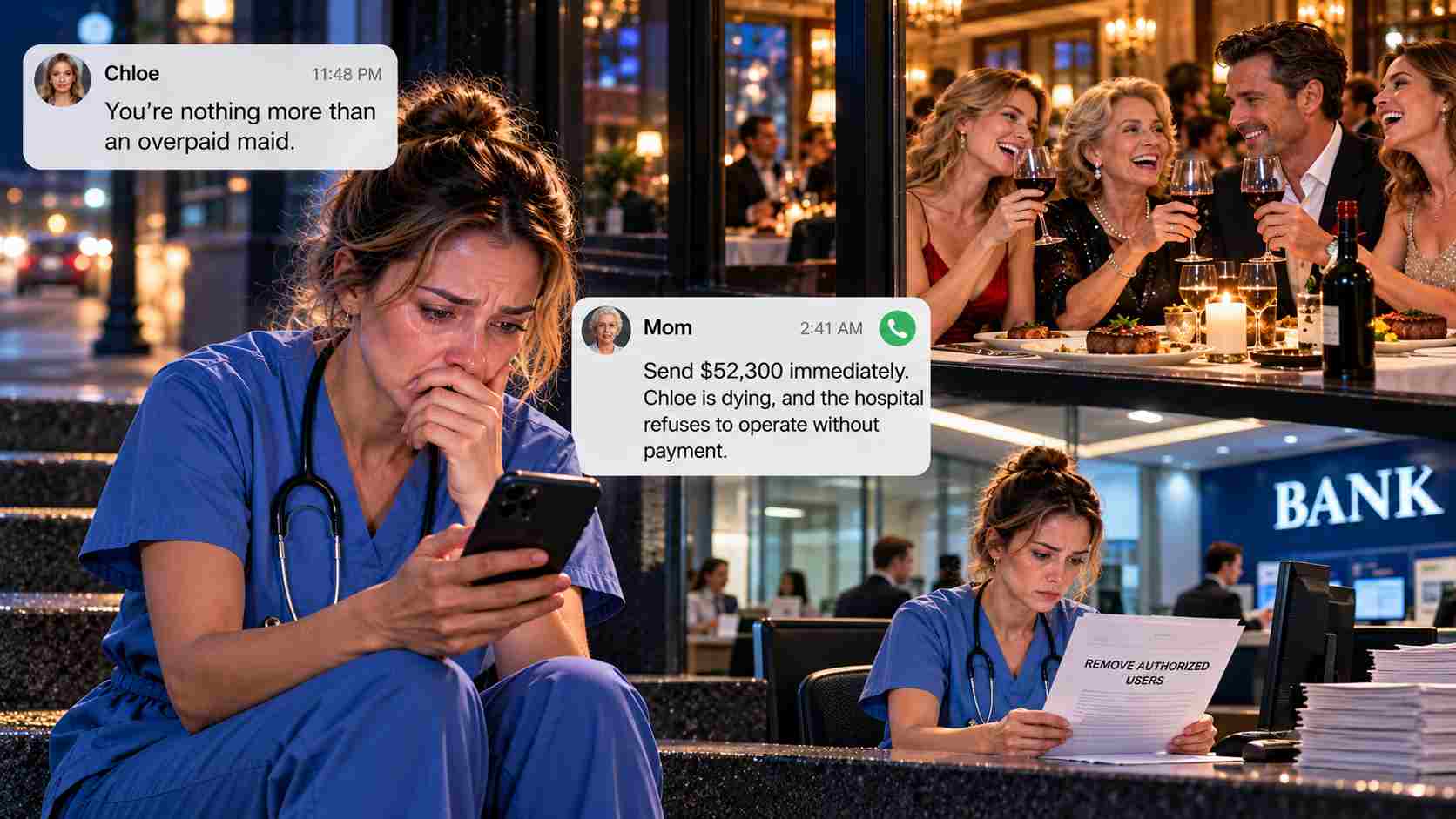
Chloe is dying, and the hospital refuses to operate without payment.” I am an emergency-room nurse. I knew that claim could not be true. By three-thirty, I had checked the surgical schedule. There was no Chloe, no assigned surgeon, and no emergency procedure. By four-thirty, I was sitting outside a steakhouse, watching my family celebrate. At five-thirty, I entered the bank, printed one document, and quietly removed every one of them from my financial life…
PART 2
The number took almost three hours to calculate.
Some transfers were easy to identify: rent assistance, tuition, medical bills, credit-card emergencies, vehicle repairs, deposits, utility shutoff notices.
Others had been disguised beneath vague descriptions like family support, temporary loan, or urgent help.
By 8:40 a.m., the banker had traced more than four hundred thousand dollars leaving my accounts toward relatives over eleven years.
Chloe alone had received nearly one hundred and seventy thousand.
Mom had received another hundred and twelve.
Greg’s “temporary business loan” had never been repaid.
Two cousins had used me for car payments, legal fees, and a supposed funeral expense that I suddenly remembered had never resulted in any funeral.
I sat in the private banking office staring at the printout, feeling less like a daughter and more like an investigator reading the financial history of a long-running scam.
The worst part was not the amount.
I could survive the amount.
The worst part was realizing how coordinated it had been.
Whenever one person asked, another person reinforced the story.
Chloe would call crying, then Mom would confirm the emergency.
Greg would tell me I was the only responsible one in the family.
If I hesitated, someone would accuse me of becoming arrogant because I had a good career.
They had turned my reliability into a weakness.
The banker asked whether I wanted to freeze external transfers temporarily.
“Yes.”
“Change account numbers?”
“Yes.”
“Cancel all standing authorizations?”
“Yes.”
“Remove beneficiary designations?”
I paused.
That was heavier.
Beneficiaries were not about inconvenience.
They were about what happened after I died.
Chloe was listed on nearly everything.
Mom on the rest.
I thought of the text from 11:36.
Nobody actually loves you.
Then I thought about them eating steak while begging me for money to prevent Chloe’s imaginary death.
“Remove them,” I said.
By 10:15, my financial life looked completely different.
New account numbers.
New passwords.
New security questions.
No shared access.
No emergency transfer permissions.
No authorized family contacts.
I moved a large portion of my savings into accounts requiring in-person verification for high-value withdrawals.
Then I called my attorney.
By noon, my will was under review.
By one, I had changed my medical power of attorney.
My friend Elise, an ICU physician who had known me for fifteen years, replaced my mother.
My estate instructions were rewritten so that if something happened to me, a portion would fund nursing scholarships and the rest would go to carefully selected charities.
Not one dollar would pass automatically to Chloe.
The calls began at 10:43.
Mom first.
Then Chloe.
Then Greg.
Then Mom again.
I ignored every one.
At 11:12, Chloe sent:
What is going on? Mom says the transfer failed.
A minute later:
I need you to call me RIGHT NOW.
Then:
This is not funny.
I almost admired the confidence it took to accuse me of making things difficult after faking emergency surgery.
At noon, Mom left a voicemail.
“Naomi, I don’t know what is wrong with you today, but your sister’s situation is still serious. The hospital arrangement changed. They moved her somewhere else. We will explain later. Just send the money.”
The lie was mutating.
When one version failed, they simply created another.
I saved the voicemail.
At 1:26, Chloe finally texted the truth by accident.
If you don’t transfer the money today, we could lose the house.
I read the sentence twice.
Then I replied for the first time.
What house?
Silence.
Ten minutes later, Mom called.
I answered.
“Naomi,” she began carefully, “there has been a misunderstanding.”
I leaned back in my chair.
“About the ruptured appendix?”
Silence.
“Or about St. Aldric?”
More silence.
“Or about the surgeon who doesn’t exist?”
Mom’s breathing changed.
“How did you—”
“I work in emergency medicine, Mom.”
Her voice hardened.
“Fine. Chloe was not in the hospital.”
No apology.
No shame.
Just irritation that the story had failed.
“She and Mason found a house. A beautiful house. They needed fifty-two thousand three hundred dollars to complete the purchase. You would have refused if we asked normally.”
I laughed once.
“So you told me she was dying.”
“We did what we had to do.”
That sentence hit me harder than the original lie.
“You did what you had to do.”
“Naomi, stop acting dramatic. You make excellent money. You live alone. You don’t have children. What exactly are you saving for?”
There it was.
The philosophy behind every request.
My life, because it did not look like theirs, did not count.
My money was surplus simply because I had earned it without a husband, children, or expensive house attached to it.
“Is Chloe there?” I asked.
Mom hesitated, then put her on speaker.
Chloe’s voice came sharp and angry.
“You embarrassed us. The seller is expecting funds today.”
“You told me I was an overpaid maid.”
“I was upset.”
“You told me nobody loved me.”
“Oh my God, Naomi, are you really going to make this about a text?”
I looked at the stack of bank documents on my kitchen table.
“No,” I said. “I’m making it about eleven years.”
The room on their end went quiet.
“I removed all of you from my accounts this morning.”
Mom inhaled sharply.
Chloe said, “What?”
“Every authorization. Every beneficiary. Every transfer permission. Everything.”
Greg’s voice appeared in the background.
“She can’t do that.”
“They’re my accounts,” I said. “Of course I can.”
Chloe began shouting.
“You are ruining my life!”
“No. I’m simply no longer financing it.”
Then Mom said the sentence that finally confirmed I was making the right decision.
“After everything this family has done for you.”
I closed my eyes.
“Name one thing.”
Nobody answered.
PART 3 — FINAL PART
They arrived at my apartment that evening without warning.
Mom, Chloe, Greg, and Mason stood outside my door at 7:18 p.m., ringing the bell as if repetition could turn entitlement into permission.
I watched them through the security camera while Chloe paced across the hallway.
“Open the door, Naomi,” she shouted. “We need to settle this.”
I spoke through the intercom.
“There is nothing to settle.”
“The house closes tomorrow.”
“Then I hope you have financing.”
Mom stepped toward the camera.
“Do not talk to your sister like a stranger.”
I almost opened the door just to ask whether strangers usually invent fatal illnesses to steal fifty-two thousand dollars, but I had learned enough that day.
Distance was clarity.
“Leave,” I said.
Greg slammed his palm against the door.
“You think because you’re a nurse with some savings you’re better than everybody?”
“No,” I replied. “I think because they’re my savings, I get to decide where they go.”
Mason had been silent until then.
Finally, he said, “Look, this got out of hand. Chloe told me your family had an arrangement.”
Chloe spun toward him.
“Mason, shut up.”
That got my attention.
“What arrangement?”
Silence.
“Mason?”
He looked toward the camera, clearly realizing he had said too much.
Chloe grabbed his arm.
“We’re leaving.”
“No,” he said, pulling away. “I’m not taking the blame for something your mother organized.”
Mom’s face changed.
I leaned closer to the screen.
“Keep talking.”
Chloe hissed, “Don’t.”
Mason rubbed both hands over his face.
“They said you had always funded family emergencies. They said you’d complain but eventually pay. Diane said medical emergencies worked best because you responded faster.”
For a moment, nobody moved.
My entire childhood seemed to rearrange itself inside my head.
The car repair that had become a hospital bill.
The utility crisis that somehow vanished when I asked for the account number.
The emergency dental surgery Chloe had needed while posting beach photos two days later.
This was not impulsive.
It had become a system.
“How many times?” I asked.
Mason shook his head.
“I don’t know.”
“How many fake emergencies?”
Mom snapped, “Do not answer her.”
Mason looked disgusted now.
“Enough.”
Chloe started crying, but the tears did not move me the way they once would have.
I had spent years responding to tears as evidence.
Now I wanted receipts.
“Leave,” I said again.
“Naomi,” Mom pleaded, changing tactics, “we can fix this.”
“You cannot fix something you still believe you were entitled to do.”
I told them I had saved the messages, the hospital claim, the voicemail, and the admission that the money was for a house.
I also told them that if anyone attempted to access my accounts, impersonate me, use my information, or manufacture another emergency, I would file a police report immediately.
Greg muttered something about family loyalty.
“Loyalty does not require financial access,” I replied.
They finally left.
The following weeks were uglier than the confrontation.
Relatives called me cruel.
One aunt said I should help because “Chloe has always been sensitive.”
A cousin accused me of humiliating my mother.
I asked each person the same question:
“Would you send $52,300 to someone who lied that their daughter was dying?”
None of them answered directly.
Some stopped calling.
That became another kind of peace.
Chloe and Mason lost the house because they could not produce the down payment.
Three months later, they ended their engagement.
Apparently Mason had discovered debts Chloe had hidden from him, and Chloe blamed him for exposing the family scheme at my apartment.
Mom did not speak to me for six months.
During that silence, something unexpected happened.
My life became quieter.
My phone stopped producing adrenaline every time it rang.
I slept through the night.
I took my first real vacation in seven years.
I replaced the neglected plant in my bedroom with three healthy ones.
I began putting money into a scholarship fund for nursing students who had to work while in school.
The first recipient was a single mother named Rochelle who had nearly dropped out because she could not afford childcare during clinical rotations.
When she received the award, she cried and hugged me.
“You have no idea what this means,” she said.
But I did.
For the first time, my money was helping someone without being extracted through fear.
Nearly a year after the steakhouse night, Chloe asked to meet me.
We sat in a quiet coffee shop on a Sunday morning.
She looked different.
No designer bag.
No polished performance.
“I started therapy,” she said.
“Good.”
“Mom is still angry at you.”
“I know.”
Chloe looked down at her cup.
“I was angry too. For months. Then my therapist asked me why I believed your money belonged to us.”
I waited.
“I didn’t have an answer.”
That was the first honest thing she had given me in years.
“I am sorry,” she said. “Not because the plan failed. Because we did it.”
I believed she meant it.
But belief and access were two different things.
“I forgive you,” I said.
Her eyes filled.
“Does that mean we can go back to normal?”
I shook my head.
“Normal is what created this.”
She absorbed that quietly.
“Then what happens now?”
“We build something different. Slowly. Without money.”
She nodded.
We finished our coffee and walked outside together.
No emergency.
No transfer.
No guilt.
Just two sisters standing on a sidewalk trying to understand what family might look like without a financial transaction attached to it.
That evening, I came home and checked my phone.
No missed calls.
No manufactured crisis.
No demand disguised as love.
I made tea, sat beside the window, and watched the city lights come on.
For years, I had believed being useful was the price of belonging.
My family had encouraged that belief because it benefited them.
But the night they lied about Chloe dying taught me something emergency nursing never had:
Not every crisis deserves saving, and not every person demanding access to your resources deserves access to your life.
Sometimes the healthiest thing you can do is stop the bleeding at the source.
I had spent eleven years being their emergency account.
It took one fake hospital call for me to finally close it.
❤️ THE END! THANK YOU FOR READING!
Follow Page For More Real Life Stories.