PART 2: FINAL PART
For several seconds, nobody moved. The barbecue music continued playing softly, but the atmosphere had changed completely. I opened the attorney’s email and read it again.
For several seconds, nobody moved.
The barbecue music continued playing softly, but the atmosphere had changed completely.
I opened the attorney’s email and read it again.
The property records showed that my father had submitted documents attempting to transfer the house to Kelsey and Ryan.
Worse, the paperwork included a signature that appeared to authorize the transaction on my behalf.
“You forged my signature?” I asked, my voice barely above a whisper.
Dad immediately shook his head.
“That’s a ridiculous accusation. I handled the paperwork the way it needed to be handled.”
My attorney, Ms. Bennett, had already explained that the attempted transfer raised serious legal questions. She had advised me not to sign anything, confront anyone aggressively, or make assumptions before reviewing the original records.
I took a breath.
“Then you won’t mind explaining everything to a lawyer.”
Mom’s face crumpled.
“Melanie, please. We were trying to help Kelsey. Ryan’s lease is ending, and the baby is coming soon.”
“What does that have to do with my house?” I asked.
Kelsey stepped forward, her eyes filling with tears.
“I didn’t know Dad was going to do all this. He told me you agreed to give us the property.”
I stared at her.
“And you never thought to ask me?”
She looked down.
That silence answered more than words could.
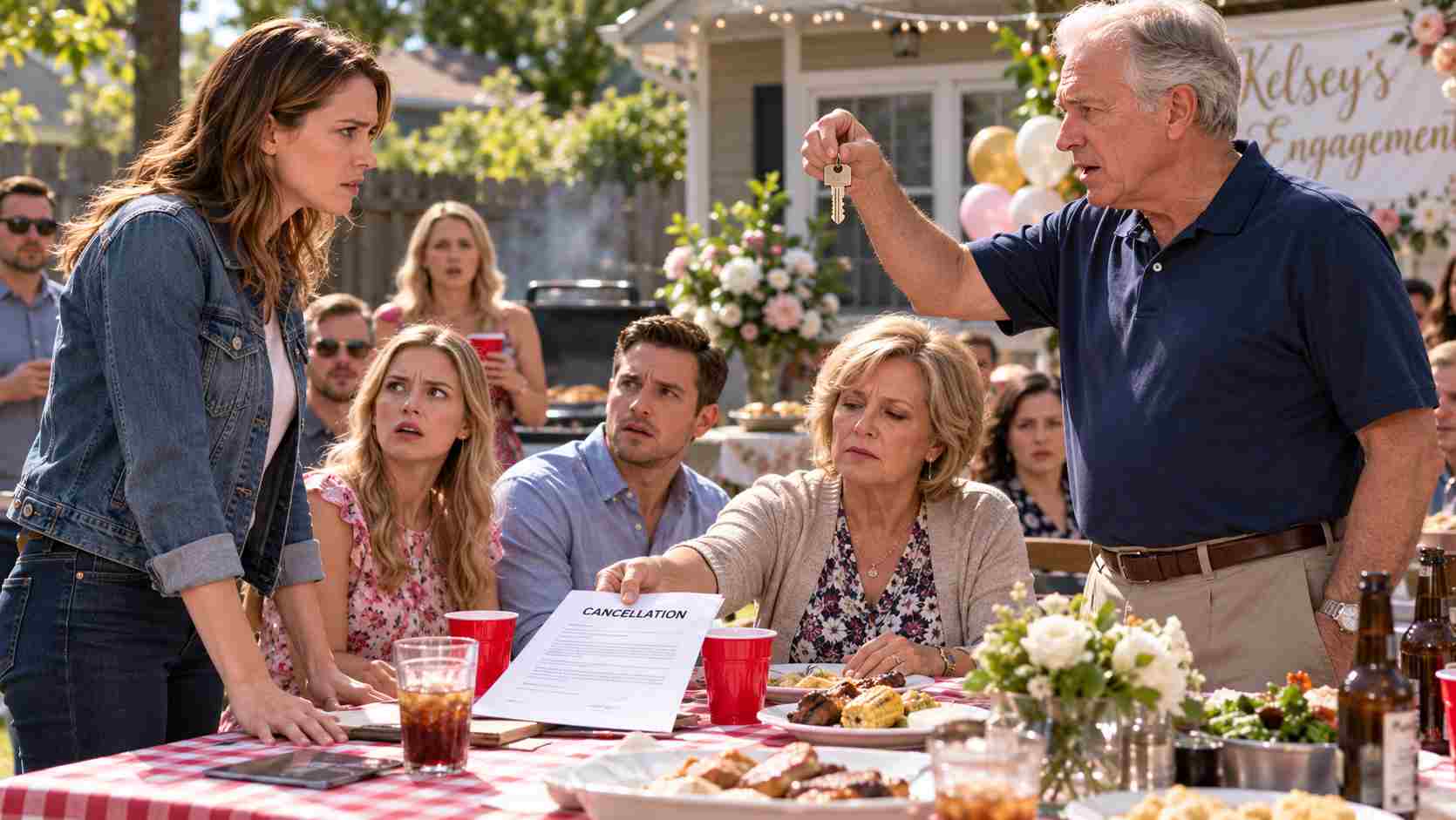
Ryan removed the engagement party key from his pocket and placed it on the picnic table.
“I don’t want a house that belongs to someone else,” he said.
My father snapped, “Stay out of this. You’re marrying into this family.”
Ryan stood his ground.
“That’s exactly why I’m saying something.”
Several relatives exchanged uncomfortable glances.
My aunt Patricia finally spoke.
“Arthur, I think you owe Melanie an explanation.”
Dad glared at her.
“This is a private family matter.”
“It stopped being private when you announced someone else’s property was a wedding gift,” she replied.
I felt an unexpected wave of relief.
For the first time that afternoon, someone had acknowledged how wrong the situation was.
I didn’t stay for another argument.
I picked up my handbag, wished everyone a good evening, and drove straight to my attorney’s office.
The following Monday, we reviewed every document together.
The original contract confirmed my rights and listed the conditions required for any transfer or cancellation.
There was no valid cancellation agreement bearing my signature.
The attempted transfer documents contained suspicious details that needed further investigation.
Ms. Bennett explained the steps available to protect my interest, including notifying the appropriate parties and pursuing legal remedies if necessary.
I authorized her to send formal notices and request the original records.
For the next few weeks, my phone became a battlefield.
Mom left tearful voicemails.
Dad sent angry messages accusing me of humiliating him.
Kelsey alternated between apologizing and insisting I was ruining her future.
I stopped answering and let my attorney handle the property dispute.
Then, one rainy Thursday morning, Ms. Bennett called.
“Melanie, we received a response. Your father has admitted that he intended to transfer the property to your sister, but he claims he believed he had the authority.”
I closed my eyes.
“Does that mean I lose the house?”
“No. It means we have more work to do, but the evidence supports your position.”
A few weeks later, the parties met at the attorney’s office.
Dad arrived looking exhausted.
Mom sat beside him, clutching her purse.
Kelsey and Ryan came together, but they barely spoke.
My attorney placed the payment records, original contract, and disputed transfer documents on the table.
“Six years of payments,” she said. “One substantial down payment. No valid cancellation. No consent to transfer.”
Dad stared at the paperwork.
Finally, he admitted that he had hoped I would surrender the house voluntarily once the family pressured me.
He had convinced himself that because he helped arrange the original deal, he could decide what happened next.
But the documents didn’t support that belief.
After further negotiations and legal review, my parents agreed to withdraw the attempted transfer and acknowledge my contractual rights.
Any remaining ownership steps would be completed according to the original agreement and applicable law.
My father also agreed to reimburse certain expenses caused by the unauthorized paperwork.
It wasn’t a dramatic courtroom victory, and there were no handcuffs or shouting crowds.
It was something much more meaningful to me:
A written resolution protecting the home I had worked so hard to secure.
On the day the final documents were signed, I drove to the house alone.
I unlocked the front door, stepped inside, and stood in the quiet living room.
The sunlight fell across the wooden floor I’d refinished myself.
I remembered the first night I had slept there, surrounded by cardboard boxes and eating takeout on an overturned bucket.
I had cried that night, not because I was unhappy, but because I finally had a place where I felt safe.
Now I cried again.
This time, I was relieved.
A month later, Kelsey visited me without our parents.
She looked nervous and held a small envelope.
“I owe you an apology,” she said.
Inside was a handwritten letter.
She admitted she’d believed our parents’ promises without checking the facts.
She also confessed that she had been so excited about the idea of a bigger home that she ignored the obvious question of whether it was actually hers to receive.
“I’m not asking you to forgive me immediately,” she said. “I just want you to know I’m sorry.”
I accepted the letter.
Forgiveness, I realized, wasn’t the same as pretending nothing had happened.
“I hope you build a beautiful life,” I told her. “But never build it on somebody else’s sacrifice.”
She nodded, tears rolling down her cheeks.
Our relationship would take time to heal, if it ever fully did.
As for my parents, I established boundaries.
They were no longer allowed to handle my finances, sign documents for me, or make decisions about my property.
Dad eventually sent a brief apology.
It wasn’t perfect, but I appreciated the acknowledgment.
Months later, I hosted a small dinner at my house.
No speeches.
No surprise announcements.
Just a few friends, good food, and laughter that didn’t come at anyone’s expense.
Before everyone left, I stepped onto the porch and looked at the roses beside the walkway.
For years, I’d believed that being a good daughter meant keeping the peace, even when it cost me everything.
That evening, I understood something different.
Family should never require you to surrender your dignity, your security, or the future you’ve worked to create.
My father once held up a key and announced that my house belonged to someone else.
Today, I keep that key on my own ring.
Not as a reminder of the betrayal, but as a symbol of the moment I finally learned to stand up for myself.
💬 THE END! THANK YOU FOR READING!