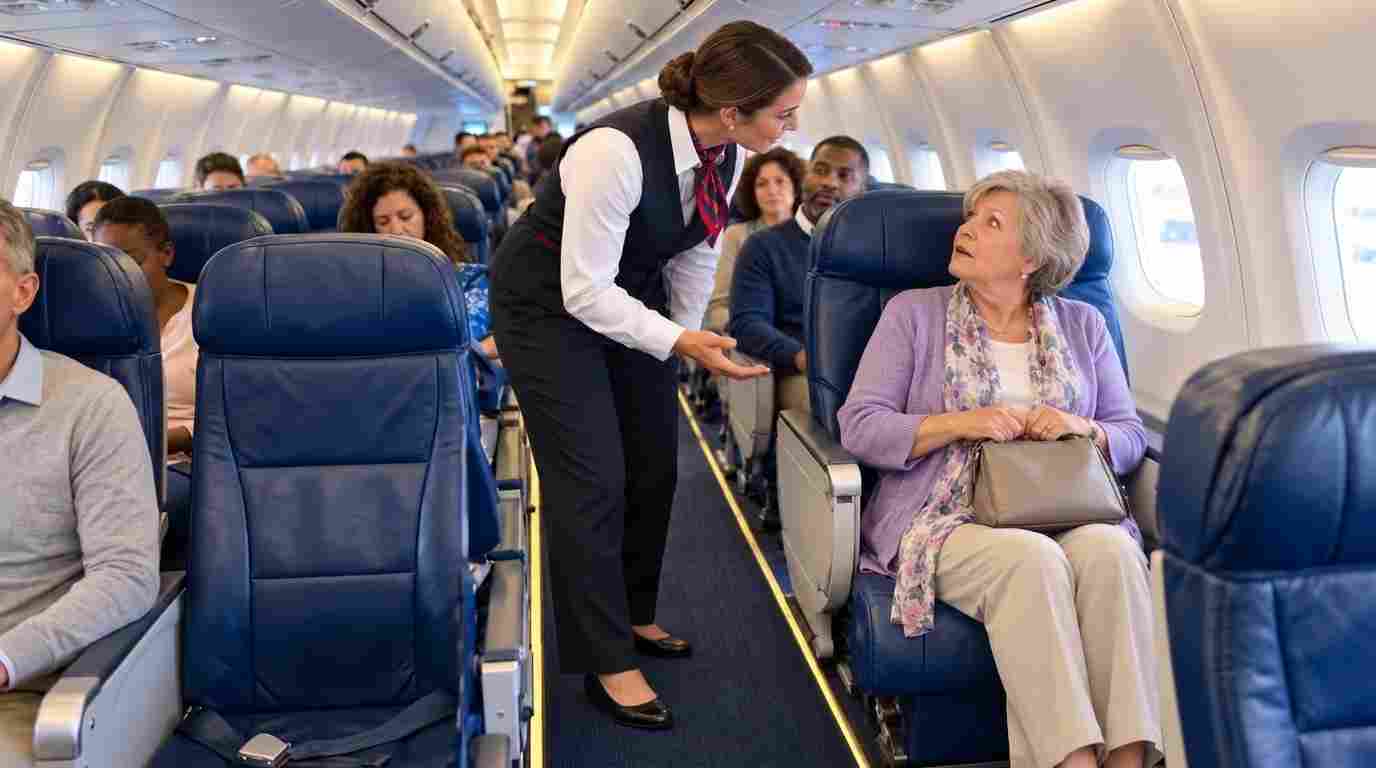
My grandmother gave away the first-class airplane seat I had saved for months to buy her. At first, I thought she was simply being kind. Then she insisted on sitting in economy, in a particular seat beside the window. Seat 34A. She held an old, yellowed boarding pass in her trembling hands and whispered, “I made a promise twenty-seven years ago. I think it’s finally time I kept it.”
I didn’t understand what she meant.
Not until the captain came out of the cockpit, looked at the silver wings pinned to her purse, and suddenly went pale.
“Ma’am,” he said, his voice barely above a whisper. “Where did you get those wings?”
My grandmother looked up at him.
“They belonged to my husband.”
The captain gripped the back of the seat.
“Was his name Thomas Walsh?”
Grandma’s expression changed so suddenly that I thought she might faint.
“Yes,” she whispered.
The captain swallowed hard.
Then he said something that made my blood run cold.
“Your husband tried to save my father’s life.”
He looked down at the ancient boarding pass.
“And I believe someone made sure he never got the chance to tell the truth.”
That was the moment I realized my grandmother hadn’t boarded that airplane simply to visit family.
She had been carrying a secret for twenty-seven years.
And before our journey ended, that secret would uncover a betrayal, expose a terrible lie, and reveal what had really happened to the grandfather I had never known.
But to understand what happened on that flight, I have to start three days earlier.
When my grandmother told me something I should have taken much more seriously.
My name is Claire Bennett.
I’m twenty-six years old, and until that week, I believed my grandmother Eleanor Walsh was the most predictable person in the world.
She was seventy-eight, lived alone in a small house outside Chicago, and followed routines that seemed older than I was.
Every morning, she made tea in the same blue teapot.
Every Sunday, she attended church, even when the weather was terrible.
Every Christmas, she baked enough cinnamon cookies to feed half the neighborhood.
And every evening, without fail, she turned on the little brass lamp beside her late husband’s photograph.
She never remarried.
She never went on dates.
She never even allowed anyone to move the photograph from its place on her bedroom dresser.
Grandpa Thomas had died twenty-seven years earlier.
I was born afterward, so I had never met him.
Whenever I asked Grandma what he had been like, her face softened.
“He was a man who believed doing the right thing mattered more than being liked,” she would say.
Then she would smile sadly.
“And he had a terrible habit of giving his last dollar to someone who needed it more.”
But whenever I asked how he died, her smile disappeared.
“It was an accident, sweetheart.”
That was all.
An accident.
Two words that ended every conversation.
My mother, Margaret, wasn’t much more helpful.
She was eighteen when her father died, and even after all those years, the subject could bring tears to her eyes.
Eventually, I stopped asking.
I assumed it was simply too painful.
I had no idea the real reason was much more complicated.
Three days before our flight, I visited Grandma to help her pack.
We were traveling to Seattle for her older sister’s eightieth birthday celebration.
Grandma hadn’t seen Aunt Rose in nearly five years, and I wanted the trip to be special.
That was why I had secretly upgraded her ticket to first class.
It cost me nearly an entire month’s savings.
But when I told her, she stared at me as though I’d announced something terrible.
“First class?” she repeated.
I grinned.
“Big seat. Real food. Extra legroom. You won’t have to fight anyone for the armrest.”
“Claire, you shouldn’t have spent that kind of money.”
“You spent half your life taking care of everyone else. Let someone take care of you.”
Her eyes grew shiny.
For a moment, I thought she was going to hug me.
Instead, she asked a strange question.
“Can I still sit in the back if I want to?”
I laughed.
“Grandma, why would you want to?”
She looked toward the dresser.
Toward Grandpa’s photograph.
“Because sometimes the place that matters most isn’t the most comfortable one.”
I thought she was being sentimental.
So I kissed her cheek and changed the subject.
Later that afternoon, while I was folding sweaters into her suitcase, I noticed her sitting beside the window with something in her lap.
A small brown leather purse.
It was old and scratched, with a broken clasp she had repaired using a piece of red thread.
I had seen it hundreds of times.
But that afternoon, she had it open.
Inside was a yellowed paper ticket, a photograph, and a pair of tiny silver wings.
She was staring at the ticket so intensely that she didn’t hear me approach.
“Grandma?”
She jumped.
Then she hurriedly closed the purse.
“Goodness, child. You’ll give me a heart attack.”
I smiled.
“What were you looking at?”
“Just an old memory.”
“Something from Grandpa?”
Her fingers tightened around the purse.
“Yes.”
“Can I see?”
She hesitated.
For a moment, I thought she might finally share something about him.
Then she shook her head.
“Not yet.”
Those two words stayed with me.
Not yet.
Not no.
Not never.
As if there were a date on a calendar when I would finally be old enough to understand.
That evening, while we ate dinner, Grandma asked me another unusual question.
“Claire, do you believe people can find each other after many years?”
I looked up from my plate.
“Of course. People find old friends online every day.”
She shook her head.
“I don’t mean that.”
“Then what do you mean?”
She stared into her tea.
“I mean, do you think two people who were connected by something terrible can somehow be brought together again?”
I didn’t know what to say.
“I suppose so.”
She nodded slowly.
“Your grandfather believed that nothing done in darkness stays hidden forever.”
Then she looked at me.
“I hope he was right.”
On the morning of our flight, Grandma was unusually quiet.
She wore a navy-blue cardigan, pearl earrings, and the small gold wedding ring she had never taken off.
Pinned to her old leather purse were the silver wings.
I had never seen her wear them before.
“Those are pretty,” I said.
She looked down.
“They’re older than you.”
“Were they Grandpa’s?”
She nodded.
“He wore them when he was young.”
“I thought he wasn’t a pilot.”
“He wasn’t, in the end. He trained to fly, but a medical problem kept him out of the cockpit. He became a flight operations engineer instead.”
She brushed the wings with her thumb.
“He loved airplanes almost as much as he loved us.”
Then, after a pause, she added, “Perhaps that was part of the trouble.”
I nearly asked what she meant.
But our taxi arrived.
And within minutes, we were on our way to O’Hare International Airport.
Everything was normal until we reached the boarding gate.
Grandma was holding her new first-class boarding pass when she noticed a young woman sitting nearby.
The woman looked exhausted.
She had dark circles beneath her eyes, a diaper bag hanging from one shoulder, and a crying baby in her arms.
Every few seconds, she tried to soothe the child while apologizing to the passengers around her.
Grandma watched her for a long moment.
Then she walked over.
“Hello, sweetheart,” she said gently. “Is this your first flight with the baby?”
The woman laughed nervously.
“Is it that obvious?”
“Only because I remember what it was like.”
The woman’s eyes filled.
“My husband couldn’t come. My mother is in the hospital, and I’m trying to get to her before her surgery tomorrow.”
Grandma glanced at her boarding pass.
“Where are you sitting?”
“Thirty-four A.”
Something happened to my grandmother’s face.
Her lips parted.
“Thirty-four A?”
The woman nodded.
“Window seat. At least that’s what they told me.”
Grandma looked at her own first-class ticket.
Then she smiled.
“Well, dear, I think we’ve found ourselves a solution.”
Before I understood what she was doing, she offered the woman her ticket.
“You take my seat.”
The woman stared.
“I’m sorry?”
“First class. You’ll have more room for the baby.”
“Oh, I couldn’t possibly—”
“Nonsense.”
“Ma’am, that must have cost a fortune.”
Grandma smiled.
“My granddaughter bought it because she loves me. And I know she’d want me to use that gift to make someone’s day a little easier.”
I opened my mouth.
Then closed it.
Because what could I possibly say?
The young woman began crying.
Grandma hugged her.
And after a flight attendant helped arrange the exchange, Grandma handed me her new boarding pass.
Seat 34A.
She studied it for several seconds.
Then she reached into her purse and removed the ancient ticket.
She placed them side by side.
I saw the numbers before she could hide the older paper.
34A.
The exact same seat.
“Grandma?”
She didn’t answer.
“Why do you have a boarding pass with the same seat number?”
Her eyes remained fixed on the faded paper.
“Because twenty-seven years ago, I was supposed to sit there.”
A strange feeling crawled up my spine.
“On this flight?”
“No, sweetheart.”
She folded the ticket carefully.
“On a flight that never reached its destination.”
I stared at her.
“What do you mean, never reached its destination?”
Grandma opened her mouth.
Then the boarding announcement echoed through the terminal.
“Passengers traveling to Seattle, we are now ready to begin boarding.”
She slipped the old ticket back into her purse.
“Come, Claire. We shouldn’t keep everyone waiting.”
“Grandma, you can’t just say something like that and walk away.”
She stopped.
For the first time that morning, I saw genuine fear in her eyes.
“Then sit beside me,” she whispered. “And I’ll tell you everything I should have told you years ago.”
The airplane climbed into a pale morning sky.
I sat beside Grandma in seat 34B, watching her stare out the window.
She hadn’t opened her book.
She hadn’t touched the complimentary biscuits.
She simply held that old leather purse in her lap.
When the seat belt sign finally went off, the captain’s voice came over the speakers.
“Good morning, ladies and gentlemen. This is Captain David Mercer speaking. We’re expecting a smooth flight to Seattle today…”
Grandma suddenly turned toward me.
“What did he say?”
I blinked.
“The captain? He said we’re expecting a smooth flight.”
“No. His name.”
“David Mercer.”
The color disappeared from her cheeks.
“Mercer?”
“Yes. Why?”
She pressed one hand against her chest.
Then she whispered, “James.”
“Who’s James?”
She stared toward the front of the airplane.
“Your grandfather’s friend.”
Before I could ask another question, Grandma pressed the flight attendant call button.
A young attendant named Melissa approached.
“Can I help you, ma’am?”
Grandma’s voice trembled.
“I know this is an unusual request, but could you give your captain a message?”
Melissa smiled politely.
“Of course. What’s the message?”
Grandma reached into her purse and removed the old boarding pass.
She turned it over and wrote a short note on the back of an unused receipt.
Then she handed it to Melissa.
I caught a glimpse of the message.
My name is Eleanor Walsh. My husband was Thomas Walsh. If Captain Mercer is the son of James Mercer, please tell him I remember Flight 217.
Melissa read the note.
Her expression became serious.
“I’ll make sure he receives it.”
She disappeared toward the front of the cabin.
For the next twenty minutes, Grandma barely moved.
I could hear the aircraft engines.
The occasional clinking of glasses.
A baby crying somewhere ahead.
But all I could think about was that number.
Flight 217.
Finally, I turned toward her.
“Was Grandpa on that plane?”
She shook her head.
“No.”
“Then what happened to him?”
A tear slipped down her cheek.
“He tried to stop it from taking off.”
My stomach tightened.
“What?”
“Twenty-seven years ago, your grandfather discovered something wrong with an aircraft’s maintenance records.”
She spoke slowly, as though every word hurt.
“He believed someone had allowed a dangerous mechanical problem to go unresolved. He reported it, but the people responsible insisted the plane was safe.”
“Who were they?”
“People with expensive offices and important titles.”
Her mouth twisted bitterly.
“People who cared more about keeping the schedule than listening to an engineer.”
I stared at her.
“Did the plane crash?”
She closed her eyes.
“Yes.”
“How many people?”
“Forty-three.”
I felt sick.
Forty-three people.
Forty-three families waiting for loved ones who never came home.
And my grandfather had known something was wrong.
“Why didn’t he stop them?” I whispered.
Grandma’s eyes opened.
“He tried, Claire.”
Her voice broke.
“He tried harder than anyone ever knew.”
Before she could continue, Melissa returned.
But she wasn’t alone.
Walking behind her was a tall man wearing a captain’s uniform.
He looked to be in his early thirties, with dark hair and tired blue eyes.
His expression was unreadable.
When he reached our row, Grandma slowly stood.
The captain looked at her purse.
At the silver wings.
Then at her face.
“What is your name, ma’am?”
“Eleanor Walsh.”
He went completely still.
“Thomas Walsh’s wife?”
She nodded.
The captain gripped the seat in front of him.
For a moment, I thought he might fall.
“My father talked about your husband,” he said quietly.
Grandma’s lips trembled.
“Your father was James?”
“Yes.”
She covered her mouth.
“Oh, my goodness.”
The captain swallowed.
“I thought you had disappeared.”
“And I thought your family had moved away.”
“My mother took me to Oregon after the accident. She couldn’t bear to stay in Chicago.”
Grandma nodded.
“I understand.”
He glanced at the old boarding pass resting on her lap.
“Flight 217.”
“Yes.”
His voice grew unsteady.
“My father was the first officer that night.”
I felt the world tilt.
The captain looked at me.
“He was thirty-nine years old. I was six.”
Then he turned back to Grandma.
“And for twenty-seven years, I’ve been trying to understand why he died.”
Grandma reached for his hand.
“Your father was a brave man.”
The captain’s jaw tightened.
“He wasn’t supposed to fly that night. Another pilot became ill. My father volunteered to replace him.”
Grandma nodded.
“Thomas told me.”
The captain drew a deep breath.
“Mrs. Walsh, my mother always believed your husband knew something about the crash.”
“He did.”
“Something that wasn’t in the official report.”
“Yes.”
The captain looked down.
Then he asked the question that changed everything.
“Did he ever tell you about a second envelope?”
Grandma froze.
I looked from one face to the other.
“What second envelope?”
The captain leaned closer.
“My father called my mother shortly before boarding. He told her Thomas Walsh had found evidence that someone altered the maintenance records.”
He paused.
“He said Thomas was preparing a second envelope for investigators in case the original report disappeared.”
Grandma’s breathing became shallow.
The captain continued.
“The original report was never recovered.”
He looked directly into her eyes.
“Neither was the envelope.”
For several seconds, Grandma said nothing.
Then she whispered, “I know where it is.”
The captain stared at her.
“Where?”
She opened her purse.
From a tiny compartment beneath the lining, she removed an old brass key.
A faded red thread was tied through its loop.
She held it between her fingers.
“Your father trusted my husband,” she said. “And my husband trusted your father.”
Her eyes filled.
“Perhaps it’s time we trusted their children.”
Captain Mercer had to return to the cockpit.
Before leaving, he gave me his contact information and promised that once we landed, we could speak privately.
But Grandma wasn’t finished.
She turned toward me.
“Your grandfather didn’t die in the airplane crash.”
I stared at her.
“What?”
“He was found dead inside the airport several hours afterward.”
My skin prickled.
“Inside the airport?”
“A service stairwell near the maintenance offices.”
“How?”
She looked down.
“The official report said he fell.”
I waited.
“But you don’t believe that.”
“No.”
“Why not?”
“Because someone came to our house the next morning.”
She swallowed.
“Two men. One of them was named Walter Baines. He was the airline’s director of operational safety.”
She closed her eyes.
“He told me Thomas had become confused and emotional after the crash. He said Thomas had been under pressure. He suggested my husband had made mistakes.”
“What kind of mistakes?”
“According to him, Thomas had approved the aircraft’s maintenance clearance.”
I frowned.
“But Grandpa knew it wasn’t safe.”
“Exactly.”
Grandma looked at me.
“They showed me a document with his signature.”
I felt cold.
“You’re saying someone forged it?”
“I believe so.”
“Did you tell the investigators?”
“I tried.”
Her voice shook.
“But the company insisted the document was genuine. They said Thomas had been distressed when he died, and that I should protect our daughter from unnecessary attention.”
I thought of my mother.
Of the way she never spoke about Grandpa.
Of the sadness she carried even when she smiled.
“What happened after that?”
Grandma gripped the purse.
“Three days after the funeral, I found an envelope in our mailbox. Inside was a photograph of Margaret walking home from school.”
My heart stopped.
“She was eighteen,” Grandma whispered. “Still my little girl, no matter how grown-up she believed she was.”
A tear ran down her cheek.
“Someone had written five words on the back.”
She looked directly at me.
“Some accidents happen twice, Eleanor.”
I stared at her in horror.
“Grandma…”
“I had just buried my husband. I couldn’t bear the thought of burying my daughter too.”
“So you stayed quiet.”
She nodded.
“I’m not proud of it.”
I reached for her hand.
“You were terrified.”
“I was.”
“Did the police know about the photograph?”
“No. I burned it.”
She turned toward the window.
“And I’ve regretted that decision every day since.”
For a long time, neither of us spoke.
Then I looked at the brass key.
“What’s in the box?”
“I don’t know everything.”
“You’ve never opened it?”
She shook her head.
“Thomas gave me the key on the morning he died. He said there was a locked document box in the bottom of his wardrobe.”
Her lips trembled.
“He told me that if anything happened, I should keep it safe until I found someone I could trust.”
“And you never opened it?”
“No.”
“Why?”
She looked at me with an expression that almost broke my heart.
“Because I thought knowing the truth might cost me the only family I had left.”
I couldn’t answer.
There are moments when you discover that the people who raised you were carrying pain you never noticed.
That their ordinary lives were built around extraordinary sacrifices.
That what looked like weakness was sometimes the only way they knew to survive.
I held Grandma’s hand until the airplane began its descent.
And when we landed in Seattle, I knew one thing with absolute certainty.
We were not going to let the past stay buried.
Captain Mercer met us in a private airport lounge after completing his duties.
Without the urgency of the cabin around us, he looked less intimidating.
He was simply a son who had spent most of his life missing his father.
He sat across from Grandma.
“My mother died four years ago,” he said quietly.
Grandma lowered her head.
“I’m sorry.”
“Before she passed, she gave me a box of my father’s belongings. There were photographs, letters, his old flight logbook…”
He paused.
“And a notebook.”
Grandma looked up.
“What kind of notebook?”
“Something he kept during the last month of his life.”
He removed his phone and opened a photograph.
It showed a handwritten page.
At the top were three words.
Ask Thomas Walsh.
Underneath was a date.
The day before Flight 217 crashed.
Grandma began crying.
Captain Mercer leaned forward.
“Mrs. Walsh, I became a pilot because of my father. But I also became one because I wanted to understand what went wrong that night.”
He swallowed.
“For years, I studied every document I could find. Every report. Every interview.”
“Did you find anything?” I asked.
He nodded slowly.
“One inconsistency.”
He turned his phone toward us.
“The official report identified a failure in the aircraft’s flight-control system. Investigators concluded the problem had developed too quickly to be detected during routine checks.”
He paused.
“But a maintenance entry from the previous afternoon mentioned unusual movement in the same system.”
I leaned closer.
“What happened to that entry?”
“It was marked resolved.”
“By Grandpa?”
“According to the company copy, yes.”
Grandma shook her head.
“No.”
The captain watched her carefully.
“You’re certain?”
“Thomas called me that afternoon. He said the inspection wasn’t finished. He was furious because someone wanted him to approve something he hadn’t personally verified.”
The captain’s eyes widened.
“Do you remember exactly what he said?”
Grandma closed her eyes.
For a moment, she seemed to be listening to a voice from long ago.
Then she whispered:
“A signature doesn’t make an airplane safe, Eleanor.”
Captain Mercer didn’t move.
Grandma opened her eyes.
“That’s what he told me.”
The captain stood and walked toward the window.
For several seconds, he stared outside.
Then he turned around.
“There’s someone you need to meet.”
“Who?” I asked.
“A woman named Ruth Bell.”
Grandma’s face changed.
“Ruth?”
“You know her?”
“She worked with Thomas. She was a maintenance records clerk.”
Captain Mercer nodded.
“She contacted me last year.”
I sat forward.
“What did she say?”
“That she had waited too long to speak.”
He hesitated.
“She told me Thomas Walsh was not responsible for what happened to Flight 217.”
Grandma covered her mouth.
The captain continued.
“And she said she knew who was.”
We met Ruth Bell the following afternoon.
She lived in a modest house outside Seattle, surrounded by rosebushes and tall pine trees.
She was eighty-one years old.
Small.
Thin.
With silver hair tied into a neat bun.
But when she opened the door and saw Grandma, her eyes filled immediately.
“Eleanor?”
Grandma stood frozen.
“Ruth.”
For a moment, neither woman moved.
Then Ruth stepped forward and embraced her.
They held each other for a long time.
“I looked for you,” Ruth whispered.
Grandma began crying.
“I was afraid.”
“I know.”
Ruth stepped back.
“I was afraid too.”
Inside, her living room was filled with photographs of children and grandchildren.
She served us tea, but nobody touched it.
Finally, Captain Mercer spoke.
“Ruth, I think it’s time.”
She nodded.
Then she disappeared into the next room.
When she returned, she was carrying a thick folder wrapped in a faded blue cloth.
She placed it on the table.
“I have spent twenty-seven years deciding whether to destroy this.”
My heart raced.
“What is it?”
Ruth opened the folder.
Inside were old documents, photocopies, handwritten notes, and several photographs.
She selected one page.
“This is the maintenance discrepancy report for Flight 217.”
Captain Mercer leaned forward.
Ruth pointed to a handwritten entry.
“On the afternoon before the crash, a technician reported intermittent problems in the aircraft’s flight-control system.”
She looked at Grandma.
“Thomas wanted the airplane grounded until further inspection.”
Grandma nodded silently.
“Walter Baines refused.”
“Why?” I asked.
Ruth’s expression hardened.
“Because the airline was already under pressure. Delayed flights, maintenance expenses, complaints from investors. Walter believed another grounding would damage his career.”
Captain Mercer asked, “Are you saying he knowingly approved an unsafe aircraft?”
Ruth hesitated.
“I’m saying he ordered the maintenance entry closed before the inspection was completed.”
She removed another page.
“Thomas refused to sign the clearance.”
Grandma began shaking.
Ruth continued.
“So someone else signed his name.”
The room fell silent.
I leaned forward.
“How do you know?”
Ruth looked directly at me.
“Because I saw it happen.”
My stomach dropped.
“Who did it?”
She took a breath.
“Walter’s assistant, Daniel Price.”
Captain Mercer sat completely still.
“Was Walter there?”
“Yes.”
“Did he order it?”
Ruth nodded.
“He handed Daniel the form and told him to make sure the aircraft was released.”
I stared at the papers.
“Why didn’t you report it?”
Ruth’s eyes filled with tears.
“I tried.”
She explained that after the crash, she had given a statement to a company investigator.
But when she reviewed the typed version, the most important parts had disappeared.
Her account of the forged signature was gone.
Her mention of Walter Baines was gone.
The statement now said she had no knowledge of any irregularities.
“I refused to sign it,” Ruth whispered.
“What happened?” I asked.
“They told me I was confused. They said I was remembering things incorrectly.”
Her voice broke.
“Then they told me my husband would lose his health insurance if I kept making accusations.”
Grandma reached across the table.
Ruth gripped her hand.
“I had three children, Eleanor. My husband was sick. I convinced myself I couldn’t afford to lose my job.”
She began crying.
“I told myself someone else would come forward.”
Grandma whispered, “I told myself the same thing.”
Ruth shook her head.
“Then Thomas died.”
She covered her face.
“And I knew someone had made sure he couldn’t speak.”
A terrible silence settled over the room.
Then Captain Mercer asked the question I had been afraid to ask.
“Ruth, do you believe Thomas Walsh was murdered?”
Ruth slowly lowered her hands.
“I can’t prove it.”
She looked at Grandma.
“But I can tell you what happened during the last hour I saw him alive.”
Ruth said Thomas had arrived at the maintenance office shortly before Flight 217 departed.
He was angry.
Not the shouting kind of angry.
The kind that made a man speak very quietly because he was struggling to control himself.
He demanded to see the original maintenance records.
Walter Baines refused.
Thomas threatened to contact federal aviation investigators.
Then something happened that Ruth had never forgotten.
“Walter laughed,” she whispered.
Grandma’s eyes narrowed.
“What did he say?”
Ruth looked down.
“He said Thomas was being dramatic. He said the aircraft had flown with worse problems and would probably fly that night without trouble.”
Captain Mercer clenched his jaw.
Ruth continued.
“Thomas told him that probably wasn’t good enough when people were trusting their lives to that machine.”
She paused.
“Then Thomas picked up the telephone.”
“Who did he call?” I asked.
“The flight crew.”
Captain Mercer leaned forward.
“My father?”
“Yes.”
Ruth’s voice shook.
“Thomas told James there was an unresolved discrepancy in the flight-control records.”
“What did my father say?”
“He asked whether Thomas had documented the concern.”
“Had he?”
“Yes. But the maintenance system showed the discrepancy as closed.”
Ruth looked at us.
“James said he would raise the concern with the captain before departure.”
I swallowed.
“Then why did they take off?”
Ruth shook her head.
“I don’t know exactly what happened between that call and departure. There were conflicting accounts afterward.”
Captain Mercer looked down.
“But my father knew.”
“He knew Thomas was worried.”
Ruth reached for another photograph.
It showed Thomas standing beside a younger man in a pilot’s uniform.
Both were laughing.
“That was taken about six months before the crash,” she said.
Grandma touched the photograph.
“Oh, Thomas.”
Ruth’s voice grew quiet.
“Your husband and James were friends. They’d worked together for years.”
She looked at Captain Mercer.
“Your father once told me Thomas was the most stubbornly honest man he’d ever met.”
The captain laughed through his tears.
“That sounds like something he’d say.”
Ruth reached into the folder again.
“There’s something else.”
She removed a photocopy of an internal memorandum.
At the bottom was a handwritten note.
Walsh refuses approval. Resolve before departure.
The initials beside it were W.B.
Walter Baines.
My heart pounded.
Ruth looked at Grandma.
“He knew Thomas wouldn’t sign.”
Then she delivered a revelation that made the entire room go silent.
“Eleanor, Thomas didn’t fall down those stairs immediately after leaving the maintenance office.”
Grandma stared at her.
“What?”
“He was seen later, near the executive offices.”
Ruth swallowed.
“And Walter Baines was following him.”
Grandma’s teacup slipped from her hand.
It struck the carpet and spilled tea across the floor.
Nobody moved.
“Are you saying Walter killed my husband?” Grandma whispered.
Ruth’s eyes filled.
“I’m saying the last person I saw following Thomas was the same man who had ordered his signature forged.”
Then she looked at Captain Mercer.
“And I think the second envelope will explain why.”
We flew back to Chicago three days later.
Grandma attended Aunt Rose’s birthday celebration, but the joy of seeing her sister was mixed with the weight of everything we had learned.
At the party, she laughed.
She cut the birthday cake.
She posed for photographs.
But each night, I heard her moving around the guest bedroom.
She wasn’t sleeping.
Neither was I.
Captain Mercer had arranged time away from flying and promised to meet us in Chicago.
Ruth agreed to provide her records and a signed statement to an independent aviation attorney.
For the first time in twenty-seven years, the pieces of Flight 217 were beginning to come together.
But there was one piece nobody had seen.
The locked box.
When we arrived at Grandma’s house, my mother was waiting on the front porch.
She took one look at Grandma’s face.
Then at mine.
“What happened?”
Grandma didn’t answer immediately.
She unlocked the front door.
“Margaret, there’s something I need to show you.”
My mother frowned.
“What?”
Grandma turned toward the hallway.
“Your father’s box.”
My mother went pale.
For several seconds, she didn’t move.
Then she whispered, “You still have it?”
I stared at her.
“Mom, you knew?”
She looked at me.
“I knew there was a box.”
Grandma nodded.
“I kept it because Thomas asked me to.”
My mother’s hands began trembling.
“Mom, why are you opening it now?”
“Because I’ve spent twenty-seven years pretending that keeping it closed would keep us safe.”
She looked at her daughter.
“And I’ve finally realized that fear has already taken enough from this family.”
We went upstairs.
Grandma opened her bedroom wardrobe.
At the bottom, beneath folded blankets and an old suitcase, was a dark wooden box.
It was about the size of a large dictionary.
Dust covered the lid.
Its brass lock was tarnished.
Grandma knelt in front of it.
I knelt beside her.
She removed the key from her purse.
For a moment, she simply held it.
Then she whispered:
“Thomas, forgive me for taking so long.”
She inserted the key.
Turned it.
The lock clicked.
And after twenty-seven years, my grandfather’s box finally opened.
Inside was a thick brown envelope.
A photograph.
A small cassette tape.
And a letter.
Grandma reached for the letter first.
Her hands shook so badly that I helped unfold it.
Across the top, in careful handwriting, were two words.
My Eleanor.
She pressed the paper against her chest.
“Oh, Thomas.”
Then she began reading aloud.
My dearest Eleanor,
If you are reading this, something has happened that has prevented me from explaining everything myself.
I know you’ll be frightened.
And I know you’ll be angry that I kept things from you.
But please understand that I didn’t remain silent because I doubted your strength.
I remained silent because I was trying to give you one more ordinary day.
Grandma stopped.
She wiped her eyes.
Then continued.
There are things happening at work that I cannot ignore.
People are signing documents without performing the inspections those signatures are supposed to confirm.
Warnings are being buried.
And men who should know better are treating human lives like numbers on a spreadsheet.
I have tried to resolve this quietly.
I can no longer do that.
My mother sat down on the edge of the bed.
Grandma’s voice trembled.
The documents in this box show what I discovered.
I made copies because I fear the originals may disappear.
I have also recorded what happened during a meeting with Walter Baines.
If I am wrong, the evidence will prove it.
But if I am right, someone must know.
Grandma covered her mouth.
I felt tears running down my cheeks.
She continued.
Eleanor, please do not let anyone convince you that I cared more about airplanes than I cared about you.
I am doing this because I love you.
Because I love Margaret.
Because I cannot bear the thought of another husband failing to come home, another mother waiting beside a telephone, or another child growing up wondering why her father disappeared.
I am afraid.
But I would be more afraid of the man I would become if I knew people were in danger and chose to say nothing.
Grandma was sobbing now.
I put my arm around her.
She read the final lines.
If the world remembers me badly, let it.
As long as you remember that I tried to do what was right.
And if there is one thing I want our daughter to know, it is this:
Being brave does not mean you are never frightened.
Sometimes it means you are frightened every moment and still refuse to turn away.
I love you, Eleanor.
In this life and whatever comes after it.
Your Thomas.
Grandma lowered the letter.
For a long time, nobody spoke.
Then my mother began crying.
Not quietly.
Not politely.
She cried with the terrible grief of someone who had spent decades believing a lie.
“I thought he gave up,” she whispered.
Grandma looked at her.
“What?”
Mom covered her face.
“After he died, Walter came to see me.”
My heart stopped.
“What did he say?”
“He told me Dad had made mistakes. He said Dad couldn’t live with the guilt after the crash.”
Grandma shook her head.
“No.”
“He said that’s why Dad fell.”
My mother’s voice broke.
“For twenty-seven years, I wondered whether my father had done something terrible.”
She stared at the letter.
“And now I find out he was trying to stop it.”
Grandma crossed the room and embraced her.
“My darling girl.”
They held each other.
And I realized that Walter Baines hadn’t simply tried to destroy my grandfather’s reputation.
He had poisoned the memories of the people who loved him.
Captain Mercer arrived the following morning with an aviation attorney named Rebecca Ellis.
We placed the contents of the box on Grandma’s dining room table.
The brown envelope contained copies of maintenance records.
Several were marked with handwritten corrections.
Others showed signatures that appeared to have been added after the original inspections.
Rebecca examined them carefully.
Then she picked up the cassette tape.
A small label was attached.
Meeting—W.B.—October 14, 1999.
The day before Flight 217 crashed.
Rebecca looked at Grandma.
“Do you have a cassette player?”
Grandma nodded.
“In the sewing room.”
I found it on a shelf beneath a stack of old magazines.
It was a bulky gray machine with worn buttons.
I carried it into the dining room.
Rebecca explained that the original recording needed to be preserved carefully and arranged for a specialist to make a protected copy.
Later that week, we gathered again to hear the recovered audio.
There was a hiss.
A click.
Then Grandpa’s voice.
I had never heard him speak before.
But the moment he began, I knew.
His voice was warm.
Deep.
A little rough around the edges.
“Walter, I’m not signing the clearance.”
A second voice answered.
“Thomas, we’ve discussed this.”
“Then we can discuss it again.”
“You’re making a routine maintenance issue into a crisis.”
“I’m making sure the aircraft is inspected.”
There was a pause.
Then Walter spoke sharply.
“You have any idea what delaying that flight will cost this company?”
Grandpa answered without hesitation.
“Less than the funerals.”
Nobody in the room moved.
The recording continued.
Walter said, “The aircraft has been cleared.”
“Not by me.”
“The paperwork says otherwise.”
“Then the paperwork is wrong.”
Another silence.
Then Grandpa said something that made my heart pound.
“If my name appears on that clearance, someone forged it.”
Walter laughed.
“You’d better be careful making accusations like that.”
Grandpa’s voice hardened.
“Then give me the original records.”
“I don’t answer to you.”
“No. But you will answer to someone.”
The tape hissed.
A chair scraped.
Then Walter said, in a low voice:
“You’ve got a wife and daughter at home, Thomas. Think about them.”
Grandpa answered immediately.
“I am.”
The recording ended.
Grandma stared at the speaker.
Tears streamed down her face.
For twenty-seven years, she had lived with the memory of her husband’s final morning.
Now, for the first time since his death, she had heard his voice again.
She reached toward the cassette player.
Touched it.
And whispered:
“You kept your promise.”
The evidence didn’t solve everything immediately.
Rebecca was careful to explain that the recording proved a confrontation and supported Thomas’s refusal to approve the maintenance clearance.
It did not, by itself, prove who caused his death.
The records required authentication.
Witnesses needed to be interviewed.
And the circumstances surrounding Flight 217 needed an independent review.
But one thing had changed forever.
There was now evidence that Thomas Walsh had warned someone.
Evidence that his signature had been disputed before the aircraft departed.
Evidence that Walter Baines had invoked Thomas’s family while pressuring him.
And Ruth Bell was prepared to testify about what she had witnessed.
Rebecca helped us provide the material to the appropriate investigators.
A separate request was made to review my grandfather’s death.
For several weeks, very little happened publicly.
Then, one rainy Tuesday afternoon, our telephone rang.
It was Rebecca.
“Claire, can you bring Eleanor to my office tomorrow?”
My pulse quickened.
“Why?”
She hesitated.
“There’s something you need to see.”
The following morning, Rebecca placed a photograph on her desk.
It showed the service stairwell where Grandpa had been found.
The picture was grainy.
Black and white.
Taken by an airport security camera.
At the bottom of the image was a timestamp.
Grandpa was visible near the stairwell entrance.
And standing several feet behind him was another man.
Walter Baines.
I felt my stomach drop.
“Where did you find this?”
Rebecca folded her hands.
“A retired airport security employee contacted investigators after learning that the case was being reviewed. He had retained copies of records connected to the original inquiry.”
Grandma stared at the photograph.
“That’s Walter.”
Rebecca nodded.
“This confirms he was in the area around the time Thomas died. It doesn’t establish exactly what occurred inside the stairwell.”
I looked at her.
“But Walter told investigators he never saw Grandpa that night.”
“Yes.”
“And this contradicts him.”
“Yes.”
Grandma closed her eyes.
Rebecca continued.
“There’s more.”
She opened another folder.
“Daniel Price, Walter’s former assistant, has agreed to speak with investigators.”
I leaned forward.
“The man who forged Grandpa’s signature?”
Rebecca nodded.
“He has acknowledged that he completed the maintenance clearance using Thomas’s name, after being instructed to do so.”
Grandma covered her mouth.
Rebecca looked at her gently.
“Eleanor, your husband did not sign that clearance.”
For several seconds, Grandma said nothing.
Then she began to cry.
It wasn’t the loud grief I’d heard when we opened the box.
It was quieter.
Almost relieved.
As if an enormous weight had finally begun lifting from her chest.
“I knew,” she whispered.
Rebecca leaned forward.
“I believe you.”
Grandma shook her head.
“No. I mean… I knew my Thomas.”
Her voice trembled.
“I knew he would never put those people in danger.”
She pressed a hand over her heart.
“And now someone else knows too.”
Over the following months, the story of Flight 217 began to change.
Investigators reviewed the recovered records.
Additional former employees were interviewed.
The old maintenance documents were compared with surviving copies.
Experts examined Grandpa’s recorded conversation and the signatures attributed to him.
Finally, a supplemental public finding acknowledged that the original account had failed to reflect important evidence about the unresolved maintenance warning.
Thomas Walsh had not authorized the disputed clearance.
He had objected to it.
He had attempted to escalate the problem.
And his concerns had been ignored.
The question of whether Walter Baines had caused his death remained under investigation.
By then, Walter was an elderly man living in a retirement community.
He denied any involvement in Thomas’s death.
But his previous account of his whereabouts was no longer consistent with the evidence.
The truth about every moment of that night had not yet emerged.
And perhaps some parts never would.
But the lie that had followed our family for twenty-seven years was finally beginning to collapse.
One afternoon, Captain Mercer visited Grandma’s house.
He brought two framed photographs.
The first showed his father, James Mercer, standing beside an aircraft.
The second showed Grandpa Thomas beside him.
Both men were smiling.
Both appeared young and impossibly happy.
Captain Mercer placed the photographs on the table.
“My mother kept this one,” he said.
Grandma smiled through her tears.
“I remember when it was taken.”
He sat beside her.
“For most of my life, I thought my father’s final flight was just another tragedy that nobody could have prevented.”
He swallowed.
“Now I know he had a friend who was trying to protect him.”
Grandma held his hand.
“And your father trusted Thomas enough to listen.”
Captain Mercer nodded.
“I wish that had been enough.”
Grandma looked at him for a long moment.
Then she said something I will never forget.
“David, we cannot give them back their lives.”
He looked down.
“No.”
“But perhaps we can give them back their names.”
He began crying.
And Grandma embraced him as though he were the little boy his father had left behind.
Six months after that flight to Seattle, an aviation safety organization invited our family to attend a memorial gathering for the victims of Flight 217.
There were families from across the country.
Children who had grown into adults.
Spouses whose hair had turned gray.
Parents who still carried photographs of sons and daughters who had never come home.
Some were angry.
Some were quiet.
Some had spent decades wondering what had happened in those final moments.
I watched Grandma walk slowly toward the memorial wall.
There were forty-three names engraved on it.
Forty-three lives lost.
Captain Mercer stood beside her.
He reached into his jacket pocket and removed a tiny pair of silver wings.
“My father’s,” he said.
Grandma looked down at the wings pinned to her purse.
“Thomas’s.”
For a moment, they simply stood there.
Two people holding pieces of men they had loved.
Then Captain Mercer spoke.
“My father used to tell me that a good pilot never stops learning.”
Grandma smiled sadly.
“Thomas used to say that a good engineer never stops asking questions.”
Captain Mercer looked at the memorial.
“They would have liked each other.”
“They did.”
Grandma’s voice softened.
“Very much.”
Then she opened her purse.
And for the first time since I could remember, she removed Grandpa’s silver wings.
She held them in her palm.
I thought she was going to place them beside the memorial.
But instead, she turned toward me.
“Claire.”
I stepped closer.
“Yes, Grandma?”
She took my hand.
Then she placed the wings in it.
“These belong to you now.”
My throat tightened.
“Grandma, I can’t take them.”
“Yes, you can.”
“But they’re Grandpa’s.”
She smiled through her tears.
“That’s exactly why.”
I looked at the little silver wings.
They were worn.
One edge was slightly bent.
The metal had dulled with age.
But to Grandma, they had been priceless for nearly three decades.
“Why me?” I whispered.
She touched my cheek.
“Because you’re the one who asked the questions I was too frightened to answer.”
I shook my head.
“No, Grandma. You were the brave one.”
She gave a small laugh.
“Oh, sweetheart. I was afraid for twenty-seven years.”
“Being afraid doesn’t mean you weren’t brave.”
Her eyes filled.
Then I repeated the words Grandpa had written in his final letter.
“Sometimes it means you’re frightened every moment and still refuse to turn away.”
Grandma covered her mouth.
And for a moment, I saw something in her face I had never seen before.
Peace.
Not because everything had been repaired.
Not because every question had been answered.
But because she no longer had to carry the truth alone.
A year after our first flight, Grandma and I traveled together again.
This time, we were going to visit Aunt Rose for Christmas.
I bought two first-class tickets.
When I told Grandma, she laughed.
“Claire, you’re going to spoil me.”
“You’ve earned it.”
She looked at the boarding passes.
Then at me.
“Promise me something.”
“Anything.”
“If you see someone who needs that seat more than I do, let me give it away.”
I groaned.
“Grandma!”
She laughed.
And I laughed too.
But this time, when we boarded the airplane, something was different.
She didn’t clutch her old purse.
She didn’t stare nervously down the aisle.
She didn’t search for seat 34A.
She simply settled into the wide leather seat beside me.
Then she reached for my hand.
“Your grandfather would have loved flying like this.”
I smiled.
“You think?”
“Oh, absolutely.”
She looked toward the window.
“He always said the most wonderful thing about an airplane wasn’t how high it could climb.”
“What was it?”
She smiled softly.
“It was that it could take people home.”
I looked down at the silver wings attached to my own purse.
And suddenly, I understood.
Grandpa had spent his final hours fighting for people he didn’t know.
Captain Mercer’s father had gone to work expecting to return to his little boy.
Ruth Bell had carried regret for decades.
And Grandma had spent twenty-seven years believing that survival meant silence.
But the truth had brought us together.
It had given my mother back the memory of a father she could be proud of.
It had given Captain Mercer another piece of the man he had lost.
And it had given Grandma something she thought she’d never have again.
The freedom to remember her husband without fear.
As our airplane lifted into the sky, Grandma leaned back and closed her eyes.
For a moment, I thought she had fallen asleep.
Then I heard her whisper:
“I kept my promise, Thomas.”
I looked at her.
A tear slipped down her cheek.
But she was smiling.
And for the first time in my life, I didn’t feel sad looking at my grandfather’s photograph.
I felt proud.
Because the man I had never known had left behind something greater than money, property, or a famous name.
He had left behind an example of courage.
And his wife had finally found the strength to share it.
As we flew above the clouds, Grandma opened her eyes and squeezed my hand.
“Claire?”
“Yes?”
“Do you remember what I told you about the most important seat not always being the most comfortable one?”
I smiled.
“Of course.”
She looked out the window.
“Well, I think I was wrong about one thing.”
“What?”
She turned toward me.
“Sometimes you have to spend a long time in the wrong seat before life finally brings you to the place where you belong.”
Then she rested her head against my shoulder.
And we flew toward the sunset.
Together.
THE END! THANK YOU FOR READING!