without telling me. I heard him tell his sister, “My wife won’t read a thing.” I didn’t fuss. I baked his favorite pound cake and packed a folder of my own. I’m Lorene. I buried my first husband, Leroy, seven years ago. Three years after that, I married Harvey, a retired bus mechanic with kind eyes and a bad knee. We met in line-dancing class at the senior center. I still smile a little when I think about how we kept going left when everyone else went right.
This fall, we decided to sell my house and buy a small condo by the lake. Two bedrooms, a screened porch, and no yard to mow. I put in the money from my house, three-quarters of the price. Harvey was putting in the rest from his savings.
I had pictured us sitting on that porch in the evenings, arguing over whether the water looked different at sunset. For a while, the plan felt like something we had made together.
On Tuesday afternoon, the phone on my kitchen wall rang while I was rinsing a coffee cup. The caller was Missy from the title company, a nice young woman who sounded as if she was checking one last detail before Friday.
“Mrs. Whitley? I’m just checking the spelling on the updated deed.”
“Updated?”
“Yes, ma’am. For Mr. Whitley’s mother. Is her middle name Ruth or Ruthie?”
I held on to the counter. “Ruth,” I said. “Just Ruth.”
“Thank you, ma’am. See you Friday!”
I put the receiver down and stayed where I was. I could hear the refrigerator humming. His mother, Dorcas, was ninety-one and lived with Harvey’s sister two hours north. She had never liked me, not even on our wedding day. At our reception, she told the whole table Harvey had married himself a retirement plan.
Now her name was going on the deed to a home I was mostly paying for.
I knew enough to understand that this was no small courtesy. If the deed gave Dorcas an ownership share, she would have a claim to the condo right away. And if something happened to me, my share could go to Harvey’s family instead of my children. I wasn’t going to pretend that possibility didn’t scare me.
That evening Harvey came in whistling, kissed my cheek, and asked what was for supper.
“Pot roast,” I said.
He looked at me while I set out the rolls. “You’re quiet tonight, Lorene.”
“Just tired, honey. Big week.”
“Friday’s the day,” he said, rubbing his hands together. “Our little place by the water.”
Our little place. I smiled and passed him the rolls. I wish I could tell you I challenged him right there. I didn’t. I wanted to know what he had done before I let him talk me out of what I already knew.
After supper, he took the phone out on the porch to call his sister, the way he often did. I was rinsing plates at the sink, and the window was open a crack. I turned off the water so I could hear.
“Mama’s on it, Sis. It’s done,” he said.
Then he laughed. “My wife won’t read a thing. She just signs where they put the little flags.”
There was a pause. I couldn’t hear his sister.
“Once Mama’s on there, it stays in our family. That’s the whole point.”
I dried my hands and folded the dish towel. Then I went to bed beside him and lay awake, listening to him breathe. I was angry, and I was embarrassed. I had believed that because we were married, we were making this decision as a couple.
Wednesday morning, I went to see my banker, the same man who had handled Leroy’s affairs. I didn’t call a lawyer. I didn’t yet know what kind of deed Harvey had arranged, and I didn’t want to walk into a fight without understanding what I could control. First I needed to know what would happen to my money if I didn’t send it.
“Then there’s no closing, Lorene,” the banker said. “Not without your funds.”
“And the other unit for sale in that building? The one-bedroom next door?”
He looked at me over his glasses and started to smile.
“Lorene, you sold your house for cash. That money is yours until you send it.”
“Then I’d like to keep it a while longer,” I said. “And the one-bedroom?”
“Write me an offer,” I said. “In my name. Just mine.”
We were in his office for two hours. I signed an offer on the one-bedroom and made sure my own money stayed where it was.
I didn’t know yet if the seller would accept. I only knew I would not send my share toward a deed Harvey had changed behind my back.
Thursday, the seller accepted my offer. I put a copy of the signed agreement in a folder, along with my bank paperwork. I didn’t tell Harvey. Maybe that was unfair. I couldn’t bring myself to hand him another chance to make me feel foolish for asking a plain question.
That evening I baked him a lemon pound cake, the kind he liked. I had already promised to bring something to the closing office, and some part of me still wanted to make the day feel ordinary. I know how that sounds. I was trying to keep the peace with the man who had made a plan to keep my children from inheriting my share.
Friday morning, I put on my navy suit and good pearls. Harvey drove and sang along with the radio the whole way. I held the cake on my lap and the folder in my purse. I remember thinking I could still turn around and go home. I also knew that doing so would leave me right where he wanted me.
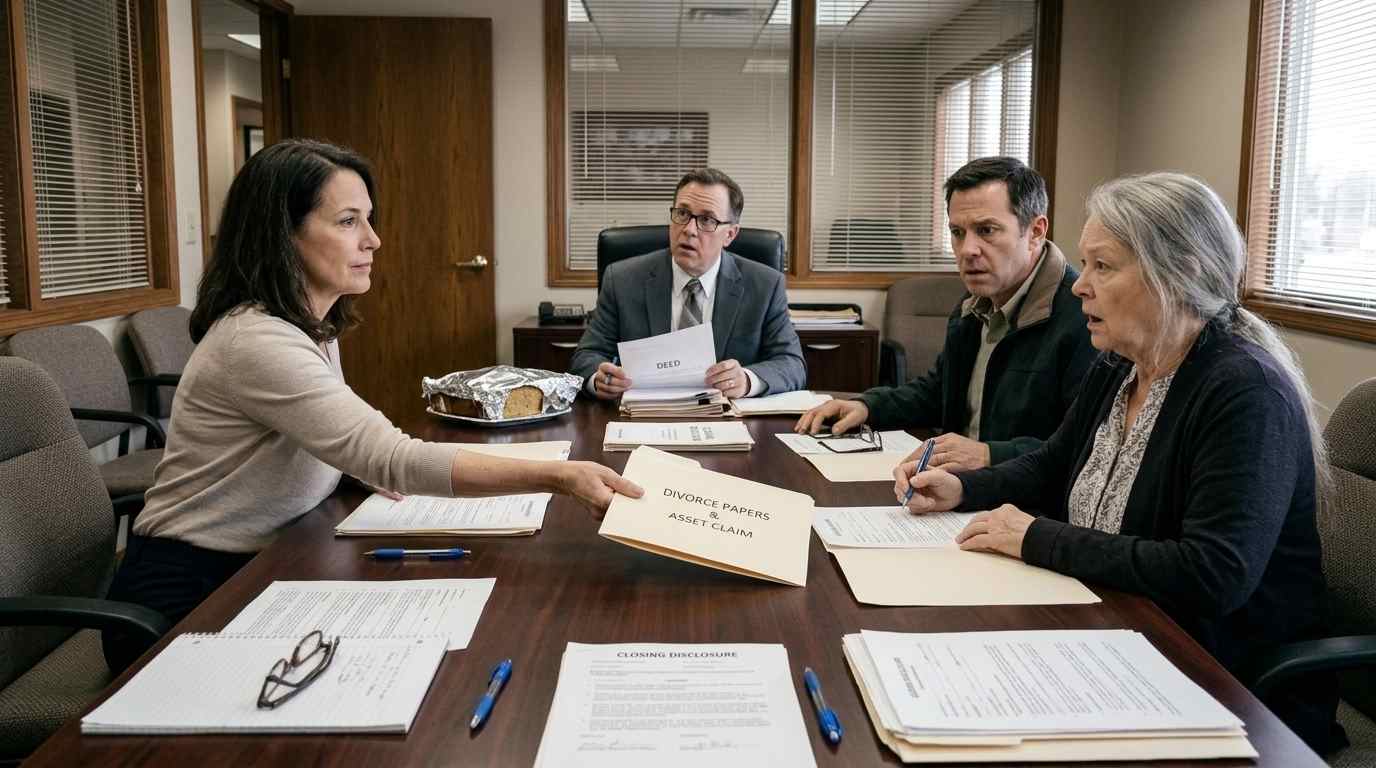
At the title office, his mother sat at the head of the long table in a lavender dress. Harvey’s sister had driven her down that morning.
“Mama wanted to see the place,” Harvey said, not looking at me.
“Of course she did,” I said.
Dorcas looked me up and down. She was wearing the pearl earrings Harvey gave her last Christmas, the ones I had picked out.
“You look nice, dear,” she said. “For your age.”
I set the cake on the side table and sat down. A tall woman from the title company laid out a stack of papers.
“Mrs. Whitley, your funds haven’t come in yet,” she said. “Did your bank send the wire?”
“Not yet,” I said.
Harvey’s head turned. “Lorene?”
“In a minute, honey.”
“We’ll start with the deed,” the woman said. “Mr. Whitley, Mrs. Whitley, and Mr. Whitley’s mother.”
Harvey cleared his throat. “Mama’s on there to keep it in the family. It’s just a formality, Lorene.”
“Is it,” I said.
His mother picked up the pen. Her hand shook a little, but she was smiling. She had waited three years to see that smile on her face.
“Before you sign, Mrs. Whitley,” I said, “there’s one more paper.”
I took my folder out of my purse and slid it across the shiny table. Not to Harvey or his mother, but to the closing woman. She opened it, read the first page, and turned to the second. Then she took off her reading glasses, looked straight at my husband, and said, “This deed gives your mother an ownership share today. It isn’t a formality, and Mrs. Whitley has not agreed to it.”
The first page in my folder was the signed purchase agreement for the one-bedroom, with my name alone as the buyer. The second showed that my bank had kept my funds where they were. The money for the two-bedroom condo had not been sent.
Harvey looked at the papers, then at me. His mother’s pen stayed in her hand.
“What’s this?” he asked.
“My offer on the one-bedroom next door. The seller accepted it yesterday.”
“You bought another condo?” His voice was low, but the whole table heard him.
“I made an offer. I haven’t closed yet.”
The woman from the title company looked from the folder to the deed. “I can’t complete this closing without Mrs. Whitley’s funds and her signature.”
Harvey pushed his chair back. “This is supposed to be our place.”
“It was,” I said. “Then you put your mother on the deed without asking me.”
He rubbed his bad knee, then stopped. “It’s just a formality.”
The closing woman kept her eyes on him. “It isn’t. Your mother would have an ownership interest as soon as the deed was recorded.”
Dorcas set the pen down. “Harvey told me you were all right with it.”
Harvey looked at her. “I said we were putting you on.”
“You said she knew,” his sister said. She had been quiet up to then, hands folded in front of her. “You told me she’d agreed. I asked you.”
Harvey looked down at the table. That was the first time his face showed anything besides irritation.
“I thought she’d come around,” he said.
“That isn’t the same as asking me,” I said.
His sister looked at me, then at Harvey. “You said she wouldn’t read anything. I should have called you, Lorene. I knew that was wrong.”
I was grateful she said it, and I was still angry with her. I didn’t let her apology make the decision for me.
Dorcas turned toward her son. “You told me it would be part of the family.”
“It is part of the family,” Harvey said. “That’s why I wanted it this way.”
“Whose family?” I asked.
He rubbed his palms together, the same way he had at supper when he said Friday was the day. “You have your children. I have Mama and my sister. I didn’t want them left out.”
The words sat between us. It was the explanation I had been waiting for, and it hurt more than any excuse could have. He had looked at the money from my house and thought of it as something he could use to make sure his side had a claim.
“My children aren’t strangers to me,” I said. “And you don’t get to give away part of what I paid for without asking.”
“Your money wasn’t all of it,” he said.
“No. You put in the rest. You could have asked me to make a plan together. You didn’t. You told your sister I wouldn’t read.”
He opened his mouth, then looked toward the title woman. She had taken her glasses off again and was sitting very still. Nobody at that table was going to pretend he hadn’t said it.
Dorcas touched the deed with two fingers. “I thought I was being included.”
“You were,” I said. “You were being included in a decision I hadn’t made.”
She lifted her chin. “Harvey said this would stay with us.”
“That is what he wanted,” I said. “It isn’t what I agreed to.”
I could feel my hands shaking under the table. I was furious, and part of me wanted to tell them all exactly what I thought. I also knew there was a cost to walking away. I had signed papers for the two-bedroom. I might lose money getting out of that agreement, and the one-bedroom offer was a risk until I had the keys.
I said it aloud. “I understand I may lose money by stopping this. I’m willing to take that chance.”
The closing woman nodded. “I’ll note that you aren’t authorizing the wire and aren’t signing this deed.”
Harvey leaned toward me. “Lorene, we can talk about this at home.”
“You had time to talk to me before adding your mother. You chose not to.”
He glanced at his sister. “You knew I was doing this.”
“I knew you were talking about it,” she said. “You told me Lorene was fine with it. I should have asked her myself.”
Harvey’s mouth tightened. “I was trying to help Mama.”
“Then you should have asked me,” I said again. My voice had begun to shake, so I stopped there.
The closing woman gathered the pages. She explained that without my funds and signature, the two-bedroom closing couldn’t go forward. I didn’t need her to tell me what the folder had already made clear. Harvey’s mother slid the pen back across the table.
Dorcas looked at me. “I didn’t know you hadn’t agreed.”
I believed she might not have known that part. She had still been ready to sign a deed that gave her an interest in a home she hadn’t paid for. I could feel sorry for her without handing her my share.
“I know,” I said. “But you can’t sign it today.”
Harvey stood. “You’re making this a bigger thing than it is.”
I looked at the deed. “The paper says what it says.”
I told the title woman I would not send the money. I asked her to give me the steps for withdrawing from the two-bedroom purchase in writing. I knew it could cost me. I also knew I couldn’t sit there and sign just to avoid an argument in front of his mother.
The meeting ended without a closing. Harvey drove me back. The pound cake stayed on the side table at the office. Neither of us sang along to the radio.
On the way, he tried again.
“You could have just told me you were upset.”
“I heard you tell your sister I wouldn’t read anything.”
“I didn’t mean it the way you took it.”
“How did you mean it?”
He gripped the steering wheel and stared ahead. “I thought you’d trust me.”
That was the part I was still struggling to understand. He wanted my trust, but he had counted on me not checking the deed.
I didn’t answer right away. I was too angry to say something I couldn’t take back. When we got home, I called the banker and asked him to keep helping me with the one-bedroom purchase. The offer was signed. My money was still mine. I wasn’t going to let Harvey’s decision take the other place away from me, too.
There was paperwork to finish, and I had to accept that walking away from the two-bedroom could cost me. I paid what I had to pay to get out of that agreement. The one-bedroom purchase went forward in my name alone. Harvey didn’t put in money toward it, and I didn’t put his name on the deed.
Before it was finished, Harvey asked if I would still let him live there.
I looked at him across the kitchen table. “I don’t know if I want to live with you right now.”
“I made a mistake.”
“You made a choice. You called it a formality because you thought I wouldn’t notice.”
He ran his thumb along the edge of the table. “Mama’s ninety-one. I thought I was doing right by her.”
“You could have talked to me.”
He had no answer for that. He sat there with the same face he had worn at the closing table when his sister told the truth.
The one-bedroom closed. My name was the only one on the deed. Harvey stayed with his sister for a while, and I moved into the condo by myself. I told him I wanted a divorce. He didn’t argue in front of me, and I didn’t ask him to change his mind.
The first evening there, I unpacked my good pearls and set them beside the keys. Then I cut a slice of lemon pound cake and ate it at the kitchen counter.
FINAL PART — THE HOME I CHOSE
The first evening in my new condo, I unpacked my good pearls and set them beside the keys. Then I cut a slice of lemon pound cake and ate it at the kitchen counter.
It was the first meal I had eaten in weeks without wondering what Harvey was thinking.
The condo was smaller than the place we had planned to share. There was no second bedroom for visiting grandchildren, no enormous dining table, and no extra closet for Harvey’s collection of old fishing equipment.
But there was a screened porch overlooking the lake.
And every inch of that little home belonged to me.
I was sixty-eight years old, and for the first time since Leroy died, I was beginning to understand the difference between being alone and being at peace.
Three weeks after I moved in, Harvey called.
“Lorene, we need to talk.”
“We’ve talked, Harvey.”
“Not about everything.”
I looked out at the lake. A pair of ducks drifted past the reeds, completely unconcerned with the problems of human beings.
“All right,” I said. “I’m listening.”
He hesitated.
“Mama’s upset.”
I almost laughed.
“Harvey, your mother was about to become an owner of a home she didn’t pay for. I think she’ll recover from the disappointment.”
“She’s ninety-one, Lorene.”
“And I’m sixty-eight. I don’t have another twenty years to spend pretending people are treating me fairly when they’re not.”
There was a long silence.
Then he said something I hadn’t expected.
“I went to see a lawyer.”
My hand tightened around the telephone.
“For what?”
“Because I wanted to know whether I had any claim to your new condo.”
I closed my eyes.
For one foolish moment, I had hoped he might say he had gone to a counselor, or a minister, or anyone who could help him understand what had happened to our marriage.
Instead, he had gone looking for another way into my property.
“And what did the lawyer tell you?”
Harvey cleared his throat.
“He said it depends on the circumstances. That marriage and property aren’t as simple as I thought.”
“Then I hope you listened carefully.”
“Lorene, I wasn’t trying to steal from you.”
“Then why did you ask whether you could claim the condo I bought after you tried to give your mother part of the first one?”
He didn’t answer.
That silence told me more than any explanation could have.
“Good night, Harvey.”
I hung up before he could respond.
The next morning, I made an appointment with a family-law attorney of my own.
I brought every document I could find: the sale of my old house, bank statements tracing my money, the abandoned purchase agreement, the paperwork for my new condo, and the documents from Leroy’s estate.
The attorney was a woman named Patricia Bell, about my daughter’s age, with silver-framed glasses and the reassuring habit of listening without interrupting.
When I finished explaining everything, she folded her hands.
“Mrs. Whitley, I’m glad you preserved these records. We need to review how the property was acquired, the source of the funds, and the law that applies here. Having the condo titled only in your name is important, but it doesn’t automatically settle every question in a divorce.”
I nodded.
“I don’t want anything that belongs to Harvey.”
“What do you want?”
I thought about that.
“To keep what is rightfully mine. And to stop being afraid that someone I love will use my trust against me.”
Her expression softened.
“Then we’ll start with the paperwork.”
Over the following months, I learned that standing up for yourself doesn’t always produce an immediate happy ending.
There were legal expenses. Difficult conversations. Nights when I missed Harvey so much that I nearly picked up the phone.
I missed the man who had danced the wrong direction with me at the senior center.
I missed the man who warmed my car on freezing mornings and brought me coffee when my knees hurt.
But I couldn’t stop remembering the other Harvey.
The man who laughed to his sister because he believed his wife wouldn’t read a document involving most of her savings.
Love could not erase that sentence.
One Sunday afternoon, my daughter, Rebecca, came to visit.
She was forty-two, with Leroy’s dark eyes and my stubborn chin. She brought homemade chicken salad and a vase of yellow chrysanthemums.
We sat on the screened porch watching sailboats cross the lake.
“Mom,” she said quietly, “why didn’t you tell me what was happening?”
“Because I thought I could handle it.”
“You did handle it.”
“I almost didn’t.”
She reached across the table and took my hand.
“You know what Dad used to say?”
I smiled despite myself.
“Your father said a great many things.”
“He said you were the strongest person he ever met, but that you had a terrible habit of mistaking kindness for obligation.”
I looked away.
That sounded exactly like Leroy.
Rebecca squeezed my fingers.
“You can be generous without giving people permission to take from you.”
I carried those words with me.
By early spring, the divorce was progressing. We exchanged financial information through our attorneys, reviewed the proposed settlement, and worked through the property questions without another scene in a conference room.
Harvey didn’t fight every point. He also didn’t give up every claim immediately. The process took longer than either of us wanted.
Then, one afternoon, an envelope arrived.
It wasn’t from an attorney.
The handwriting on the front was shaky but familiar.
Dorcas.
I sat at my kitchen counter for several minutes before opening it.
Inside was a single sheet of lavender stationery.
Lorene,
I’ve had a lot of time to think about what happened at that closing table.
Harvey told me you wanted my name on the deed because you knew I was getting old and wanted me to feel secure.
I believed him because he is my son, and because believing him suited me.
I should have questioned why you weren’t the one telling me.
I cannot pretend I have always been kind to you. I thought you were taking my son away from his family. I see now that I was willing to accept something that wasn’t mine, and I didn’t care enough to ask whether you truly wanted to give it.
I am sorry.
You don’t have to forgive me.
Dorcas.
I read that letter twice.
Then I folded it and placed it in the drawer beside the telephone.
I didn’t call her immediately.
An apology deserved consideration, but it did not require me to pretend nothing had happened.
A week later, I wrote back.
I thanked her for telling me the truth. I told her I hoped she remained healthy and comfortable. And I told her that forgiveness, for me, would mean no longer carrying the anger into every morning.
It would not mean changing my decision.
That summer, Harvey came to my condo one final time.
He called ahead, and I agreed to speak with him on the porch.
He looked older than I remembered. His hair was thinner, and he leaned more heavily on the cane he had once refused to use.
I offered him iced tea.
He accepted.
For a while, we watched the lake without speaking.
Finally, he said, “I was jealous of Leroy.”
I turned toward him.
“What?”
“Your first husband. Everything you had together. The house, the money, the children. I felt like I was living in a life somebody else had built.”
“Harvey, we were building something of our own.”
“I know that now.”
He stared into his glass.
“I thought if Mama’s name was on the condo, I’d have something that belonged to my side of the family. Something that couldn’t just go back to Leroy’s children someday.”
I felt the familiar ache return, but this time it didn’t swallow me.
“Rebecca and Thomas are my children, too,” I said. “Not just Leroy’s.”
“I know.”
“And you had a share in the home we planned. You were contributing your own money. We could have discussed how to protect both our interests.”
He nodded.
“I was ashamed to admit how much it bothered me.”
“So you tried to solve that feeling by making a decision for me.”
“Yes.”
It was the first time he had answered without making an excuse.
He looked up.
“I loved you, Lorene.”
“I believe you did.”
His eyes filled.
“Wasn’t that worth trying again?”
I looked across the water.
There had been a time when I would have said yes without thinking. I would have convinced myself that love meant accepting another apology, offering another chance, and finding another way to make everything comfortable for everyone else.
But I had changed.
“Love matters, Harvey,” I said gently. “But trust is what makes a home feel safe. When you decided I wasn’t entitled to know what was happening to my own money, you took that safety away.”
He wiped his eyes.
“I’m sorry.”
“I know.”
He stayed another ten minutes.
When he stood to leave, I walked him to the door.
He looked around the little living room, taking in the bookshelves, the photographs of my grandchildren, and the blue quilt my mother had sewn when I was young.
“You made it nice,” he said.
“Thank you.”
Then he smiled sadly.
“You always did know how to make a house feel like home.”
I smiled back.
“Yes, Harvey. I did.”
And for the first time, I understood that I had never needed someone else’s permission to do it.
The divorce was finalized that autumn. The signed settlement resolved our property disagreements, and I kept the condo.
I didn’t celebrate with champagne or a fancy dinner.
Instead, I invited Rebecca, Thomas, and all five grandchildren for Sunday lunch.
We crowded around a table that was too small. My youngest grandson spilled lemonade on the floor. Someone burned the rolls, and my daughter insisted the chicken needed more salt.
There was laughter in every room.
After everyone left, I stepped onto the porch with a cup of tea.
The sunset turned the lake a deep shade of copper.
I remembered how Harvey and I had once imagined sitting together, arguing over whether the water looked different every evening.
It did.
Sometimes the lake looked silver. Sometimes it looked blue. And on that particular evening, it looked like someone had scattered pennies across the surface.
I felt a pang of sadness for the future we had lost.
Then I felt something else.
Gratitude.
Not because Harvey had hurt me. Not because the marriage had ended.
But because when the moment came to decide whether I would protect myself, I had finally listened to the quiet voice inside me.
I thought about the closing table, Dorcas holding that pen, and Harvey insisting the deed was only a formality.
I thought about the folder in my purse.
Such a simple thing.
A few sheets of paper.
Proof of where my money was, what I had agreed to, and what I hadn’t.
Harvey had been right about one thing.
I had trusted him.
But he had made a terrible mistake when he assumed trusting him meant I would never think for myself.
I went inside, washed my teacup, and switched on the little lamp beside my favorite chair.
On the kitchen counter sat a fresh lemon pound cake.
This time, I hadn’t baked it for Harvey.
I’d baked it because I liked lemon pound cake, too.
And there was nobody left in my home who needed me to explain why.
MORAL OF THE STORY: Love should never require you to surrender your voice, your security, or your right to make decisions about your own future. Trust is a gift, not permission to deceive. Sometimes the strongest thing a person can do is walk away from a future they once dreamed of, because they finally understand they deserve a peaceful one.