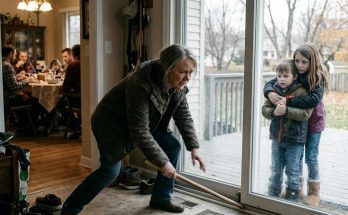
MY SON-IN-LAW SMIRKED AT SUNDAY DINNER AND SAID, “I FINALLY TAUGHT YOUR DAUGHTER HOW TO BEHAVE.” THEN I NOTICED HER BROKEN ARM, MADE ONE PHONE CALL, AND WATCHED HIS SMILE DISAPPEAR.
PART 1: THE SUNDAY DINNER THAT CHANGED EVERYTHING
For sixty-three years, I had believed that the most frightening thing a mother could hear was her child calling for help.
I was wrong.
Sometimes the most frightening thing is hearing nothing at all.
No phone calls. No laughter. No familiar voice asking whether you have enough groceries or reminding you to take your medicine.
Just silence.
And when that silence comes from a daughter who has spent her entire life telling you everything, you begin to understand that something is terribly wrong.
My name is Catherine Miller, and I live in a quiet neighborhood outside Columbus, Ohio.
I lost my husband, Robert, six years ago after thirty-eight years of marriage. Since then, my only daughter, Emily, had become the brightest part of my days.
She was thirty-four, worked as an elementary school teacher, and had been married to a man named Daniel Carter for seven years.
When Emily was little, she followed me everywhere.
She sat beside me while I folded laundry, helped me plant flowers in the garden, and insisted on holding my hand whenever we crossed a parking lot.
Even after she grew up and married, our closeness never changed.
Every Friday afternoon, she called.
“Mom, are you coming for Sunday dinner? I’m making your favorite roast.”
And every Sunday, I arrived with dessert.
Sometimes an apple pie.
Sometimes lemon cake.
Sometimes nothing more than a loaf of homemade bread.
But I always arrived.
And Emily always greeted me with a smile.
At least, she used to.
Everything began changing about two months before that unforgettable Sunday.
The Friday calls stopped.
At first, I didn’t worry.
Emily was busy with school, and Daniel had recently received a promotion at the construction company where he worked.
I assumed they were adjusting to new schedules.
But after two weeks, I called her myself.
“Sweetheart, I haven’t seen you lately. Is everything all right?”
“Of course, Mom.”
Her answer came too quickly.
“Are you sure?”
“Yes. I’ve just been exhausted. Work is crazy.”
I could hear a television playing in the background.
Then a man’s voice.
Daniel.
“Emily, who are you talking to?”
“My mom.”
There was a pause.
Then Emily said, “I have to go. I’ll call you tomorrow.”
She hung up.
She didn’t call the next day.
Or the day after.
The following week, I tried again.
This time, she answered in a whisper.
“Mom, I can’t talk right now.”
“Are you sick?”
“No.”
“Is Daniel there?”
Another pause.
“Yes.”
“Emily, honey, what’s going on?”
“Nothing. Please don’t worry.”
Then she said something that stayed with me.
“Mom, if I ever need you, you’ll come, right?”
My heart tightened.
“Of course I will.”
“Even if it’s inconvenient?”
“Emily, there is nothing in this world more important to me than you.”
She made a small sound, almost like a sob.
Then the call ended.
That evening, I sat at my kitchen table, staring at my phone.
Something was wrong.
I knew it as surely as I knew my own name.
But knowing something is wrong and understanding what to do about it are two very different things.
I didn’t want to push Emily away by accusing her husband without evidence.
I also didn’t want to become the kind of mother who interfered in every disagreement between a married couple.
So I waited.
And I watched.
A few days later, Emily stopped by my house unexpectedly.
She stayed less than fifteen minutes.
She wore a long cardigan despite the warm weather, and she seemed unusually nervous.
When I offered to make tea, she glanced at the clock.
“I can’t stay.”
“Why not?”
“Daniel’s expecting me.”
“You’re allowed to have tea with your mother.”
She forced a smile.
“Of course I am.”
But she didn’t sit down.
As she reached for her purse, her sleeve slipped back.
I noticed a faint discoloration near her wrist.
“What’s that?”
She pulled the sleeve down.
“Oh, nothing. I bumped into a door.”
I looked at her.
“Emily.”
“I’m fine, Mom.”
Her eyes filled for the briefest moment.
Then she hugged me.
It was not her usual quick embrace.
She held me tightly, as though she were afraid to let go.
“I love you,” she whispered.
“I love you too, sweetheart.”
Then she left.
I watched her car disappear down the street.
For the first time since her wedding, I felt afraid of the home she was returning to.
Three days later, I called an old friend.
Margaret Ellis.
Margaret and I had known each other for nearly forty years.
We met when our children attended the same elementary school, and we remained close through birthdays, marriages, illnesses, and funerals.
Margaret had spent most of her career practicing family law.
Although she was retired, she volunteered with a local organization that helped people experiencing domestic abuse.
I told her what I had noticed.
She listened carefully.
Then she asked, “Has Emily told you Daniel is hurting her?”
“No.”
“Has she asked to leave?”
“No.”
“Then don’t corner her with accusations, Catherine. If she’s frightened, pressure may make her retreat.”
I swallowed.
“What should I do?”
“Keep the door open. Let her know she can come to you without judgment. And if she tells you she’s in danger, help her reach people who can protect her.”
I rubbed my forehead.
“I feel useless.”
“You’re not useless. You may be the one person she still believes she can trust.”
Those words gave me a little hope.
Two days later, Emily called.
“Mom?”
I nearly dropped my coffee.
“Sweetheart!”
“Would you like to come over Sunday?”
I closed my eyes with relief.
“I would love to.”
“I’m making roast.”
“Then I’ll bring apple pie.”
There was a small pause.
“Mom?”
“Yes?”
“Please don’t be upset if things seem different.”
My smile faded.
“What do you mean?”
“Nothing. I’ll see you Sunday.”
Before I could ask another question, she ended the call.
I spent Saturday baking.
I made her favorite apple pie, using the same recipe my mother had given me forty years earlier.
As the kitchen filled with cinnamon and butter, I tried to convince myself that everything would be fine.
Perhaps Emily and Daniel had been arguing.
Perhaps his promotion had created stress.
Perhaps I was imagining dangers that weren’t there.
But on Sunday afternoon, when I pulled into their driveway at 5:25, those explanations disappeared.
Daniel’s truck was parked crookedly across the driveway.
Beside it stood his mother’s expensive black SUV.
I recognized the license plate immediately.
Patricia Carter.
My daughter’s mother-in-law.
Patricia had never hidden her opinion that marriage worked best when a woman knew her place.
At Emily’s wedding, she had told me that my daughter was fortunate to marry a man who would “keep her from becoming too independent.”
I had laughed politely at the time.
I wasn’t laughing now.
I carried the warm pie toward the front door.
Before I knocked, I heard voices.
Patricia was speaking.
“Well, she finally learned, didn’t she?”
A man laughed.
Daniel.
“She certainly won’t try that again.”
My steps slowed.
Then Patricia said something that made my blood run cold.
“Sometimes a woman needs a firm reminder of who’s in charge.”
I stood frozen with my hand inches from the door.
Before I could move, the door opened.
Patricia stood in front of me.
Her smile vanished.
“Oh. Catherine.”
“Hello, Patricia.”
“You’re early.”
I glanced at my watch.
“Five minutes.”
She looked over her shoulder.
For a moment, she seemed uncertain whether to let me inside.
Then she stepped aside.
“Well, come in.”
I entered the house I had visited dozens of times.
But it no longer felt familiar.
The curtains were drawn.
The television was playing loudly.
There were four plates on the dining table.
And my daughter was sitting in the chair nearest the kitchen, looking as though she wanted to disappear.
She wore a loose gray sweater.
Her hair was pulled back carelessly.
Her face was pale.
But none of those things frightened me as much as what I saw next.
Her left arm was secured in a sling.
There was a fading bruise near her cheekbone.
And when she noticed me, she didn’t smile.
She looked terrified.
“Emily?”
She lowered her eyes.
“Hi, Mom.”
I placed the apple pie on the counter.
My hands felt strangely calm.
“What happened to your arm?”
Daniel leaned back in his chair.
“She fell.”
His tone was casual.
Almost amused.
I looked at Emily.
“Sweetheart?”
She didn’t answer.
Patricia gave a dismissive laugh.
“Don’t make such a fuss. She’s fine.”
I turned toward her.
“Her arm is in a sling.”
“Women can be terribly dramatic about little accidents.”
Daniel smirked.
“She understands the rules now.”
Something inside me tightened.
“What rules?”
He shrugged.
“Marriage rules.”
Patricia nodded approvingly.
“My son works very hard. He deserves respect in his own home.”
I looked at Emily.
Her eyes remained fixed on her plate.
“Emily, please look at me.”
She slowly raised her head.
I saw fear.
Not embarrassment.
Not annoyance.
Fear.
And in that moment, I knew this was not an ordinary disagreement.
I pulled out the chair beside her.
“May I sit here?”
She nodded.
I sat down and gently took her uninjured hand.
Her fingers were cold.
“Does your arm hurt?”
“A little.”
“Have you seen a doctor?”
“Yes.”
“Did they take an X-ray?”
She nodded again.
Daniel sighed.
“Catherine, you’re turning this into a medical interrogation.”
I ignored him.
“Was anything broken, Emily?”
Her lips trembled.
“My wrist.”
I felt as though someone had struck me in the chest.
“A broken wrist?”
Daniel rolled his eyes.
“She’s exaggerating. It’s a small fracture.”
Patricia reached for her wineglass.
“Honestly, Catherine, your daughter has always been rather stubborn. Daniel has been incredibly patient.”
I turned toward her.
“Patient?”
“Yes. Marriage requires discipline. A woman can’t challenge her husband every time she disagrees with him.”
I looked at Daniel.
He was watching me with a faint smile.
Almost daring me to object.
Then he said the sentence I will remember for the rest of my life.
“Don’t worry, Catherine. I’ve finally taught your daughter how to behave.”
The room fell silent.
I looked at my daughter.
She was crying without making a sound.
And suddenly I understood why the Friday phone calls had stopped.
Why she always hurried home.
Why she had asked whether I would come if she needed me.
She had been afraid.
And the people sitting around her were treating that fear like an accomplishment.
I wanted to scream.
I wanted to drag my daughter out of that house.
I wanted Daniel to understand every ounce of pain he had caused.
But I remembered Margaret’s warning.
Don’t make her less safe.
So I took a slow breath.
Then I asked Emily one quiet question.
“Sweetheart, do you want to come home with me tonight?”
She looked at Daniel.
That single glance told me almost everything.
Daniel laughed.
“She’s not going anywhere.”
I kept my attention on Emily.
“I’m asking her.”
Patricia pushed back her chair.
“This is ridiculous.”
Daniel’s smile disappeared.
“She’s my wife.”
“And she’s my daughter,” I replied.
“She’s staying here.”
Emily began shaking.
“Mom, please.”
I squeezed her hand.
“Look at me, honey.”
She did.
“You don’t have to explain anything right now.”
Tears rolled down her cheeks.
“I don’t want anybody getting hurt.”
The words broke my heart.
I reached into my purse and took out my phone.
Daniel chuckled.
“What are you doing? Calling the police?”
I looked at him.
“I’m calling someone who knows how to help.”
Patricia frowned.
“Who?”
I didn’t answer.
Instead, I opened a message thread with Margaret.
Earlier that afternoon, I had told her I was visiting Emily and that I might need advice afterward.
Now I sent a short message.
I’m at Emily’s house. She has a broken wrist, visible bruising, and appears frightened. Daniel is refusing to let her leave. Please call me.
Margaret called almost immediately.
I answered in front of everyone.
“Catherine?” she asked.
“Yes.”
“Are you safe?”
“For the moment.”
“Is Emily with you?”
“Yes.”
“Can she speak privately?”
I looked at my daughter.
“Not yet.”
Margaret was silent for a second.
Then she said, “I’m going to help you contact the right people. Don’t escalate anything. If anyone is in immediate danger, call emergency services.”
I nodded.
“Thank you. I’ll speak to you soon.”
I ended the call.
Daniel stared at me.
“What was that?”
“A conversation.”
“With whom?”
“An old friend.”
Patricia laughed nervously.
“You really think bringing outsiders into a family disagreement is appropriate?”
I looked at her.
“A broken wrist isn’t a family disagreement.”
Daniel stood up so quickly his chair scraped against the floor.
“You need to leave.”
Emily flinched.
I stood slowly.
“If that’s what Emily wants, I’ll go.”
Daniel pointed toward the door.
“I’m telling you to leave.”
I turned to Emily.
“Honey, I love you. My door is open. Day or night.”
Her lips moved.
I barely heard the words.
“I know, Mom.”
I leaned close enough to whisper.
“You don’t have to decide anything to protect my feelings. I want you safe.”
She squeezed my hand.
Then she released it.
I picked up my purse.
Daniel followed me toward the hallway.
“Don’t interfere in my marriage again.”
I stopped.
For several seconds, we looked at each other.
Then I said, “You seem very confident that nobody will ever ask what happened to her.”
His expression changed.
“You’d better be careful.”
I nodded.
“I intend to be.”
I opened the door and walked outside.
But I didn’t drive home.
I parked a short distance away, where I could see the house, and called Margaret again.
This time, my hands were shaking.
“Margaret,” I whispered, “I think he’s hurting her.”
My friend listened as I described everything.
Then she asked me to repeat Daniel’s exact words.
When I finished, she said quietly, “Catherine, we need to focus on Emily’s safety. And we need to find out whether she’s ready to accept help.”
I began crying.
“She was so frightened.”
“I know.”
“Her wrist is broken.”
“I know.”
“What if I leave and something happens to her?”
Margaret’s voice remained steady.
“We’ll take this seriously. But we must do it carefully.”
Then she asked a question.
“Did Emily give you any sign that she wants to leave?”
I thought about the phone call.
If I ever need you, you’ll come, right?
I remembered the way she squeezed my hand.
The way she looked toward Daniel before answering.
And I remembered something else.
When I was leaving, Emily had slipped a folded piece of paper into the pocket of my coat.
At the time, I barely noticed.
Now I reached into my pocket.
My fingers found it.
I unfolded the paper beneath the streetlight.
There were only seven words.
Mom, please come back. Don’t come alone.
I pressed the paper against my chest.
“Margaret,” I whispered, “she wants help.”
My friend answered immediately.
“Then we’re going to help her.”
I looked across the street.
A shadow moved behind Emily’s living-room curtains.
Then the lights went out.
And just as I reached for my car door, my phone vibrated.
A message from Emily.
Mom, he found out I kept the photographs.
Another message followed.
He’s coming upstairs.
Then one final message appeared.
Please hurry.
PART 2: THE NIGHT MY DAUGHTER FINALLY CAME HOME
I have lived through the death of my husband, the loss of both parents, and more difficult years than I care to count.
But nothing had ever frightened me as much as those three messages from my daughter.
He found out I kept the photographs.
He’s coming upstairs.
Please hurry.
For several seconds, I couldn’t breathe.
I sat in my parked car, staring at the screen.
Then I called Margaret.
“She’s asking for help,” I said. “And Daniel knows she’s been keeping evidence.”
Margaret didn’t waste time.
“Catherine, call 911. Tell them what Emily has written and what you witnessed. Do not go inside alone.”
I made the call.
I told the dispatcher my daughter’s address.
I described the broken wrist, the bruise, Daniel’s statements, and the message asking me to return.
The dispatcher asked whether I knew if Emily was in immediate danger.
“I don’t know,” I answered, struggling to control my voice. “But she’s frightened, and her husband has refused to let her leave.”
I was told officers would respond.
Then I called Emily.
No answer.
I called again.
Nothing.
I sent a message.
I’m nearby. Help is coming. You are not alone.
The message showed as delivered.
But there was no reply.
Across the street, the house remained dark.
I watched the windows.
Every second felt impossibly long.
At 8:17 that evening, headlights appeared at the end of the road.
A police vehicle slowed in front of Emily’s house.
Another arrived shortly afterward.
Margaret pulled up behind my car.
She stepped out and walked toward me.
I hadn’t seen my friend look so serious in years.
“Where is she?”
“Inside.”
“Have you heard from her?”
“Not since the messages.”
Margaret put a hand on my shoulder.
“You did the right thing calling.”
“I should have done something months ago.”
“Catherine, focus on what you can do now.”
We approached only after an officer came over to speak with us.
I showed him the messages.
Then I told him everything that happened at dinner.
The officer listened carefully.
“Does your daughter have any other injuries you’re aware of?”
“Her wrist is fractured. There’s a bruise on her cheek. I don’t know what else.”
“Has she told you how those injuries happened?”
“Not directly. But her husband said he taught her how to behave, and his mother suggested she needed discipline.”
He wrote down my words.
Then he asked me to remain outside while officers spoke with the people inside.
I watched them knock.
For a while, nothing happened.
Then the porch light came on.
Daniel opened the door.
He was smiling.
At first.
I couldn’t hear every word from where I stood, but I saw him gesture casually toward the living room.
He seemed to be explaining something.
Then he looked past the officers.
He saw me.
His smile vanished.
Even from across the driveway, I could see the anger in his face.
He pointed toward me.
One officer raised a hand and asked him to remain where he was.
Patricia appeared behind Daniel.
She folded her arms and began speaking rapidly.
I could imagine the explanation.
A misunderstanding.
An overprotective mother.
A daughter who was clumsy and emotional.
But I had seen Emily’s eyes.
And no explanation could erase what I had seen.
After several minutes, one officer entered the house.
Another remained near Daniel.
Then Emily appeared in the doorway.
Her face was pale.
She still wore the sling.
But she was standing.
When she saw me, she began crying.
“Mom!”
I stepped forward instinctively.
An officer asked me to give them a moment so he could speak privately with her.
I stopped.
Emily looked at me.
I placed my hand over my heart.
“I’m here, sweetheart.”
She nodded.
Then she went with the officer to speak away from Daniel and Patricia.
I learned later what happened during that conversation.
At first, Emily struggled to explain anything.
She kept saying she didn’t want Daniel to get into trouble.
She worried about their home.
Their finances.
Her job.
What his parents would say.
Whether anyone would believe her.
Then the officer asked a simple question.
“Emily, do you feel safe staying here tonight?”
She began crying.
And finally, she said no.
That one word changed the evening.
She told the officer that Daniel had grabbed her during an argument several weeks earlier and that she had fallen, injuring her wrist.
She admitted the bruise on her cheek came from another incident.
She explained that she had been frightened to tell me because Daniel repeatedly threatened to ruin her reputation if she left.
And she revealed something I hadn’t known.
This had been happening far longer than two months.
For nearly a year, Daniel had been controlling her movements.
He checked her phone.
He questioned her whenever she stayed late at school.
He demanded access to her personal email.
He criticized her clothing, her friends, and the time she spent with me.
Whenever she challenged him, he became furious.
Then afterward, he apologized.
He bought flowers.
He promised to change.
Sometimes he cried and claimed he was terrified of losing her.
Emily wanted to believe him.
She loved the man she had married.
She remembered the Daniel who once made breakfast on Saturday mornings and drove across town to bring her medicine when she was sick.
She kept hoping that man would return.
But the apologies grew shorter.
The restrictions grew worse.
And eventually, she began arranging her entire life around avoiding his anger.
The broken wrist had frightened her enough to start documenting what was happening.
She photographed injuries.
She saved threatening messages.
She made copies of records from medical appointments.
Then she reached out to a domestic violence support service during her lunch break at school.
She had been quietly preparing to leave.
That was why she invited me to dinner.
She hoped I might see something wrong.
She hoped I would give her a chance to ask for help.
But when Daniel and Patricia began boasting about the way he treated her, she panicked.
She feared what he might do after I left.
So she slipped the note into my coat pocket.
Mom, please come back. Don’t come alone.
When the officer finished speaking with Emily, she returned to the doorway.
I walked toward her.
She stepped into my arms.
For a long time, she simply cried.
“I’m sorry, Mom.”
I held her gently, careful of her injured wrist.
“Sweetheart, you have nothing to apologize to me for.”
“I should have told you.”
“You told me when you could.”
“I thought I could make him stop.”
I kissed her forehead.
“Oh, Emily.”
Behind us, Daniel was speaking with an officer.
His voice had grown louder.
“This is ridiculous! She’s my wife!”
Emily stiffened.
I felt her entire body react to his voice.
An officer noticed.
He calmly asked Daniel to remain apart from her.
Patricia stepped forward.
“Emily, stop this foolishness!”
My daughter turned.
Her mother-in-law stood near the doorway, looking more offended than worried.
“Do you have any idea what you’re doing to this family?” Patricia demanded.
Emily’s hand tightened around mine.
For a moment, I thought she might retreat.
Then she looked directly at Patricia.
“I’m going home with my mother.”
Patricia stared at her.
“You are home.”
Emily shook her head.
“No. I live here. But I haven’t felt at home here in a long time.”
Those words silenced Patricia.
Daniel attempted to approach.
An officer stopped him.
“Emily,” he called, “come on. We can talk about this.”
She didn’t answer.
“Don’t throw away seven years over one argument.”
Still, she said nothing.
Then he tried another approach.
“You know I love you.”
My daughter looked toward him.
And in a voice so quiet I almost missed it, she answered.
“Love shouldn’t make me afraid to come home.”
That was the first time I had heard her challenge him in months.
Daniel’s face tightened.
But Emily didn’t wait for his reply.
She turned away.
With the officers’ assistance and after discussing her safety, she collected essential belongings.
A small suitcase.
Her wallet.
Identification.
Medication.
Her laptop.
A folder of important documents.
And one framed photograph of her father.
That photograph nearly broke me.
Robert had died when Emily was twenty-eight.
He had adored her.
At her wedding, he cried while walking her down the aisle.
I remembered him placing her hand in Daniel’s and whispering, “Take care of my girl.”
He had meant those words as a blessing.
Not permission for anyone to control her.
When Emily returned carrying the photograph, she held it against her chest.
“Dad would be disappointed in me,” she whispered.
I looked at her.
“No, sweetheart.”
She began crying again.
“He would be heartbroken that you were hurt. But he would be proud that you found a way to ask for help.”
She leaned into me.
And together, we walked toward my car.
Daniel remained behind.
The officers continued their investigation.
In the weeks that followed, the evidence Emily provided helped authorities review the reported incidents and pursue charges related to the assault.
But that night, I wasn’t thinking about charges.
Or divorce.
Or what would happen to Daniel.
All I cared about was that my daughter was sitting safely beside me.
For the first time in months, she was coming home.
The drive was quiet.
Emily stared through the passenger window.
Her suitcase rested in the back seat.
The photograph of Robert lay carefully across her lap.
Halfway home, she whispered, “Mom?”
“Yes, honey?”
“Are you angry with me?”
I glanced toward her.
“Why would I be angry?”
“For hiding it.”
I pulled into a quiet parking area and stopped the car.
Then I turned toward her.
“Emily, look at me.”
She did.
“I wish I’d known sooner because I wish you hadn’t suffered alone. But I am not angry with you for being frightened.”
She wiped her eyes.
“I feel stupid.”
“You’re not stupid.”
“I used to think I was strong.”
“You are strong.”
She shook her head.
“Strong women don’t let things like this happen.”
I felt my heart ache.
“Sweetheart, strength isn’t measured by whether someone hurts you. It’s measured by what you keep finding the courage to do afterward. And asking for help took courage.”
She looked down at her father’s photograph.
For several moments, she said nothing.
Then she whispered, “I thought leaving meant I’d failed at marriage.”
I reached across the console and took her hand.
“Leaving a relationship where you’re being hurt isn’t a failure.”
She leaned toward me.
And for a long moment, we cried together.
When we finally arrived at my house, I opened the front door.
Emily stepped inside.
She looked around the familiar living room.
The same family photographs lined the mantel.
The same old clock ticked above the fireplace.
Robert’s favorite chair still stood beside the window.
For a moment, she looked like a little girl returning home after a difficult day at school.
“Can I sleep in my old room?” she asked.
I smiled through my tears.
“Of course.”
She walked upstairs.
I followed with her suitcase.
Her old bedroom was almost unchanged.
There was a pale blue quilt on the bed.
A bookshelf filled with childhood novels.
A photograph from her college graduation.
And a small wooden sign Robert had made for her eighteenth birthday.
It read:
No matter how far you go, you will always have a place to come home.
Emily stood in front of it.
Then she started crying again.
I held her until the tears slowed.
That night, I made her tea.
She barely touched it.
She was exhausted.
She sat on the edge of the bed, looking uncertain.
“Mom?”
“Yes?”
“Could you leave the hallway light on?”
I felt tears sting my eyes.
“Of course, honey.”
I left the light on.
Then I sat outside her bedroom for a while, listening to the quiet.
For the first time in months, the silence didn’t frighten me.
It meant she was resting.
The following weeks were difficult.
Emily met with an attorney and began divorce proceedings.
She worked with a victim advocate on a safety plan and obtained legal protection through the court.
She attended follow-up medical appointments for her wrist.
She also began counseling.
Some mornings, she seemed hopeful.
Other mornings, she cried over breakfast.
Sometimes she said she missed Daniel.
That was one of the hardest things for me to hear.
But Margaret reminded me that leaving an abusive marriage doesn’t erase years of attachment overnight.
Emily was grieving the marriage she believed she had, not simply the one she had escaped.
So I listened.
When she cried, I sat beside her.
When she became angry, I let her speak.
When she felt embarrassed, I reminded her that she didn’t owe anyone a perfect explanation for what had happened.
I learned not to rush her recovery.
One afternoon, she came downstairs holding her phone.
“Daniel sent me an email.”
My stomach tightened.
“What did he say?”
“He says he’s changed. He says he’ll go to counseling. He wants another chance.”
I looked at her carefully.
“What do you want?”
She stared at the screen.
Then she said, “I want to believe him.”
I nodded.
“I understand.”
She looked surprised.
“You’re not going to tell me what to do?”
“No. But I will remind you what you’ve told me about how you were treated. And I hope you’ll talk to your lawyer and counselor before making any decisions.”
She sat beside me.
“I miss the person he used to be.”
I took her hand.
“I know.”
She stared at the email.
Then she opened the folder containing the photographs and messages she’d saved.
For several minutes, she looked through them.
Finally, she placed the phone on the table.
“I think I’ve been remembering the good days because the bad ones are too painful.”
I didn’t answer.
She was beginning to reach her own conclusions.
And those would matter far more than anything I could force her to believe.
By the end of the third month, something began to change.
Emily started sleeping better.
She returned to work with support from her school.
She reconnected with friends she hadn’t seen in nearly a year.
She laughed at dinner.
Not every day.
Not all the time.
But enough that I began recognizing my daughter again.
One Saturday morning, I found her in the backyard.
She was kneeling beside the flower bed, pulling weeds.
Her sling was gone.
Her wrist had healed enough for light activity.
I stood on the porch watching her.
She looked up and smiled.
“Mom, your roses need help.”
I laughed.
“They’ve needed help for years.”
She wiped her forehead.
“Dad would have had this garden looking beautiful by now.”
“He certainly would.”
She looked toward the old rosebush near the fence.
“Remember when I was little and he planted that for your anniversary?”
I nodded.
“Your father insisted it would bloom forever.”
Emily smiled.
“Maybe he was right.”
Then she looked at me seriously.
“Mom, can I ask you something?”
“Anything.”
“Did you know?”
I felt my stomach tighten.
“Know what?”
“That Daniel was hurting me.”
I sat beside her on the garden bench.
“I suspected something was wrong. I saw changes. I saw you pulling away. But I didn’t know how bad it had become.”
She lowered her eyes.
“I thought I was hiding it well.”
“You were trying to survive a situation that frightened you.”
She leaned against my shoulder.
“I wish I’d told you sooner.”
I looked toward the roses.
“Me too, sweetheart. But I’m grateful you told me at all.”
She was quiet for a while.
Then she said something I never forgot.
“I used to think courage meant never being afraid.”
I smiled.
“What do you think now?”
“I think courage means being afraid and still choosing to protect yourself.”
I kissed the top of her head.
“Your father would have liked that answer.”
Summer arrived.
Then autumn.
The divorce process continued, along with the criminal case arising from the reported assault.
There were hearings, documents, difficult conversations, and days when Emily felt emotionally drained.
Patricia sent angry messages through various family members, blaming me for the marriage falling apart.
I didn’t respond.
Emily eventually asked her attorney about restricting unwanted contact.
Daniel’s control over her life ended not through one dramatic confrontation, but through many difficult steps, legal boundaries, support, and her own decisions.
Then, almost a year after that Sunday dinner, Emily called me on a Friday afternoon.
I was standing in the grocery store, deciding whether to buy apples or peaches.
“Mom?”
“Hello, sweetheart.”
“Are you busy Sunday?”
I smiled.
“Not especially.”
“Would you like to come over for dinner?”
I stopped walking.
Emily had recently moved into a small townhouse ten minutes from mine.
It wasn’t fancy.
The kitchen was narrow, the backyard needed work, and the living-room carpet had seen better days.
But it was hers.
A place where she could lock the door, sleep peacefully, and make her own decisions.
“I’d love to,” I said.
“I’m making roast.”
I swallowed.
“Your favorite?”
“Yours.”
I laughed.
“Should I bring anything?”
There was a pause.
Then she answered.
“Apple pie?”
I stood in the grocery store smiling like a fool.
“I’ll bring two.”
Sunday afternoon, I drove to her townhouse.
The windows were open.
Sunlight filled the living room.
Music played softly from the kitchen.
And when Emily opened the door, she was smiling.
A real smile.
Not the frightened expression I’d seen at Daniel’s house.
Not the exhausted smile she had forced during those early weeks of recovery.
This one reached her eyes.
“Mom!”
She hugged me.
I hugged her back.
Then I carried the pies inside.
The table was set for four.
Emily had invited Margaret and a close friend from work.
As we sat down, I noticed something that nearly brought me to tears.
Everyone was talking.
Laughing.
Interrupting one another.
Nobody was watching Emily for signs of disapproval.
Nobody was correcting the way she spoke.
Nobody was telling her how a wife should behave.
She reached for the potatoes.
Then she laughed at a joke Margaret made.
A simple, ordinary moment.
But after everything we’d been through, it felt extraordinary.
Before dinner, Emily raised her glass.
“I want to say something.”
Everyone looked at her.
She turned toward me.
“Last year, my mom came to my house carrying an apple pie.”
I smiled.
She continued.
“I was scared. I thought my whole life was over. I thought nobody would understand why I’d stayed so long.”
Her eyes filled.
“But Mom looked at me and saw what I couldn’t say.”
I reached for her hand.
Emily took a breath.
“She made one phone call. And that phone call helped me get the support I needed.”
She looked at Margaret.
“And there were people who showed me that I had choices.”
Then she turned back toward me.
“Thank you for coming back, Mom.”
My throat tightened.
“I’ll always come back when you need me.”
Emily shook her head gently.
“I know. But I think you taught me something even bigger.”
“What was that?”
“That asking for help doesn’t make me weak. And that I don’t have to stay where I’m afraid just because I once promised someone forever.”
I couldn’t speak.
She squeezed my hand.
Then she smiled.
“Now, can we eat before the roast gets cold?”
Everyone laughed.
And the evening continued.
We ate.
We talked.
We remembered Robert.
We made plans for the holidays.
When dinner ended, Emily walked me to my car.
The sky was turning pink.
Autumn leaves drifted across the driveway.
She hugged me one more time.
“Mom?”
“Yes?”
“Do you remember what Daniel said that night?”
I sighed.
“I remember.”
“He said he’d finally taught me how to behave.”
I looked at her.
She smiled faintly.
“For a long time, I kept hearing those words in my head.”
I squeezed her hand.
“And now?”
She looked toward her little townhouse.
The warm lights glowing through its windows.
The flowers she’d planted near the front steps.
The life she was building.
“Now I think about what I learned instead.”
“What’s that?”
She looked directly at me.
“That nobody has the right to frighten me into obedience and call it love.”
My eyes filled.
She hugged me again.
Then she walked back toward her front door.
I watched until she stepped inside.
For years, I had believed that being a good mother meant protecting my daughter from every hardship.
But life had taught me otherwise.
I couldn’t prevent every cruel person from entering her world.
I couldn’t make every choice for her.
And I couldn’t heal every wound.
What I could do was believe her.
Listen without judgment.
Help her find support.
And remind her that she never had to earn the right to be safe.
That night, when I got home, I placed the empty pie dish in the kitchen sink.
Then I looked at the photograph of Robert on the mantel.
“She’s going to be all right,” I whispered.
I imagined him smiling.
And for the first time in a very long time, I felt at peace.
Because my daughter hadn’t simply left a painful marriage.
She had begun finding herself again.
And sometimes, the greatest victory in a mother’s life isn’t watching her child become successful, wealthy, or admired.
Sometimes it’s something much simpler.
Watching her daughter sit at her own dinner table, surrounded by people who love her, without being afraid to speak.
THE END! THANK YOU FOR READING! ❤️
MORAL OF THE STORY: Love should never require someone to live in fear. Abuse is not discipline, control is not respect, and marriage does not give anyone ownership over another person. When someone finds the courage to ask for help, believing them and supporting their safety can make all the difference. Walking away from harm is not a failure—it can be the beginning of a new life.
❤️ Follow Our Page for More Emotional Family Stories, Powerful Life Lessons, and Unforgettable Endings!