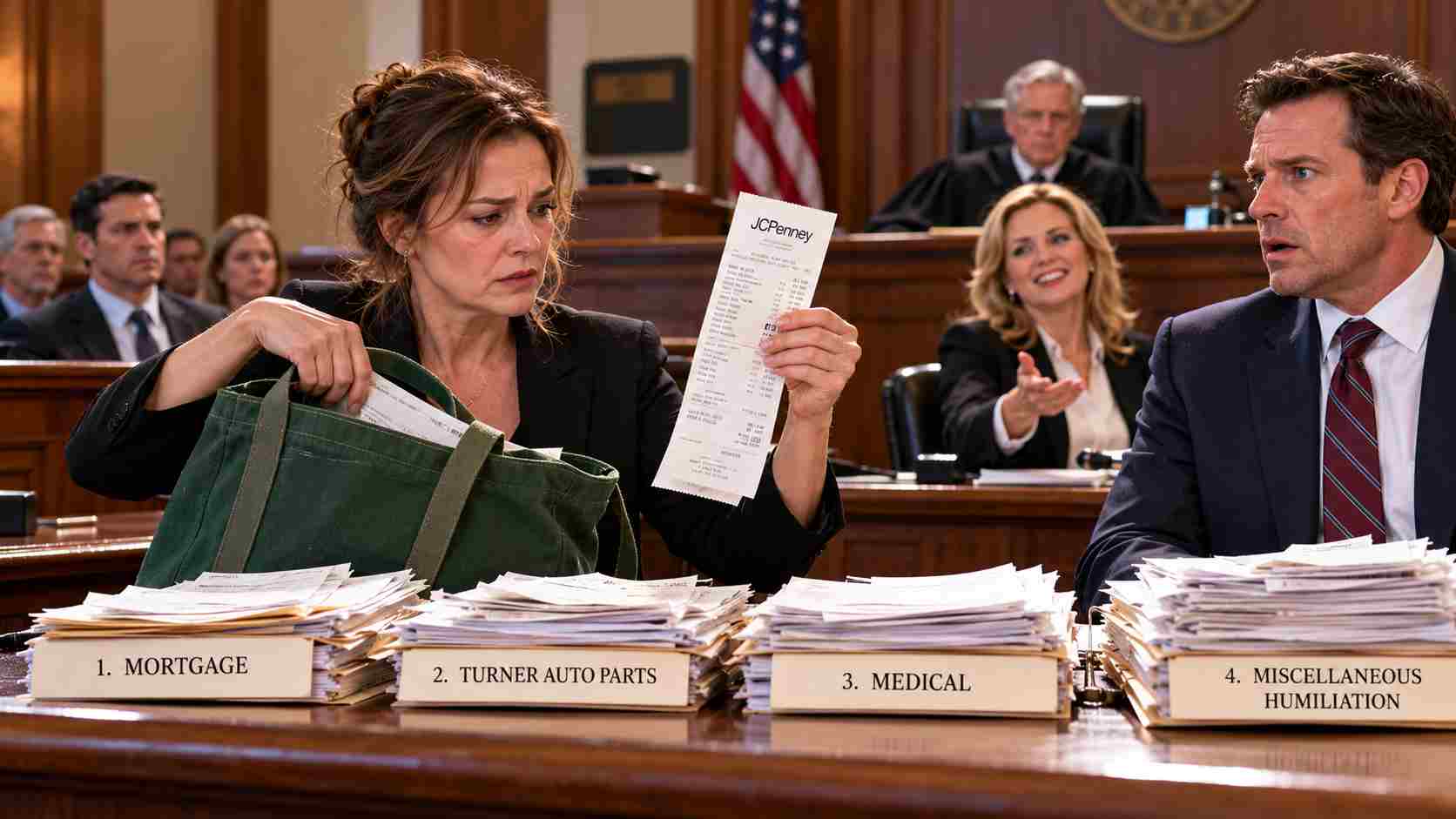
He said it at 10:19 in Courtroom B while wearing the tie I bought him at JCPenney with grocery money I stretched for 3 weeks. His lawyer smiled and said, “She’s asking for charity.” I opened my tote bag, pulled out 4 folders of receipts, and watched Neal stop breathing through his nose.
I did not plan to look dramatic. I had packed the folders in a green canvas tote from the library book sale because my good purse was too small. Folder 1 was mortgage. Folder 2 was Turner Auto Parts. Folder 3 was medical. Folder 4 was what my attorney, Ms. Bell, called “miscellaneous humiliation.”
That one was thickest.
He Told the Judge I Never Contributed a Dime—Then I Opened My Green Tote Bag
PART 3
Neal’s lawyer stood.
“Objection. We don’t know the circumstances under which this was written.”
Judge Harper looked at him.
“Then perhaps you should ask your client.”
The lawyer hesitated.
That was the first crack.
Tiny.
Almost invisible.
But I saw it.
Ms. Bell turned to me.
“Mrs. Turner, do you recognize this handwriting?”
I looked at the page.
There was no reason to pretend.
“Yes.”
“Whose is it?”
“My husband’s.”
Neal shifted in his chair.
Ms. Bell held up the notebook.
“What does the first page say?”
I looked at Judge Harper.
Then at Neal.
Then back at the notebook.
“It says, ‘Diane is putting in everything. Pay her back first.’”
Judge Harper nodded.
“Thank you.”
Ms. Bell closed the notebook.
But she didn’t sit down.
“Your Honor, there is more.”
Neal’s lawyer stood again.
“Your Honor, this is becoming cumulative.”
Judge Harper looked at him.
“Counsel, sit down.”
He sat.
Ms. Bell walked back to our table and picked up another folder.
This one was thinner.
I knew what was inside.
I had almost begged her not to use it.
Because numbers were one thing.
But sometimes numbers had names attached to them.
And names hurt.
She returned to the witness stand.
“Mrs. Turner, I’m going to ask you about a payment dated September 14, 2003.”
My stomach tightened.
I knew the date.
I knew the payment.
I knew the person.
“Do you remember a payment of $4,200?”
“Yes.”
“What was it for?”
I looked at Neal.
His face had gone pale.
“His gambling debt.”
The courtroom changed.
It wasn’t dramatic.
Nobody gasped.
Nobody shouted.
But I felt the atmosphere move.
Neal’s lawyer closed his eyes for half a second.
Judge Harper leaned forward.
“Mr. Turner?”
Neal didn’t answer.
Ms. Bell continued.
“Mrs. Turner, where did the $4,200 come from?”
“My savings.”
“Was this money related to the business?”
“No.”
“Why did you pay it?”
I looked down at my hands.
Because this was the part I had never told anyone.
Not even our son.
“Because a man was threatening to come to the house.”
Neal finally spoke.
“That’s not what happened.”
I turned toward him.
“Then tell them what happened.”
He opened his mouth.
Nothing came out.
Judge Harper said quietly, “Mr. Turner, you will have an opportunity to respond.”
I looked back at Ms. Bell.
She nodded.
“Continue.”
I took a breath.
“I paid it because I thought I was protecting my family.”
Ms. Bell sat down.
For a moment, nobody spoke.
Then Neal’s attorney stood.
“Your Honor, whatever happened twenty-three years ago has little relevance to the current financial dispute.”
Judge Harper considered that.
“Perhaps.”
She glanced at the exhibits.
“But the court is determining the financial contributions of both parties over a twenty-seven-year marriage. The history may be relevant.”
The lawyer sat down again.
I could almost feel Neal’s anger returning.
Fear had been replaced by something harder.
Resentment.
That was familiar.
I had lived beside it for twenty-seven years.
Then Ms. Bell said something I hadn’t expected.
“Your Honor, we would like to call Mr. Turner back for questioning.”
Neal’s lawyer immediately objected.
“He’s already testified.”
Judge Harper looked at him.
“He’s still under oath.”
The lawyer sighed.
Neal returned to the witness stand.
He walked differently this time.
The first time he’d walked up there like a man arriving to collect a trophy.
Now he looked like someone approaching a locked door.
He sat.
Judge Harper reminded him he remained under oath.
Ms. Bell stood.
“Mr. Turner, you testified that your wife never contributed a dime to Turner Auto Parts.”
“Yes.”
“You testified that she merely helped with minor clerical tasks.”
“Yes.”
“You testified that the business was built entirely through your efforts.”
“Yes.”
Ms. Bell picked up the original lease.
“Is this your signature?”
Neal looked at it.
“Yes.”
“Is this your wife’s signature?”
He hesitated.
“Yes.”
“Why is her name listed first on the lease?”
“I don’t know.”
Ms. Bell looked at the judge.
“Your Honor, may I show the witness the credit report attached to the original lease application?”
Judge Harper nodded.
Ms. Bell handed it to Neal.
He glanced at it.
“Is this your credit score?”
He said nothing.
“Mr. Turner?”
“Yes.”
“512?”
“At the time.”
“And your wife’s score?”
He looked at the paper.
“714.”
“So whose credit allowed the business to obtain the lease?”
Neal rubbed his jaw.
“Both of ours.”
“That’s not what you told the court earlier.”
He looked at her.
“I said I built the business.”
“That’s not my question.”
Silence.
Ms. Bell waited.
“Whose credit allowed Turner Auto Parts to open?”
“Diane’s.”
I heard the words.
They should have felt satisfying.
They didn’t.
Because I remembered the night we signed that lease.
Neal had been so happy.
He had hugged me in the parking lot.
“We’re going to make it,” he’d said.
And I had believed him.
I had believed him with the absolute certainty of a woman who hadn’t yet learned that sometimes the person you help climb the ladder will kick it away once he reaches the top.
Ms. Bell picked up another document.
“Now let’s discuss the mortgage.”
Neal’s lawyer stood.
“Your Honor—”
Judge Harper raised a hand.
“Counsel, let her proceed.”
Ms. Bell looked at Neal.
“Who made the mortgage payments between 1999 and 2010?”
“Both of us.”
“Your wife has bank records showing payments from her personal account.”
“She paid some.”
“Forty-seven payments?”
“I don’t remember.”
“Thirty-eight thousand six hundred dollars?”
“I don’t remember the exact amount.”
“Forty-seven payments totaling $38,614?”
He looked away.
“Possibly.”
Ms. Bell nodded.
“And during that period, where did your salary go?”
“Into the business.”
“All of it?”
“Most of it.”
“And why?”
“Because the business needed capital.”
Ms. Bell picked up the red notebook again.
“Did your wife agree to reinvest your salary into the business?”
“Yes.”
“Did she agree to receive nothing for her work?”
“She was my wife.”
The words landed strangely.
I felt something inside me go still.
Ms. Bell looked at him.
“That wasn’t my question.”
Neal frowned.
“She was my wife. We were building a life together.”
“Exactly.”
Ms. Bell turned toward the judge.
“Which is why the characterization of her contribution as ‘charity’ is particularly misleading.”
Neal’s lawyer objected.
“Sustained,” Judge Harper said. “Counsel, save argument for closing.”
Ms. Bell nodded.
Then she turned back to Neal.
“Let’s talk about your wife working at the shop.”
“I never said she didn’t help.”
“You said she performed ‘little clerical things.’”
“That’s what she did.”
“Did she handle payroll?”
“Sometimes.”
“Vendor invoices?”
“Sometimes.”
“Bank deposits?”
“Sometimes.”
“Collections?”
“Sometimes.”
“Inventory?”
“Sometimes.”
“Employee scheduling?”
“Sometimes.”
“Tax paperwork?”
“Sometimes.”
“Insurance?”
“Sometimes.”
“Customer accounts?”
“Sometimes.”
“Bookkeeping?”
“Sometimes.”
Ms. Bell smiled faintly.
“Mr. Turner, what exactly did she do that wasn’t ‘sometimes’?”
Neal stared at her.
“She wasn’t an employee.”
“No?”
“No.”
“Did you pay her a salary?”
“No.”
“Hourly wages?”
“No.”
“Health insurance through the business?”
“No.”
“Retirement contribution?”
“No.”
“Paid vacation?”
“No.”
“Paid sick leave?”
“No.”
“Then what was her compensation?”
Neal’s eyes moved toward me.
“She had a house.”
I closed my eyes.
There it was.
The sentence I had heard in different forms for years.
The house.
As though walls were wages.
As though groceries appeared in cabinets because a house loved you.
As though children raised themselves.
As though a wife who kept everything together was somehow consuming resources rather than creating them.
Ms. Bell nodded slowly.
“Your Honor, I’d like to submit the household labor valuation prepared by our financial expert.”
Neal’s lawyer objected.
Judge Harper reviewed the document.
“This is admitted subject to weight.”
Ms. Bell returned to her table.
I thought that was the end.
It wasn’t.
Because Neal suddenly leaned toward his microphone.
“I never forced her to stay home.”
Judge Harper looked at him.
“Mr. Turner, you have counsel. You should allow your attorney to conduct your examination.”
But Neal continued.
“She wanted to.”
His voice had become defensive.
“She said she wanted to take care of the kids.”
I stared at him.
That was true.
Partly.
I had wanted to.
But he left out the other part.
The part that mattered.
I had wanted to stay home when our daughter was born because the daycare near us cost more than my paycheck.