Three Days After Dad Died, My Husband Quit His Job to Spend My Inheritance—Then Dad’s Lawyer Revealed Everything He Hid…The moment my father’s lawyer opened the second folder, I realized my husband hadn’t simply been waiting for my father to die. He had been preparing for it. And the worst part was that someone I trusted had been helping him.
Robert Hayes sat across from me, his expression so serious that I forgot how to breathe. Outside his office window, Chicago traffic moved through the gray morning rain. People hurried beneath umbrellas.
Cars honked.
Somewhere, a siren wailed.
The world continued as though nothing extraordinary was happening.
But inside that quiet office, my entire marriage was about to fall apart.
Robert placed a thick folder on his desk.
My husband’s name was written across the front.
DAVID MILLER.
Beneath it was a date.
Six months earlier.
I stared at the folder.
“What is that?”
Robert didn’t answer immediately.
Instead, he removed his glasses and folded them carefully.
“Sarah, before I show you what’s inside, I need to ask you something.”
“All right.”
“Has David recently made any significant financial decisions without discussing them with you?”
A bitter laugh escaped my throat.
“He quit his job three days after Dad died.”
Robert’s expression tightened.
“He resigned?”
“Yes.”
“Without another position lined up?”
“He says he doesn’t need one.”
Robert looked down at the folder.
“And why does he believe that?”
I swallowed.
“Because he thinks Dad left me millions.”
Robert closed his eyes briefly.
Then he asked a question that made my skin turn cold.
“Has David promised any of that money to other people?”
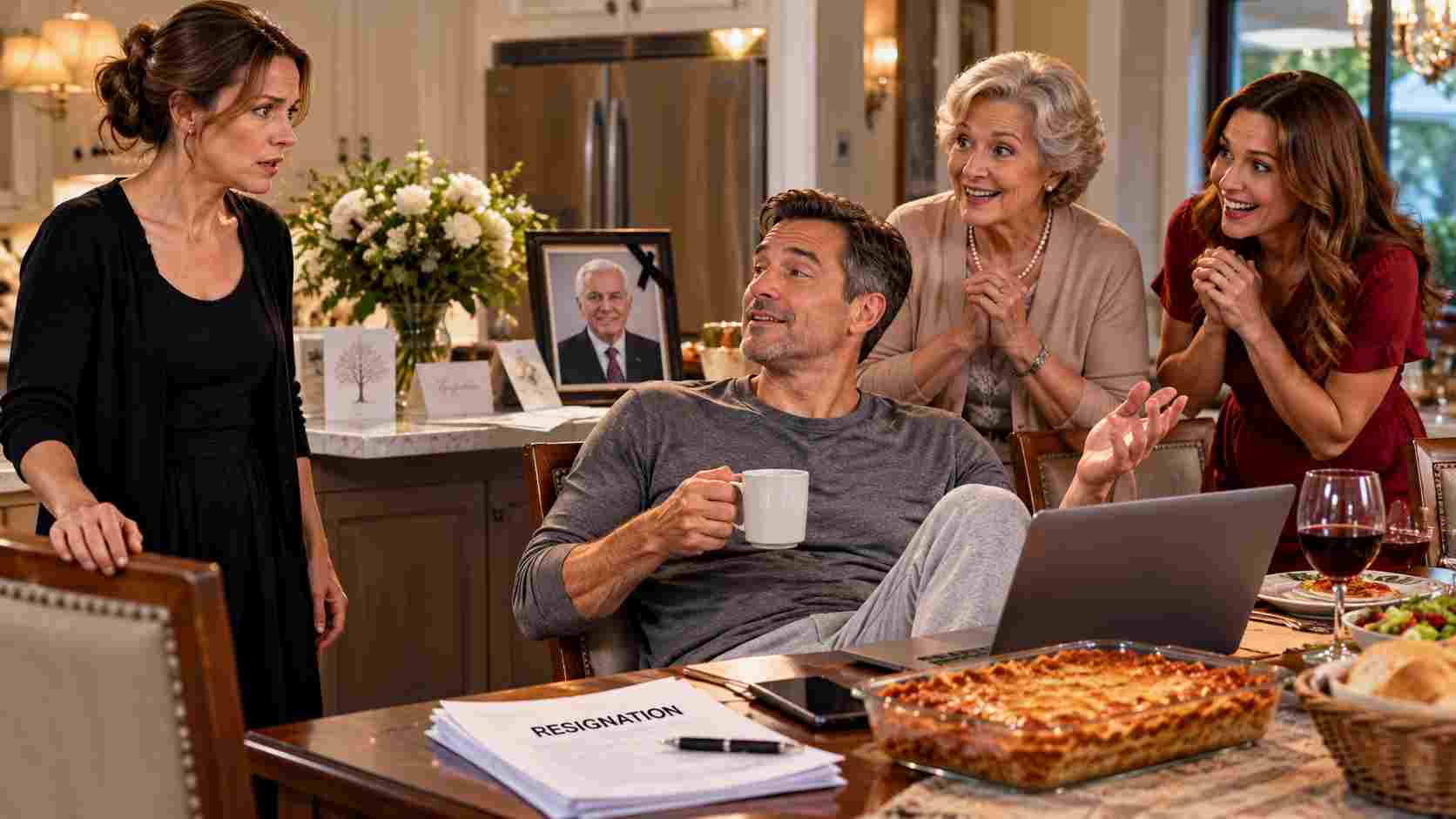
I thought of Helen smiling over her lasagna.
I thought of Rachel throwing her arms around David.
I thought of my husband’s cheerful confidence as he handed away an inheritance he hadn’t even seen.
“He promised his mother a house,” I whispered.
Robert said nothing.
“And his sister two hundred thousand dollars.”
The silence that followed felt enormous.
Finally, Robert opened the folder.
“Sarah, your father was afraid something like this would happen.”
I stared at him.
“Afraid of what?”
“That your husband would begin spending your inheritance before you even knew what it was.”
He slid a photograph across the desk.
It showed David standing outside a restaurant in downtown Chicago.
He was wearing the navy coat I’d bought him for our anniversary.
Beside him stood a woman I recognized immediately.
Rachel.
His sister.
They were speaking to a third person.
A man in a charcoal suit.
I had never seen him before.
“Who is that?”
“His name is Martin Keller.”
“And?”
“He’s a financial consultant.”
I frowned.
“David has always handled our investments.”
“Apparently, he wanted professional assistance with something much larger.”
Robert turned the photograph over.
On the back was a date.
April 17.
Six months before my father died.
“Your husband met with Mr. Keller on four separate occasions,” Robert explained. “During those meetings, they discussed ways to borrow against an anticipated inheritance.”
I shook my head.
“That doesn’t make sense. Dad was alive.”
“Yes.”
“And David had no idea what Dad was leaving me.”
“That should have been true.”
Something in his voice made me look up.
“Should have?”
Robert reached into the folder again.
This time, he removed a photocopied document.
At the top were the words:
CONFIDENTIAL ESTATE SUMMARY — ARTHUR VANCE.
My father’s name.
His financial holdings.
The sale proceeds from Vance Industrial.
A list of properties.
Investment accounts.
And a number near the bottom that made my eyes widen.
$8,740,000.
I read it twice.
Then a third time.
“Where did David get this?”
Robert’s expression darkened.
“That’s precisely what your father wanted to know.”
I felt a strange pressure building behind my ribs.
“Robert, what are you telling me?”
He leaned forward.
“I’m telling you that someone accessed a preliminary estate planning document without authorization. A copy appears to have reached your husband.”
I looked at the page again.
The numbers seemed to swim.
Eight million dollars.
Nearly nine.
For twenty-two years, David and I had lived comfortably but carefully.
We clipped coupons.
We compared mortgage rates.
We waited for appliance sales.
We argued over whether replacing the upstairs carpet was worth the expense.
And all the while, my husband had apparently been calculating how much money he could extract from my father’s eventual death.
“Did Dad know?”
“Yes.”
“When?”
“Last spring.”
I covered my mouth.
Last spring.
Dad had still been alive.
Still making terrible jokes about the Cubs.
Still calling me every Sunday.
Still insisting he didn’t need help carrying groceries.
And he’d known something was wrong with my marriage.
“Why didn’t he tell me?”
Robert’s face softened.
“Because he wanted proof before he frightened you.”
I looked down at my hands.
They were trembling.
Then Robert said something I would remember for the rest of my life.
“Sarah, the money wasn’t what worried your father most.”
I lifted my eyes.
“What was?”
Robert turned another page.
“Your husband had already made arrangements to receive it.”
For several seconds, I couldn’t speak.
I simply stared at Robert, waiting for him to explain a sentence that made no sense.
“Receive it how?”
“Through a proposed financial agreement.”
“What agreement?”
He pushed another document toward me.
It was a draft.
My name appeared at the top.
SARAH MILLER.
David’s name appeared below it.
And beneath both names were the words:
MARITAL ASSET MANAGEMENT AUTHORIZATION.
I scanned the first paragraph.
Then the second.
My eyes caught phrases I barely understood.
Financial administration.
Investment discretion.
Transfer authorization.
Joint asset consolidation.
“What is this?”
“A document your husband asked Mr. Keller to prepare.”
I looked up.
“Did I sign it?”
“No.”
Relief washed through me.
Then Robert continued.
“But according to the investigator’s report, David intended to present it to you shortly after your father’s death.”
My stomach twisted.
“Why?”
“Because he believed you would be emotionally vulnerable.”
I stared at him.
Robert spoke carefully.
“The consultant’s notes suggest David wanted you to sign while you were overwhelmed by funeral arrangements and estate paperwork.”
I thought of the previous evening.
David following me into the kitchen.
His irritated expression.
His insistence that there wouldn’t be my money and his money.
We’re set.
Suddenly, those words sounded different.
Not reassuring.
Possessive.
I looked down at the document again.
“What would signing this have done?”
“It would have given David broad authority over certain assets you voluntarily transferred into accounts covered by the agreement. It would not automatically override the terms of your father’s trust, but it could have exposed money distributed to you if you agreed to move it.”
I swallowed hard.
“So he wanted control.”
“Yes.”
“Of everything?”
“Of as much as he could persuade you to give him.”
The room felt smaller.
I stood and walked to the window.
Below us, a woman in a red coat waited at a crosswalk with a little boy holding her hand.
The boy jumped over a puddle.
The woman laughed.
It was such an ordinary scene.
I wanted to be part of something ordinary.
I wanted to go back three days.
Back to a time when my greatest pain was losing my father.
Before I knew my husband was already dividing his money.
Before I knew the man I’d slept beside for twenty-two years had been planning something behind my back.
“Sarah?”
I turned.
Robert was holding an envelope.
Cream-colored.
My name written across the front.
In my father’s handwriting.
I recognized every crooked letter.
Dad always wrote his capital S too large.
Always pressed harder on the final letters of a word.
I sat down slowly.
“What’s that?”
“He asked me to give it to you after we’d discussed the investigation.”
I reached for it.
My fingers hesitated against the paper.
For one irrational moment, I didn’t want to open it.
Because while the envelope remained sealed, Dad was still someone who might have something left to say.
Once I opened it, those words would be all I had.
Robert turned toward the window, giving me privacy.
I broke the seal.
Inside were three handwritten pages.
And at the top, my father had written:
My dearest Sarah,
If you’re reading this, then I’m gone, and I owe you an explanation.
Tears blurred the words immediately.
I wiped my eyes and continued.
I know you loved David.
I know you’ve spent most of your adult life believing that marriage means sharing everything.
Your mother believed that too.
But there is a difference between sharing your life with someone and allowing that person to take ownership of it.
I pressed the paper against the desk.
Dad had never been particularly sentimental.
He expressed love by checking tire pressure.
By arriving with soup when someone was sick.
By replacing broken porch lights without being asked.
Reading those words felt like hearing a voice he’d kept hidden for years.
Six months ago, I discovered that someone had been asking questions about my estate.
At first, I thought it was a mistake.
Then I learned that David had been discussing my death as a financial opportunity.
A sob escaped me.
I covered my mouth.
Robert remained silent.
I wanted to confront him.
God knows I wanted to.
But I remembered something your mother once told me.
“Arthur, if Sarah ever has to choose between the people she loves, don’t make that choice harder for her.”
So I waited.
I gathered information.
And I changed my estate plan.
My eyes moved down the page.
I have left you everything I intended you to have, but I have placed it in a trust designed to protect you from pressure, manipulation, and decisions made in grief.
David cannot demand distributions.
He cannot borrow against the trust.
He cannot authorize investments on its behalf.
And he cannot make promises using money that does not belong to him.
I let out a shaky breath.
Then I reached the final paragraph.
But Sarah, there is something else.
Something I should have told you years ago.
If David reacts badly when he learns about the trust, ask Robert to show you the blue file.
You’ll understand why I never trusted him completely.
And sweetheart, whatever happens next, remember this:
You are not responsible for financing another person’s greed.
You are my daughter.
Not anyone’s retirement plan.
Love always,
Dad.
I folded forward over the letter.
And cried.
Not quietly.
Not gracefully.
I cried the way children cry when the world becomes too large and there is nobody left to make it smaller.
Robert handed me tissues.
He didn’t tell me to be strong.
He didn’t say everything would be fine.
He simply waited.
After several minutes, I straightened.
My eyes were burning.
My throat hurt.
But one thought had become impossible to ignore.
“The blue file.”
Robert nodded.
“Yes.”
“What is it?”
He hesitated.
“Sarah, I think you should take a moment.”
“No.”
My voice surprised both of us.
“I’ve spent twenty-two years taking moments. Making excuses. Keeping the peace.”
I placed Dad’s letter carefully inside its envelope.
“Show me.”
Robert opened the bottom drawer of his desk.
And removed a blue folder.
It was thinner than the first.
Somehow, that frightened me more.
He placed it between us.
“Before you read this,” he said, “you need to understand that your father did not know everything.”
“What do you mean?”
“Some information came from public records. Some came from interviews. And some came from a source who contacted your father directly.”
I frowned.
“What source?”
Robert opened the folder.
Inside was a photograph.
An old one.
David looked much younger.
His hair was darker.
His face thinner.
He was standing outside a small brick house.
Beside him was a woman holding a little girl.
I had never seen either of them.
I stared at the picture.
“Who are they?”
Robert looked at me.
“The woman is named Laura Bennett.”
“And the child?”
He paused.
“Her daughter, Emily.”
I looked again.
The girl couldn’t have been more than four.
She wore a yellow sweater.
Her hair was tied into two uneven ponytails.
David had one hand resting on her shoulder.
I felt a strange, creeping sensation.
“Why is my husband in a photograph with them?”
Robert took a breath.
“Because before David met you, he lived with Laura.”
I blinked.
“David told me he’d never lived with anyone before.”
“I know.”
“Who is the little girl?”
Robert’s eyes held mine.
“Sarah, Emily is David’s daughter.”
The room went silent.
Completely silent.
For a moment, even the traffic outside seemed to disappear.
I stared at him.
“No.”
Robert didn’t respond.
“No,” I repeated. “David doesn’t have children.”
“He has one.”
“That’s impossible.”
“She was born twenty-seven years ago.”
My mind began racing.
Twenty-seven years.
David and I had been married twenty-two.
We’d met twenty-four years earlier.
Emily would have been three when David and I first started dating.
I remembered our early conversations.
Sitting in a diner at midnight.
Sharing stories about childhood.
Talking about whether we wanted children.
David had told me he was an only child until Rachel was born.
He’d told me his longest relationship had lasted six months.
He’d told me he’d never been responsible for anyone except himself.
And I had believed every word.
“Did Dad know?”
“Not until last spring.”
“How did he find out?”
“Laura contacted him.”
I stared at the photograph.
“Why?”
Robert slid a letter across the desk.
It was dated May 2.
I began reading.
Dear Mr. Vance,
I apologize for contacting you this way. I understand that Sarah is your daughter and that this information may cause pain.
But I recently learned that David has been telling people he expects to inherit a significant amount of money through his wife.
I am writing because David still owes substantial court-ordered support related to our daughter, and I believe he is attempting to avoid those obligations while arranging access to new assets.
I do not want your daughter’s money.
I do not want to destroy her marriage.
I simply believe she deserves to know who she married.
The letter continued.
There were references to old court orders.
Missed payments.
A long history of promises.
And one sentence that made my stomach turn.
David told Emily that he had no money to help her finish college, yet he recently contacted her asking whether she would support a business proposal once he received funds from his wife’s family.
I lowered the letter.
“He contacted his daughter?”
Robert nodded.
“Apparently.”
“After abandoning her?”
“I can’t speak to the full history of their relationship. But the records indicate a long period of limited contact.”
I stared at the photograph.
The little girl’s smile seemed unbearably innocent.
I wondered how many birthdays she’d waited for him.
How many Christmas mornings.
How many school events.
How many times she’d looked toward a doorway, hoping her father would appear.
Then I thought of David at our kitchen table.
Announcing his retirement.
Promising Helen a house.
Promising Rachel two hundred thousand dollars.
He’d been generous with everyone except the daughter he had hidden from me.
I felt sick.
“Does Emily know about me?”
“Yes.”
“Has she tried to contact me?”
Robert looked uncomfortable.
“Once.”
My head snapped up.
“When?”
“Approximately four years ago.”
I stared at him.
“What?”
“According to the investigator, she sent a letter to your home.”
I shook my head.
“I never received anything.”
Robert said nothing.
And in that silence, I remembered something.
Four years earlier.
A Tuesday afternoon.
David had been standing by the mailbox when I came home from work.
He’d been holding several envelopes.
One was pink.
I remembered because I had joked about him having a secret admirer.
He’d laughed.
Then he’d said it was junk mail.
I had forgotten about it almost immediately.
Until now.
“Robert.”
“Yes?”
“Did the investigator find out what happened to that letter?”
He slowly turned a page.
“Emily kept a copy.”
He handed it to me.
The handwriting was neat.
Careful.
Almost painfully polite.
Dear Mrs. Miller,
My name is Emily Bennett.
I believe your husband is my biological father.
I’m not writing to ask you for anything.
I just wanted you to know that I exist.
I’ve spent most of my life wondering whether he ever told you about me.
If he has, I’m sorry to bother you.
If he hasn’t, I hope someday he’ll find the courage to tell you himself.
I don’t want to hurt your family.
I only want to stop feeling like a secret.
I read those last words again.
A secret.
I pressed my fingers against my lips.
David had spent twenty-two years telling me he was an honest man.
That loyalty mattered.
That family came first.
And somewhere in the world was a young woman who had grown up believing her existence was something her father needed to hide.
I thought I had reached the bottom of the betrayal.
I was wrong.
Because Robert wasn’t finished.
“Sarah, there’s one more document.”
I looked at him through tears.
“What now?”
He pulled out a financial statement.
Several transfers were highlighted.
The account belonged to David.
The dates went back nearly two years.
The amounts varied.
Five thousand dollars.
Twelve thousand.
Eight thousand.
Then one transfer for forty thousand dollars.
“What’s this?”
“Your husband has been moving money into an account you may not know about.”
I frowned.
“David has a separate savings account. We both do.”
“This account appears to have received transfers from a joint brokerage account.”
I leaned forward.
“Our brokerage account?”
“Yes.”
I stared at the highlighted numbers.
“How much?”
“Approximately one hundred and eighty-six thousand dollars over twenty-one months.”
My mouth went dry.
“That’s impossible.”
Robert’s expression was grave.
“I recommend having an independent forensic accountant review the complete records before drawing final conclusions.”
I shook my head.
“No. I check our statements.”
“How often?”
I opened my mouth.
Then stopped.
David had handled the investments for years.
He paid the quarterly taxes.
He managed retirement contributions.
He sent me summaries.
I trusted him.
Why wouldn’t I?
He was my husband.
I had shared my bed with him.
Raised a family with him.
Built a home with him.
And somewhere along the way, trust had become an excuse not to look.
“Sarah,” Robert said gently, “your father believed David had been preparing financially for the possibility that you might leave him.”
I stared at him.
“Leave him?”
“Yes.”
“Why would David think that?”
Robert hesitated.
“Because he knew that if you discovered everything, you might.”
I left Robert’s office carrying three things.
My father’s letter.
A copy of the investigator’s report.
And a truth so heavy that I could barely hold myself upright.
I sat in my car for almost forty minutes.
The rain had stopped.
Sunlight broke through the clouds, illuminating the windshield.
My phone buzzed.
David.
I watched his name appear.
Then disappear.
Then appear again.
On the third call, I answered.
“Where are you?”
His tone was irritated.
Not worried.
Not concerned.
I noticed that immediately.
“At Robert’s office.”
A pause.
“Still?”
“Yes.”
“What could possibly take that long?”
I stared at the steering wheel.
“Estate paperwork.”
“Well, did he tell you?”
“Tell me what?”
“How much?”
There it was.
Not How are you holding up?
Not Was it difficult talking about your dad?
Not even Are you okay?
Just two words.
How much?
I closed my eyes.
“David, Dad has been dead less than a week.”
He sighed.
“Sarah, please don’t start that again.”
Something inside me became very still.
“I’m not starting anything.”
“Then answer the question.”
I looked at the envelope on the passenger seat.
My father’s handwriting.
My name.
The last words he would ever give me.
And suddenly, I understood why he’d insisted I come alone.
“Robert says the estate is complicated.”
“Complicated how?”
“There are trusts.”
Silence.
Then David spoke more sharply.
“What kind of trusts?”
“I don’t know all the details yet.”
“Did he say when the money gets released?”
“Not exactly.”
“Sarah.”
“What?”
“Don’t let that lawyer talk circles around you. It’s your money.”
I almost laughed.
He had finally called it mine.
Only because he wanted access to it.
“I’ll be home later.”
“Wait. I need you to ask him something.”
“What?”
“Whether the trust can make an early distribution.”
My fingers tightened around the phone.
“Why?”
Another pause.
Then he said, “Mom found a house.”
I stared through the windshield.
“What?”
“A really nice place. Three bedrooms. One level. Perfect for her knees.”
“David.”
“It’s listed at four hundred and twenty thousand, but I think we could get it for four hundred.”
I couldn’t speak.
He continued cheerfully.
“And Rachel talked to her creditors. They’d settle for one hundred and sixty thousand if she pays quickly. So we’re actually saving forty grand.”
I felt something inside me break.
Not loudly.
Not dramatically.
Just a quiet snapping sound in the part of my heart that had spent twenty-two years making excuses for him.
“David,” I said, “my father isn’t even buried.”
“Sarah, you keep saying that.”
“Because you keep forgetting it.”
He exhaled angrily.
“Fine. We’ll talk when you get home.”
He hung up.
I sat there staring at the phone.
Then I did something I hadn’t done in years.
I turned it off.
My father’s funeral was held two days later.
The church was filled with people who had known him for decades.
Former employees.
Neighbors.
Friends from his bowling league.
Men who had worked beside him when Vance Industrial was still a small machine shop with twelve employees and a leaking roof.
They told stories about his stubbornness.
His generosity.
His terrible singing.
One man told me Dad had quietly paid for his daughter’s nursing school tuition after he’d lost his job.
Another said Dad used to leave grocery gift cards in the break room before Christmas.
A woman I’d never met took both my hands and said, “Your father helped my husband when nobody else would.”
I listened.
I cried.
I smiled through tears.
And for the first time, I began to understand how much of my father’s life had existed beyond the version I knew.
David stood beside me wearing his best black suit.
He accepted condolences.
Shook hands.
Spoke solemnly about what a remarkable man Arthur had been.
Watching him felt like watching a stranger perform the role of my husband.
At the cemetery, he placed one hand against my back.
Anyone watching would have thought he was comforting me.
But as the minister finished speaking, David leaned close to my ear.
“Did Robert give you the full numbers?”
I went cold.
Not even here.
Not beside my father’s grave.
Not while the flowers were still being lowered.
I turned slowly.
“What?”
“The estate. Did he give you a valuation?”
I looked at him.
Really looked.
At the expensive watch.
The carefully combed hair.
The face I’d kissed good morning for more than two decades.
And I realized something devastating.
He wasn’t grieving.
He was waiting.
Waiting for the funeral to end.
Waiting for the paperwork to clear.
Waiting for my father’s life to become a number in our bank account.
I stepped away from him.
“Not now.”
He frowned.
“Sarah—”
“Not. Now.”
My voice was louder than I’d intended.
Several people turned.
David’s expression hardened.
But I didn’t care.
I walked toward my father’s grave.
Kneeling beside the flowers, I placed my fingertips against the polished wood of the casket.
“I’m sorry, Dad,” I whispered.
The words came out broken.
“I’m sorry I didn’t see it.”
A breeze moved through the trees.
For one foolish second, I imagined hearing his voice.
You see it now, sweetheart.
That’s enough.
That evening, David’s family came to our house.
I hadn’t invited them.
Helen arrived carrying a casserole.
Rachel brought a bakery box.
And David opened a bottle of wine as though we were celebrating something.
I sat on the living-room couch, exhausted.
My black dress still smelled faintly of the lilies from the church.
Helen settled into the armchair opposite me.
“Sarah, your father had a beautiful service.”
“Thank you.”
“He was certainly a successful man.”
I looked up.
She smiled.
“I mean, look at everything he accomplished.”
Rachel sat beside her.
“David says the company sale was huge.”
I said nothing.
Helen folded her hands.
“Of course, I don’t want to be presumptuous.”
I nearly laughed.
“But David mentioned that once things are settled, you two might help me find a little place.”
“A little place?” I repeated.
“Just something manageable.”
Rachel smiled.
“Mom’s being modest. She already found the perfect house.”
David appeared in the doorway.
“Can we not talk about this tonight?”
For one moment, I almost felt grateful.
Then he added, “Sarah’s had a long day. We can go over the numbers tomorrow.”
The numbers.
Always the numbers.
I stood.
“I’m going upstairs.”
Helen looked surprised.
“But we haven’t had dessert.”
I turned toward her.
“My father was buried today.”
The room went quiet.
I looked at each of them.
“Please forgive me if I’m not interested in discussing real estate.”
I went upstairs.
And locked the bedroom door.
For the first time in twenty-two years, I didn’t care whether David thought I was being difficult.
The next morning, I called Robert.
“I want to protect myself.”
His response was immediate.
“All right.”
“I don’t know what David has done with our accounts. I don’t know what he’s planning. And I don’t know how to confront him.”
“Then don’t confront him yet.”
I sat at the kitchen table.
David had gone to meet Rachel.
He said they were discussing her creditors.
I suspected they were discussing my inheritance.
“What should I do?”
“First, you need independent legal advice regarding your marriage and marital property. I can recommend an attorney who specializes in divorce and complex financial matters.”
The word hit me.
Divorce.
For twenty-two years, it had belonged to other people.
Friends.
Coworkers.
Neighbors.
Couples who couldn’t make things work.
Never us.
I swallowed.
“I’m not saying I’m getting divorced.”
“I understand.”
“I’m just saying I need to know what’s happening.”
“That’s exactly what you should do.”
He gave me a name.
Margaret Collins.
A family-law attorney in downtown Chicago.
Then he added, “Sarah, I also recommend reviewing your credit reports and gathering your financial records. Don’t move or conceal marital assets. Let your attorney guide you.”
I wrote everything down.
“And the trust?”
“Your father’s trust remains under the terms he established. You are the primary beneficiary, but the assets are administered by an independent trustee.”
“How much is actually in it?”
Robert paused.
“After estate expenses, taxes, and the specific charitable gifts, the current estimated value of the assets designated for your benefit is approximately six million, eight hundred thousand dollars.”
I gripped the pen.
Six million.
Eight hundred thousand.
I had known Dad was wealthy.
But hearing the number made it real.
“Sarah?”
“I’m here.”
“Are you all right?”
I stared at the kitchen wall.
A photograph hung above the breakfast nook.
David and me on our twentieth anniversary.
We were standing on a beach in Florida.
His arm was around my waist.
My head rested against his shoulder.
We looked happy.
Maybe we had been.
Or maybe I had simply been happy enough for both of us.
“Robert?”
“Yes?”
“Did Dad leave anything directly to David?”
“No.”
“Nothing?”
“Nothing.”
I looked at the photograph again.
For the first time, I smiled.
Not because I was pleased my husband had been excluded.
But because my father had seen the danger.
And even at the end of his life, he’d found a way to protect me.
Margaret Collins was a woman in her late fifties with silver hair, sharp eyes, and a voice that never rose above conversational volume.
She listened while I explained everything.
David’s resignation.
His promises to Helen and Rachel.
The trust.
The investigator.
The hidden daughter.
The unexplained transfers.
When I finished, she remained silent for a moment.
Then she asked, “Sarah, do you still love your husband?”
The question caught me off guard.
I looked down.
“I don’t know.”
“That’s an acceptable answer.”
“I loved him yesterday.”
“Did you?”
I looked up.
Margaret leaned back.
“Or did you love the man you believed he was yesterday?”
My throat tightened.
I thought about that.
For a long time.
Then I whispered, “I don’t know that either.”
She nodded.
“Then we’re not going to force an emotional decision today. We’re going to establish facts.”
For the next hour, she explained what we needed to review.
Our joint accounts.
Our mortgage.
Retirement funds.
Tax returns.
Investment statements.
Any loans David might have taken.
Any transfers he had made.
She was careful not to promise outcomes.
“The treatment of inherited property depends on how it is held, whether it’s been commingled, and the applicable law,” she told me. “Your father’s trust appears to provide substantial protections, but we’ll review everything carefully.”
I appreciated that.
For the first time in days, someone was speaking to me without making assumptions about money.
Before I left, Margaret asked one more question.
“Does David know you’ve consulted an attorney?”
“No.”
“Good. For now, keep your communications calm and preserve any relevant records you lawfully have access to. We don’t need a dramatic confrontation.”
I nodded.
Then she added, “One more thing.”
“What?”
“People who expect access to money sometimes become unpredictable when they learn they won’t get it.”
A chill passed through me.
“Do you think David could hurt me?”
“I don’t know him well enough to make that judgment. But I want you to take your safety seriously.”
I left with her business card in my purse.
And a growing certainty that my marriage was approaching a moment from which it might never recover.
The first real confrontation happened that Friday.
David was waiting for me when I returned home.
He sat at the kitchen table.
A stack of papers lay in front of him.
His expression was bright.
Almost excited.
“Perfect timing.”
I set my purse down.
“What’s going on?”
“I’ve been doing some planning.”
Of course he had.
He gestured toward the chair opposite him.
“Sit down.”
I remained standing.
“David, I’m tired.”
“This won’t take long.”
He pushed a document toward me.
At the top was the name of a financial advisory firm.
Below it were several pages of legal language.
I recognized the wording almost immediately.
Asset management.
Investment authority.
Joint administration.
It was the same type of agreement Robert had shown me.
My heart began pounding.
“What’s this?”
“Just a practical step.”
“What kind of step?”
“Consolidating things.”
“Which things?”
He gave me an impatient look.
“Sarah, once the inheritance comes through, we need a strategy. We can’t have millions sitting around without a plan.”
I slowly pulled out the chair.
And sat.
“Who prepared this?”
“A financial consultant.”
“What’s his name?”
“Martin Keller.”
There it was.
The name from the photograph.
The man David had been meeting six months before my father died.
I kept my face still.
“How long have you known him?”
David hesitated.
“A little while.”
“How long?”
“Why does it matter?”
“Because you’re asking me to sign something.”
He sighed.
“Six months, maybe.”
I stared at him.
“Six months.”
“Yes.”
“While Dad was alive.”
His expression changed.
Only slightly.
But I saw it.
“Sarah, what’s your point?”
“Why were you consulting someone about my inheritance while my father was alive?”
David leaned back.
“I was planning ahead.”
“For what?”
“Our future.”
I looked at the papers.
Then back at him.
“Did you tell Martin how much money you expected?”
He frowned.
“What?”
“Did you give him an estimate?”
“Obviously.”
“Based on what?”
David’s jaw tightened.
“Your dad sold his company. Everybody knew that.”
“Everybody knew he sold the company. Not everybody knew his private financial details.”
He looked away.
I felt my pulse quicken.
“David.”
“What?”
“Where did you get the numbers?”
He stood abruptly.
“Why are you interrogating me?”
“I’m asking a question.”
“And I’m trying to help us.”
“Then answer it.”
His face reddened.
“Fine. Rachel heard some things.”
I went still.
“Rachel?”
“She knows people.”
“What people?”
“Sarah, for God’s sake.”
I looked down at the agreement.
Then I pushed it back across the table.
“I’m not signing this.”
David stared at me.
“What?”
“I’m not signing it.”
“You haven’t even read it.”
“I’ve read enough.”
He laughed sharply.
“You’re being ridiculous.”
“Maybe.”
“Do you have any idea how complicated managing that kind of money is?”
“That’s why Dad appointed a trustee.”
The room changed.
David stopped moving.
For a moment, he looked as though someone had slapped him.
“A what?”
“A trustee.”
He stared.
“What do you mean?”
“The inheritance is held in trust.”
He sat down slowly.
“Okay.”
His voice was cautious.
“That’s normal. We’ll work with the trustee.”
I looked at him.
“You can’t.”
He blinked.
“What?”
“The trust isn’t jointly controlled.”
“Sarah—”
“You don’t have authority over it.”
His expression hardened.
“What exactly did Robert tell you?”
“That Dad structured everything to protect the assets.”
“Protect them from what?”
I held his gaze.
“People who might try to spend them before they belong to anyone.”
Silence.
Then David laughed.
But it wasn’t a pleasant laugh.
It was thin.
Cold.
Disbelieving.
“You’re joking.”
“No.”
“Your father actually did that?”
“Yes.”
He stood so quickly his chair scraped across the floor.
“That manipulative old man.”
I flinched.
David didn’t notice.
“Even from the grave, he’s trying to control our marriage.”
I felt something hot rise in my chest.
“Don’t.”
He turned.
“What?”
“Don’t speak about my father that way.”
“Sarah, he deliberately cut me out.”
“Of his money.”
“Of our future!”
I stared at him.
“Our future?”
“Yes!”
I stood.
“David, you quit your job without asking me. You promised your mother a house. You promised Rachel two hundred thousand dollars. You hired a consultant to prepare documents giving you access to money I hadn’t even received.”
His face changed.
“How do you know when I hired Martin?”
I didn’t answer.
He took a step toward me.
“Sarah.”
I remained still.
“Did Robert tell you something?”
I looked into my husband’s eyes.
And realized he wasn’t frightened of losing our marriage.
He was frightened of being discovered.
“What else have you been hiding?” I asked quietly.
His mouth opened.
Then closed.
For one moment, I thought he might tell the truth.
I thought perhaps he would sit down.
Put his face in his hands.
Admit everything.
Ask forgiveness.
Instead, he said, “Your father poisoned you against me.”
And that was when I knew.
He wasn’t ready to tell the truth.
Not yet.
That night, I slept in the guest bedroom.
David didn’t apologize.
He didn’t knock.
He didn’t ask whether I was okay.
Instead, around midnight, I heard him on the phone downstairs.
The house was quiet enough that his voice carried through the hallway.
“No, Rachel. She won’t sign.”
A pause.
“I know what I promised.”
Another pause.
“Because her father locked it up in some damn trust.”
I sat upright in bed.
My heart pounded.
David lowered his voice.
“No. Don’t tell Mom yet.”
Silence.
Then something he said made my blood turn cold.
“We still have another option.”
I pressed a hand over my mouth.
Another option?
What option?
I heard him pacing.
Then:
“Just find out whether Keller can make it work.”
I stayed awake until dawn.
The following Monday, Margaret’s forensic accountant called me.
His name was Daniel Price.
He had spent twenty years tracing complicated financial transactions.
He spoke calmly.
Almost gently.
But what he told me made my hands shake.
“Mrs. Miller, we’ve identified several transfers that need explanation.”
“How many?”
“Seventeen.”
I closed my eyes.
“Where did the money go?”
“Some went into an account held solely in your husband’s name. Some appears to have been transferred onward.”
“To whom?”
“We’re still verifying the records.”
I swallowed.
“Daniel, please.”
He paused.
“One recipient appears to be a company called RLM Holdings.”
I frowned.
“RLM?”
“Yes.”
The initials meant nothing to me.
Then I remembered.
Rachel Louise Miller.
David’s sister.
“Is Rachel involved?”
“We can’t establish that solely from the initials. But public business records list Rachel Miller as a manager of an entity with that name.”
I gripped the edge of the desk.
“How much went there?”
“Approximately ninety-four thousand dollars in the records we’ve reviewed.”
I stared at the wall.
Ninety-four thousand.
David had promised Rachel two hundred thousand from my inheritance.
But apparently, he’d already been sending her money from our existing investments.
“Was it a loan?”
“We haven’t found loan documentation yet.”
“Could it have been business expenses?”
“Possibly. We need more information.”
I appreciated his caution.
But my mind was already racing.
Rachel’s business had failed twice.
First a boutique.
Then an online furniture company.
David had always said she was unlucky.
That the market was difficult.
That she just needed one good opportunity.
I’d believed him.
I had even agreed to help her once.
Ten thousand dollars.
A family loan.
She’d promised to repay it within a year.
That was seven years ago.
I’d never seen a penny.
Now I wondered how many other “loans” existed.
And how much of our marriage had been quietly financing David’s family.
Daniel continued.
“There’s something else.”
I closed my eyes.
Of course there was.
“Your husband appears to have opened a line of credit approximately fourteen months ago.”
I sat straighter.
“A line of credit?”
“Yes.”
“Against what?”
“An investment account.”
I stared at my hands.
“How much?”
“The original limit was two hundred and fifty thousand dollars.”
My mouth went dry.
“How much has he used?”
“Approximately one hundred and seventy-eight thousand, based on the available statement.”
I couldn’t speak.
Daniel waited.
Then he said, “Mrs. Miller, I recommend you discuss these findings with your attorney before contacting your husband.”
I nodded, forgetting he couldn’t see me.
After the call ended, I sat in silence.
The refrigerator hummed.
A clock ticked above the stove.
Outside, a neighbor’s dog barked.
Everything looked exactly as it always had.
And yet my home suddenly felt unfamiliar.
I had thought the worst thing David had done was plan to spend my inheritance.
Now I was beginning to understand something far more frightening.
He might have already spent our future.
Two days later, I met Emily Bennett.
I hadn’t planned to do it so soon.
But after reading her letter, I couldn’t stop thinking about her.
The little girl in the yellow sweater.
The young woman who had written that she didn’t want to feel like a secret.
Robert contacted Laura on my behalf.
Laura asked Emily whether she wanted to speak with me.
Emily agreed.
We arranged to meet at a quiet café in Oak Park.
I arrived twenty minutes early.
My hands were cold despite the warmth inside.
I ordered tea.
Didn’t drink it.
Watched the door.
Then a young woman walked in.
She had dark brown hair.
Green eyes.
A serious expression.
And David’s smile.
Not the smile he wore when he was trying to charm someone.
The real one.
The one I’d fallen in love with twenty-four years earlier.
Seeing it on her face almost broke me.
She approached my table.
“Sarah?”
I stood.
“Emily?”
She nodded.
For a moment, neither of us moved.
Then she said, “Thank you for meeting me.”
Her voice trembled slightly.
I wanted to hug her.
But I didn’t know whether that would be welcome.
So I simply said, “I’m glad you came.”
We sat.
Emily ordered coffee.
She kept both hands wrapped around the cup.
For several minutes, we spoke about ordinary things.
Her job.
The weather.
The traffic.
She worked as a pediatric occupational therapist.
She lived in a small apartment with a rescue cat named Oliver.
She liked hiking.
She hated winter.
She had recently started learning to play the piano.
Every detail made her more real.
Not a secret.
Not a file.
Not evidence.
A person.
A young woman with a life my husband had chosen not to share.
Finally, I asked the question that had been haunting me.
“Did David ever tell you about me?”
Emily looked down.
“Yes.”
My chest tightened.
“When?”
“When I was nineteen.”
I swallowed.
“What did he say?”
She gave a sad smile.
“That he’d married someone who wouldn’t understand.”
I stared at her.
“He said that?”
She nodded.
“He told me you were jealous. That you didn’t like reminders of his past. That if I contacted you, I’d ruin his marriage.”
I felt as though someone had punched me.
“Emily, that’s not true.”
Her eyes filled.
“I know that now.”
I reached across the table.
“Listen to me. I would never have asked him to abandon his daughter.”
A tear rolled down her cheek.
I continued.
“If I’d known you existed, I would have wanted to meet you.”
She covered her mouth.
And began to cry.
I moved around the table and sat beside her.
This time, when I reached for her, she leaned into my arms.
We stayed like that for a long moment.
Two women who had never met.
Both grieving different versions of the same man.
When she finally pulled away, she wiped her eyes.
“I’m sorry.”
“Don’t apologize.”
She took a breath.
“There’s something I need to tell you.”
My stomach tightened.
“What?”
“Your father met me.”
I stared at her.
“What?”
“Last May.”
I couldn’t speak.
Emily nodded.
“He asked if I’d be willing to talk. He was very kind.”
I looked at her.
“What did he say?”
She smiled through tears.
“He said he wanted to understand what had happened.”
My throat closed.
“That sounds like Dad.”
Emily reached into her bag.
And removed a small envelope.
“He gave me this.”
Inside was a photograph.
My father stood beside Emily outside a diner.
He had one arm around her shoulders.
He was smiling.
That familiar crooked smile.
The one I would never see again.
I touched the photograph.
“Why didn’t he tell me?”
Emily looked down.
“He said he was trying to protect you until he understood everything.”
I nodded slowly.
Then she added, “He also said something I’ve never forgotten.”
“What?”
Emily looked into my eyes.
“He said, ‘A child should never have to earn the right to be acknowledged by her father.’”
I broke.
Again.
Because that was Dad.
That was exactly who he was.
And even while dying, even while facing his own mortality, he’d found room in his heart for a young woman who had been denied something every child deserved.
Emily reached for my hand.
“Sarah, I didn’t come here because of the money.”
“I know.”
“I don’t want anything from you.”
“I know.”
She hesitated.
“But I need you to understand something.”
I looked at her.
“My father didn’t just abandon me.”
She swallowed.
“He used me.”
A cold feeling moved through my chest.
“What do you mean?”
Emily looked toward the window.
“Last year, he called me out of nowhere.”
I waited.
“He said he was finally in a position to make things right. That he’d been thinking about me. That he wanted us to have a relationship.”
Her voice became bitter.
“I believed him.”
I squeezed her hand.
“He took me to lunch. Asked about my work. My apartment. My mother.”
She paused.
“Then he started talking about a business opportunity.”
I went still.
“What opportunity?”
“He said he was going to have access to a substantial amount of money soon.”
I felt my heart begin to race.
“He wanted me to help him establish a charitable foundation.”
“A foundation?”
Emily nodded.
“He said it would support children with developmental disabilities. He thought my professional background would make me a good public representative.”
I frowned.
“That sounds like something you might care about.”
“I did.”
She gave a painful smile.
“That’s why it worked.”
“What happened?”
“He asked me to sign some preliminary documents.”
I felt cold.
“Did you?”
“No.”
Relief washed through me.
“Why not?”
“Because my mother told me to have an attorney review them.”
I looked at her.
“And?”
Emily’s eyes filled again.
“The attorney said the documents weren’t really about a charity. They were about creating a business entity where I would have responsibilities but very little control.”
I stared at her.
“Did David explain?”
“He got angry.”
“How angry?”
“He said I was ungrateful. That he was offering me an opportunity and I was throwing it away.”
She looked down.
“Then he stopped calling.”
I closed my eyes.
He had done it again.
Used the promise of love to create an obligation.
Offered belonging with strings attached.
And when Emily refused to cooperate, he disappeared.
I thought of my own marriage.
The holidays.
The financial favors.
The countless times David had said, We’re family. That’s what family does.
I had mistaken that sentence for love.
But for David, it seemed to mean something different.
Family was a resource.
A network of people who could be persuaded to give.
And he always expected to be the one receiving.
When I returned home that afternoon, Helen’s car was parked in our driveway.
I almost kept driving.
But I was tired of running from conversations that needed to happen.
I went inside.
Helen sat at the kitchen table.
David stood by the counter.
Rachel was on speakerphone.
The moment I entered, the conversation stopped.
I looked from one face to another.
“What’s going on?”
Helen smiled too quickly.
“Oh, Sarah. We were just talking.”
“About what?”
David stepped forward.
“Mom’s housing situation.”
Of course.
I set my purse down.
“Helen, are you being evicted?”
She blinked.
“What?”
“Are you losing your apartment?”
“No.”
“Is your rent overdue?”
“Well, no, but—”
“Are you unable to afford your current home?”
She looked uncomfortable.
“That’s not really the point.”
“Then what is the point?”
David frowned.
“Sarah.”
I turned toward him.
“No. I want to understand.”
Helen’s expression hardened.
“David told me he wanted to help his mother.”
“With money he doesn’t have.”
Rachel’s voice crackled through the phone.
“That’s not fair.”
I looked at the phone.
“Rachel, are you there too?”
“Obviously.”
“Then perhaps you can answer a question.”
David moved toward the phone.
“Sarah, don’t.”
I ignored him.
“Rachel, how much money has David already given you?”
Silence.
Helen looked confused.
David’s face drained.
Rachel didn’t answer.
I repeated the question.
“How much?”
David stepped between me and the counter.
“This isn’t the time.”
I looked at him.
“Then when is the time?”
“You’re upset.”
“Yes.”
“You’re grieving.”
“Yes.”
“And you’re making accusations.”
I laughed.
A short, disbelieving sound.
“Accusations?”
I looked at Helen.
“Did you know David borrowed against our investments?”
Her eyes widened.
“What?”
“Did you know he’s been transferring money to Rachel’s business?”
Rachel spoke sharply.
“That’s private.”
I stared at the phone.
“Private?”
David reached over and ended the call.
The sudden silence felt enormous.
Helen looked at her son.
“David?”
He rubbed his forehead.
“Mom, it’s complicated.”
She frowned.
“Have you been giving Rachel money?”
“Helping her business.”
“How much?”
He didn’t answer.
Helen turned toward me.
“Sarah, I didn’t know.”
I studied her face.
For once, I believed her.
At least about that.
But then she said something that revealed just how deeply David had shaped her expectations.
“Still, your father left you enough, didn’t he?”
I stared at her.
“What?”
“I mean, surely there’s no reason to fight over money now.”
I felt my anger drain away.
In its place came something colder.
Clarity.
“Helen,” I said quietly, “my father worked his entire life for what he built.”
She nodded.
“Of course.”
“He started his company with borrowed tools and a rented garage.”
“Yes.”
“He worked nights. Weekends. Holidays. He missed birthdays because machines broke down. He drove the same truck for eighteen years.”
Helen shifted in her chair.
“And after all that,” I continued, “he chose to leave his estate in a trust for me.”
David made a frustrated sound.
“Here we go again.”
I turned toward him.
“No. You’re going to listen.”
He stared.
“That money is not a reward for being married to me.”
Silence.
“It is not compensation for quitting your job.”
David’s jaw tightened.
“It is not a house fund for your mother.”
Helen looked down.
“And it is not a bailout fund for your sister.”
David stepped forward.
“Sarah, enough.”
I looked directly into his eyes.
“No.”
The word came out calm.
Almost gentle.
But it carried twenty-two years of things I should have said sooner.
“No, David. Not enough.”
He stared at me.
I continued.
“You have spent our marriage making decisions and expecting me to accept them afterward. You’ve promised my time, my car, our savings, our home, and now my inheritance.”
His face reddened.
“We’re married!”
“Then why have you been acting alone?”
He opened his mouth.
No answer came.
I looked at Helen.
“I’m sorry David promised you a house. But he had no right to make that promise.”
She stood slowly.
Her expression had become stiff.
“I think I should leave.”
“That’s probably best.”
David followed her to the door.
I heard them whispering.
Then Helen left.
When David returned, his face was dark with anger.
“You humiliated my mother.”
I looked at him.
“I told her the truth.”
“You’ve changed.”
I almost smiled.
“Maybe I have.”
He shook his head.
“Your father always thought he was better than us.”
I felt a sharp ache.
“Don’t bring Dad into this.”
“He never respected me.”
“Did you give him a reason to?”
David stared.
Then he said something that ended the last fragile piece of hope I had been holding.
“You know what, Sarah? Maybe I should have married someone whose family wasn’t so controlling.”
I looked at him for a long moment.
Then I answered quietly.
“Maybe you should have married someone you actually loved.”
The next morning, I found a note on the kitchen counter.
David had gone to stay with Helen.
He wrote that he needed space.
That I was being unreasonable.
That my father’s lawyer was manipulating me.
And that when I was ready to behave like a wife again, we could discuss our future.
I read it twice.
Then folded it.
And placed it in the folder Margaret had given me.
Evidence.
Not because every cruel word needed to become part of a legal case.
But because I was finished pretending things hadn’t happened.
For the first time in weeks, the house was quiet.
No arguments.
No demands.
No conversations about money.
I made coffee.
Sat at the kitchen table.
And opened my father’s final letter again.
You are not responsible for financing another person’s greed.
I traced the words with my finger.
Then I called Margaret.
“I think I’m ready.”
She didn’t ask what I meant.
She simply said, “Come in this afternoon.”
The divorce process began quietly.
There was no dramatic announcement.
No public confrontation.
No angry social media post.
Just paperwork.
Financial disclosures.
Legal meetings.
And the slow, painful dismantling of a life I’d believed would last forever.
Margaret warned me that the process could take time.
She was right.
David initially refused to cooperate.
Then he demanded a full accounting of my father’s trust.
Then he claimed he’d been promised access to the inheritance.
Then he argued that because we’d been married twenty-two years, he deserved a portion.
Margaret handled the legal arguments.
I handled the grief.
And there was more grief than I’d expected.
I missed the David who brought me soup when I had the flu.
The David who danced with me in our kitchen after our tenth anniversary dinner.
The David who held my hand during my mother’s funeral.
Those memories didn’t disappear simply because I’d discovered terrible things.
Sometimes I would wake in the middle of the night and reach toward his side of the bed.
Then remember.
And cry.
I wasn’t only mourning my father.
I was mourning my marriage.
And perhaps most painfully, I was mourning the man I’d thought I’d married.
Three weeks after David moved out, Rachel appeared at my door.
It was raining.
She stood on the porch wearing a beige coat, her mascara smudged.
For a moment, I considered not answering.
Then I opened the door.
“Rachel.”
“Can we talk?”
I studied her.
“About what?”
She looked down.
“David.”
I almost closed the door.
But something in her expression stopped me.
She looked frightened.
Not angry.
Not entitled.
Frightened.
I stepped aside.
She came into the living room but refused coffee.
She sat on the edge of the couch.
Her hands twisted together.
Finally, she said, “I need to tell you something.”
I remained standing.
“All right.”
She swallowed.
“David told me the money was already arranged.”
“What money?”
“The two hundred thousand.”
I stared at her.
“Rachel, I know.”
She shook her head.
“No. You don’t understand.”
She reached into her purse.
And removed a document.
It was a promissory note.
The amount at the top was $200,000.
My eyes moved down the page.
The borrower was Rachel’s company.
The lender was a private financing firm.
And the guarantor—
David Miller.
I looked up.
“What is this?”
Rachel’s eyes filled.
“David told me he had a guaranteed inheritance coming through you.”
I felt my stomach tighten.
“He told the lender that?”
She nodded.
“He said the money would be available within ninety days.”
I stared at the document.
“Did you sign?”
“Yes.”
“When?”
“Two weeks before your father died.”
The room seemed to tilt.
Two weeks.
Before Dad died.
David had been borrowing against an inheritance that didn’t exist yet.
Against a death that hadn’t happened.
I sat down slowly.
“Rachel, how much did you receive?”
She swallowed.
“One hundred and fifty thousand after fees and deductions.”
I closed my eyes.
“And where is it?”
“Mostly gone.”
I opened my eyes.
“What?”
She began crying.
“I paid creditors. Payroll. Back rent. I thought I could save the business.”
I stared at her.
“And now?”
“The first payment is due next month.”
I looked down at the document.
The interest rate was staggering.
There were penalty provisions.
Default clauses.
And a maturity date that made my stomach sink.
“Why are you telling me?”
Rachel wiped her face.
“Because David says you can fix it.”
I stared at her.
She looked ashamed.
“He says you’re being stubborn. That the trust can distribute money if you ask.”
I said nothing.
Rachel leaned forward.
“Sarah, I know I’ve been selfish.”
I looked at her.
“I know I’ve taken advantage of you.”
My throat tightened.
She continued.
“But I didn’t know he was doing this.”
“Doing what?”
She hesitated.
Then whispered, “Planning around your father’s death.”
I looked down at the document.
For a moment, all I could hear was the rain.
Then I asked, “Rachel, how did David get the estate summary?”
Her face changed.
She looked toward the window.
I waited.
“Rachel.”
She began shaking her head.
“I didn’t know what he was going to do with it.”
My pulse quickened.
“What did you do?”
She covered her face.
“I copied it.”
The words landed like stones.
I stared at her.
“How?”
She looked at me through tears.
“Last March, when you asked me to help organize your father’s paperwork while he was recovering from pneumonia.”
I remembered.
Dad had been ill.
Nothing life-threatening, we’d thought.
But he’d needed help sorting medical bills and household paperwork.
I was working long hours.
Rachel had offered to help.
She’d spent an afternoon at his house.
I’d thanked her.
Bought her dinner.
Told David how grateful I was.
I stared at her.
“You went through his private files?”
She nodded.
“David asked me to look for anything about the company sale.”
I felt physically sick.
“And you did?”
“Yes.”
“Why?”
She began crying harder.
“Because he told me we were all going to be taken care of.”
I looked at her.
For years, Rachel had been reckless with money.
But I had always believed her mistakes came from desperation.
Now I saw something else.
She had been willing to invade a dying man’s privacy because she expected to benefit.
“Get out,” I whispered.
She looked up.
“Sarah—”
“Get out.”
She stood.
“Please, I just—”
I pointed toward the door.
“You went into my father’s home. You copied his private financial information. You handed it to my husband so he could plan how to spend money that wasn’t his.”
She cried.
“I’m sorry.”
I shook my head.
“No. You’re sorry because the plan failed.”
She flinched.
I opened the front door.
Rain blew against the porch.
Rachel stood there for a moment.
Then she whispered, “What am I supposed to do?”
I looked at her.
“Tell the truth to your attorney and your lender. Work out your debts without using me.”
She stared.
Then she walked into the rain.
I closed the door.
And locked it.
I thought that was the end of Rachel’s involvement.
But four days later, Margaret called.
“Sarah, I need you to come in.”
Her voice was unusually serious.
“What happened?”
“We received documents from David’s attorney.”
My stomach tightened.
“What kind of documents?”
“A claim regarding certain marital assets.”
I closed my eyes.
“Of course.”
“There’s something else.”
I waited.
“David is alleging that your father verbally promised him a substantial gift.”
I almost laughed.
“That’s absurd.”
“I agree there’s no evidence supporting it so far. But he’s asserting it.”
“What gift?”
Margaret paused.
“Two million dollars.”
I stared at the wall.
“Two million?”
“Yes.”
I felt anger rise.
My father had spent his final months fighting illness.
And now my husband was trying to turn an imaginary conversation into a claim against his estate.
“What proof does he have?”
“Apparently, a witness.”
My blood ran cold.
“Who?”
Margaret exhaled.
“Helen.”
I closed my eyes.
Of course.
His mother.
The woman he’d promised a house.
The woman who had already begun imagining which neighborhood she wanted.
“She says Dad promised David two million dollars?”
“According to the statement, she claims Arthur made the promise at a family dinner.”
I thought back.
There had been dozens of dinners.
Birthdays.
Thanksgivings.
Sunday lunches.
Dad had joked about money occasionally.
Once, when David complained about retirement planning, Dad had laughed and said, “Maybe I’ll leave you my old lawn mower.”
That was the closest he’d ever come to discussing an inheritance with my husband.
I sat down.
“Margaret, what do we do?”
“We respond through the proper legal channels. Your father’s signed estate documents are clear, and an alleged verbal promise doesn’t automatically create an enforceable right. But we’ll take the claim seriously.”
I nodded.
Then she added, “Sarah, I also want you to know something.”
“What?”
“Robert found an additional recording in your father’s estate materials.”
My heart stopped.
“A recording?”
“Yes.”
“Of what?”
“A conversation between Arthur and David.”
I gripped the phone.
“When?”
“About five months before your father died.”
I couldn’t breathe.
“What’s on it?”
Margaret paused.
“Sarah, I think you should hear it yourself.”
Robert played the recording in his office the next morning.
It came from a security camera Dad had installed in his home office after a burglary scare.
The device recorded sound as well as video.
Robert explained that Dad had preserved the clip after discovering what David had been doing.
I sat beside Margaret.
Robert pressed play.
The screen showed Dad seated behind his desk.
He looked thinner than I remembered.
Tired.
But his eyes were sharp.
David stood near the window.
The date in the corner read May 21.
Dad spoke first.
“David, I understand you’ve been asking questions about my estate.”
David laughed.
“Just planning ahead, Arthur.”
Dad didn’t smile.
“Planning ahead for what?”
“Our family’s future.”
“My daughter’s future?”
“Both of ours.”
Dad leaned back.
“How much do you think I’m worth?”
David hesitated.
“I don’t know.”
“Then why have you been discussing figures with financial advisers?”
Silence.
David looked toward the door.
Then he said, “Sarah deserves to be comfortable after you’re gone.”
Dad nodded slowly.
“She does.”
David relaxed.
Then Dad continued.
“But she already is.”
David frowned.
“What?”
“Sarah has a good life. A home. Savings. A career. She doesn’t need my death to make her comfortable.”
David shifted.
“That’s not what I meant.”
Dad leaned forward.
“Then tell me what you meant.”
David’s expression hardened.
“Arthur, with all due respect, I’ve spent twenty-two years supporting your daughter.”
I felt my breath catch.
Supporting me?
I’d worked throughout our marriage.
I’d contributed to our mortgage.
Our retirement.
Our household expenses.
We’d supported each other.
At least, that’s what I’d believed.
Dad’s face remained calm.
“And she’s spent twenty-two years supporting you.”
David laughed.
“That’s different.”
“How?”
David didn’t answer.
Dad looked at him for a long moment.
Then he said, “I know about Emily.”
The screen seemed to freeze.
David’s face went white.
“What?”
“Your daughter.”
Silence.
Dad continued.
“I know about Laura. I know about the unpaid support. And I know you’ve been asking people to finance plans based on money you expect my daughter to inherit.”
David stared at him.
Then his expression changed.
The charming mask disappeared.
His jaw tightened.
His eyes narrowed.
“You had no right to investigate me.”
Dad remained still.
“I had every right to protect my daughter.”
David stepped toward the desk.
“Sarah doesn’t know anything about Emily.”
“I know.”
“And you’re going to keep it that way.”
My stomach turned.
Dad looked up.
“Are you threatening me?”
David laughed bitterly.
“I’m telling you to stay out of my marriage.”
Dad stood.
Slowly.
He was shorter than David.
Older.
Physically weaker.
But he didn’t back away.
“David, I’m going to tell you something once.”
David stared.
“My daughter is not a bank account.”
Silence.
“She’s not an investment.”
Dad’s voice became firmer.
“And she’s not a prize you won by pretending to be a better man than you are.”
David’s face twisted.
“You think you’re so much better than me.”
Dad shook his head.
“No. I think you’ve forgotten what love looks like.”
For several seconds, neither spoke.
Then David said something I would never forget.
“Fine. Keep your money. But when you’re gone, Sarah will listen to me.”
Dad looked at him.
“Will she?”
David smiled.
A cold, ugly smile.
“She always does.”
I covered my mouth.
Robert paused the recording.
The room was silent.
I stared at the frozen image of my husband.
The man who had kissed me goodbye that morning.
Who had told me he loved me.
Who had apparently gone straight to my father’s house and spoken about controlling me after Dad died.
I felt tears slide down my cheeks.
Margaret placed a hand beside mine.
“Sarah, do you want to stop?”
I shook my head.
“No.”
Robert pressed play again.
Dad moved toward the door.
“Then I think we’re finished.”
David picked up his coat.
At the doorway, he turned.
“You’re making a mistake, Arthur.”
Dad looked at him.
“No, David.”
His voice was quiet.
“The mistake was thinking my daughter would never discover who you really are.”
The recording ended.
I stared at the black screen.
For a long time, nobody spoke.
Then I whispered, “He knew.”
Robert nodded.
“Yes.”
“He knew David was going to try to control me.”
“Yes.”
I pressed my hands against my face.
“And he was dying.”
Robert’s expression softened.
“He was worried about you.”
I began crying.
Not because of the money.
Not because of the trust.
But because my father had spent his final months carrying a fear he hadn’t wanted to place on my shoulders.
He had been protecting me while I was busy protecting my marriage.
And now he was gone.
That evening, I went to Dad’s house.
It was nearly empty.
I’d arranged for most of his belongings to remain untouched until I felt ready.
The living room smelled faintly of wood polish.
His old recliner sat beside the window.
A half-finished crossword puzzle lay on the side table.
I walked through the rooms slowly.
In the kitchen, his coffee mug still hung from the same hook.
In the hallway, a framed photograph showed Mom and Dad on their wedding day.
I stopped in front of it.
Mom had been twenty-three.
Dad twenty-six.
They looked nervous.
Hopeful.
Completely unaware of everything life would bring.
I touched the frame.
“Mom,” I whispered, “how did you know?”
Because she’d warned Dad not to force me to choose.
Because she’d understood that love and loyalty could become complicated.
Because she’d known her daughter well enough to recognize how hard it would be for me to admit I’d married someone who could hurt me.
I walked into Dad’s office.
Sat in his chair.
And opened the top drawer.
Inside were pens.
Paper clips.
An old calculator.
A packet of peppermint candies.
And a small notebook.
I recognized it.
Dad used notebooks for everything.
Grocery lists.
Measurements.
Phone numbers.
Reminders.
I opened it.
The first pages contained ordinary notes.
Replace garage light.
Call insurance agent.
Ask Sarah about furnace.
Then, halfway through, I found a page dated six months earlier.
At the top, Dad had written:
Things I need Sarah to know.
My heart began pounding.
Beneath it were four sentences.
She is stronger than she thinks.
She has spent too long making herself smaller to keep others comfortable.
She deserves a husband who loves her more than her usefulness.
And if she chooses to walk away, she must never believe she failed.
I pressed the notebook to my chest.
And cried until there were no tears left.
The next major twist came from someone I least expected.
Helen.
David’s mother.
She called me one Sunday afternoon.
Her voice sounded different.
Older.
Tired.
“Sarah, may I come over?”
I hesitated.
“Why?”
“There’s something I need to give you.”
I almost refused.
But she sounded genuinely shaken.
So I agreed.
She arrived an hour later.
No casserole.
No cheerful talk about houses.
No requests.
Just a brown envelope clutched tightly in both hands.
She sat at the kitchen table.
The same table where David had announced his retirement.
For a long moment, she stared at the envelope.
Then she said, “I’ve been a terrible mother.”
I didn’t answer.
She looked up.
“Not because I loved my son.”
Her eyes filled.
“But because I taught him that loving him meant never holding him accountable.”
I sat across from her.
She took a shaky breath.
“When David was little, his father left.”
I nodded.
I knew that story.
Helen had raised David and Rachel alone for several years before remarrying.
“I was so afraid he’d feel abandoned,” she continued, “that I made excuses for everything.”
She looked down.
“When he lied, I called it imagination.”
“When he took things, I said he was borrowing.”
“When he hurt someone, I said he didn’t mean it.”
A tear rolled down her cheek.
“And somewhere along the way, he learned that consequences were things other people had to face.”
I remained silent.
Helen pushed the envelope toward me.
“David asked me to lie.”
I stared at her.
“About Dad?”
She nodded.
“He wanted me to say Arthur promised him two million dollars.”
I felt my pulse quicken.
“And you agreed?”
She began crying.
“At first.”
I looked away.
Helen continued.
“He told me you were keeping everything for yourself. That you’d changed. That you were trying to punish him.”
I turned back.
“And you believed him.”
“I wanted to.”
The honesty surprised me.
She wiped her eyes.
“Because if I believed him, then I didn’t have to admit what my son had become.”
I looked at the envelope.
“What’s inside?”
“A written statement.”
I opened it.
Helen had signed a declaration explaining that she had not personally heard Arthur promise David any inheritance.
She described how David had pressured her to support his claim.
And she acknowledged that her earlier account was false.
I looked up.
“Why are you doing this?”
Helen’s face crumpled.
“Because I went to see Emily.”
I froze.
“What?”
“David’s daughter.”
I stared at her.
Helen nodded.
“I knew about her.”
The words hit hard.
“All these years?”
She looked down.
“Yes.”
I felt anger surge.
“You knew?”
“I did.”
“And you never told me?”
“No.”
I stood.
I couldn’t help it.
“You sat at my table for twenty-two years. You celebrated birthdays with me. You spent Christmas in my house. And you knew your son had a daughter he’d hidden from me?”
Helen began crying harder.
“I’m sorry.”
I shook my head.
“That doesn’t even begin to cover it.”
“I know.”
I turned toward the window.
My hands were shaking.
Helen spoke softly behind me.
“Emily asked me one question.”
I closed my eyes.
“What?”
“She asked whether I’d ever loved her.”
I turned.
Helen’s face was wet with tears.
“And I realized I couldn’t answer.”
Silence filled the kitchen.
“Because I had spent twenty-seven years pretending she didn’t exist.”
I looked at her.
She continued.
“I went home and looked at the house listings David had sent me. The kitchens. The bedrooms. The gardens.”
Her voice broke.
“And I realized I had been more excited about a house I didn’t need than about a granddaughter I’d ignored her entire life.”
I sat down slowly.
For the first time, I saw something in Helen I hadn’t expected.
Shame.
Real shame.
Not embarrassment at being exposed.
Not anger over losing money.
But the painful recognition of harm she could never fully undo.
She reached across the table.
I didn’t take her hand.
Not yet.
“Sarah, I don’t expect forgiveness.”
I nodded.
“Good.”
She flinched.
I continued.
“Because I don’t know whether I can give it.”
Helen lowered her eyes.
“But I appreciate you telling the truth.”
She nodded.
And for the first time in our relationship, that was enough.
David’s reaction to Helen’s statement was explosive.
He called me seventeen times in one afternoon.
I didn’t answer.
Then came the messages.
You turned my own mother against me.
You’ve destroyed this family.
Your father would be ashamed of you.
That last message made me stop.
I stared at the screen.
Then I opened Dad’s letter.
Read the final paragraph.
And replied with five words.
Do not contact me directly.
THANK YOU FOR READING!