PART 1 – My wife and I found $10,000 hidden inside a used couch we bought at an estate sale for just seventy-five dollars, and for about ten minutes, I truly believed our lives had changed forever. We weren’t wealthy people. I worked maintenance at an apartment complex outside Columbus, Ohio, while my wife, Emily, worked morning shifts at a grocery store so she could be home with our two children in the afternoons.
That particular month had been brutal. Our twelve-year-old Honda had finally died on the highway, our landlord had already reminded us twice that the rent was overdue, and both kids needed shoes, backpacks, and school supplies before classes started.
So when I removed one of the couch cushions to clean underneath and noticed a thick envelope wedged behind the wooden frame, I assumed it contained old photographs or forgotten paperwork.
Then I opened it.
Inside were hundred-dollar bills.
Emily stared at me from across the living room.
“What is that?” she whispered.
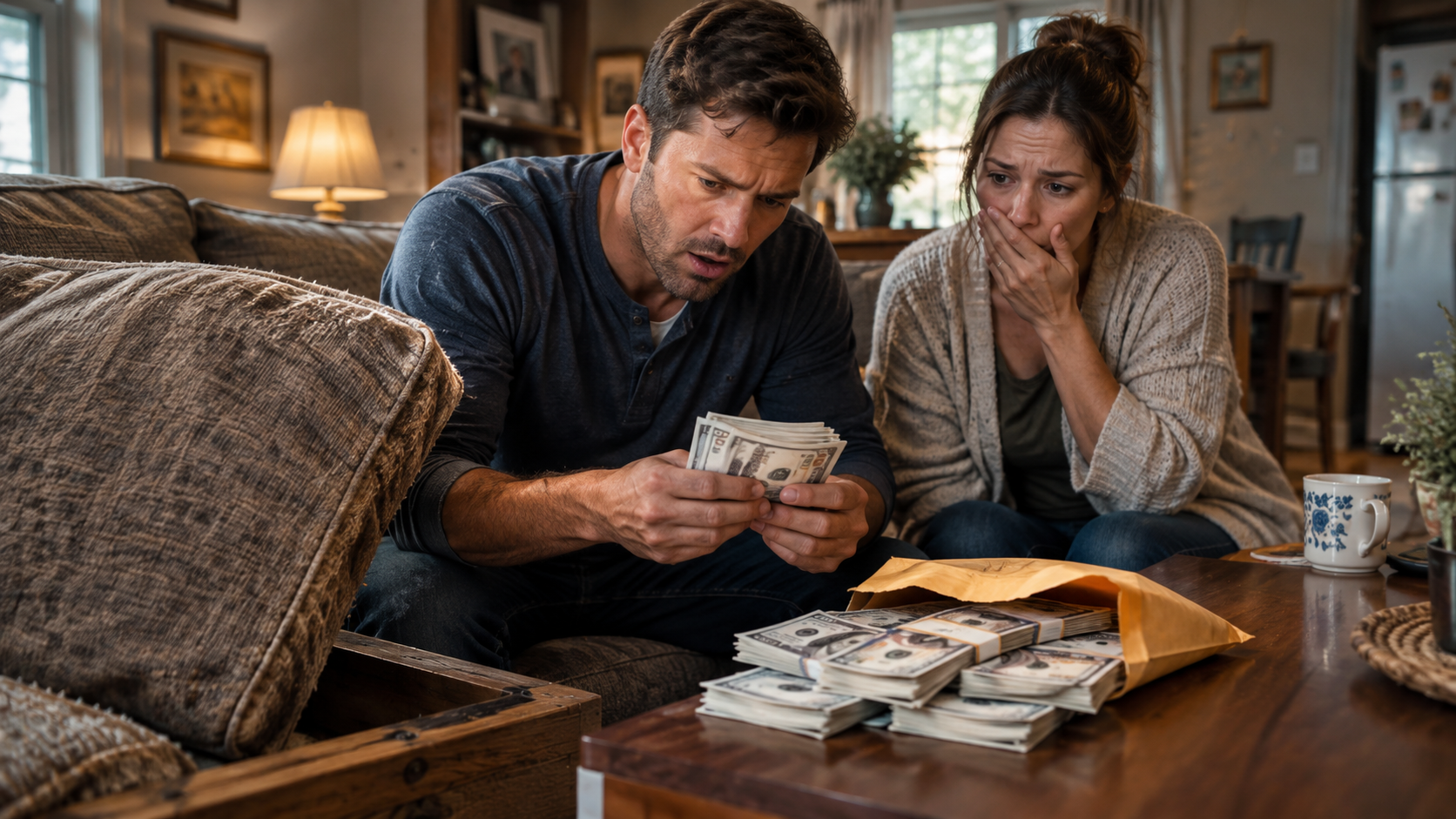
I carried the envelope to the kitchen table, emptied it, and began counting.
Ten thousand dollars.
Exactly.
For several seconds, neither of us spoke.
Then I laughed—not because anything was funny, but because relief hit me so hard I didn’t know what else to do.
I started talking immediately. We could repair or replace the car. Pay the rent. Buy everything the kids needed. Maybe, for once, put a little money into savings instead of watching every paycheck disappear before the month ended.
Emily didn’t smile.
She slowly sat across from me and looked at the cash.
“We need to find the owner,” she said.
My excitement disappeared.
“Emily, we bought the couch. The money was inside it.”
She gave me that familiar look—the one she used whenever she knew I was trying to convince myself of something I didn’t truly believe.
“Someone may be looking for this,” she said quietly. “Someone may need it even more than we do.”
I wanted to argue. I really did.
But deep down, I knew she was right.
The next morning, I called the estate-sale company. The woman who answered remembered the couch and explained that the sale had belonged to the family of an elderly woman named Margaret Whitmore, who had recently passed away.
When I explained what we had discovered, she hesitated before giving me the phone number of Margaret’s daughter, Susan.
I called immediately.
A tired woman answered.
“Hello?”
I introduced myself and told her my wife and I had purchased her mother’s couch.
Then I mentioned the envelope.
Susan went completely silent.
“There was money inside?” she finally asked.
“Yes.”
“Oh my God.”
Her voice cracked, and suddenly she was crying.
“That was Mom’s. She hid cash everywhere. We searched that house for weeks—drawers, cabinets, coat pockets, cereal boxes. After Dad died, she stopped trusting banks.”
I glanced at Emily, who was standing beside me listening.
“I’ll bring it back,” I said.
Susan sniffed.
“Thank you. You have no idea what this means.”
Then she paused.
“Wait. How much did you find?”
“Ten thousand dollars.”
Silence followed, but this silence felt different.
“Ten?” she asked carefully.
“Ten thousand. One hundred hundred-dollar bills.”
Susan didn’t answer for several seconds.
Then she said something that made my stomach tighten.
“That’s not right.”
“What do you mean?”
“There should be one hundred thousand dollars.”
I actually laughed because I thought I had misunderstood her.
“One hundred thousand?”
“Mom told me before she died. She said she had put away one hundred thousand dollars for the grandchildren. We found notes mentioning the living-room furniture, but we never found the money. We assumed she must have moved it.”
Emily’s eyes widened.
Susan continued.
“Please, before you bring anything back, check that couch again. Check everything.”
The moment I hung up, Emily and I dragged the couch away from the wall.
We removed every cushion, opened every zipper, checked beneath the fabric, examined the frame, and ran our hands through every gap we could find.
Nothing.
Then we turned the entire couch onto its back.
That was when I noticed something unusual.
A section of fabric underneath had clearly been sewn by hand. The stitches didn’t match the factory seams.
I grabbed a small pair of scissors and carefully cut the thread.
Behind the fabric was a narrow wooden compartment built directly into the frame.
My hands began to shake.
“This has to be it,” I whispered.
Emily crouched beside me.
I reached inside, expecting another envelope stuffed with cash.
Instead, my fingers touched something hard and rectangular.
I pulled out a small metal box, scratched with age, with a tiny brass latch on the front.
It wasn’t locked.
“Open it,” Emily whispered.
I lifted the latch.
There was no money inside.
Instead, we found a faded photograph of Margaret standing beside a man neither of us recognized, three sealed letters tied together with a blue ribbon, an old house key, and a thick brown envelope.
Across the front, written in shaky handwriting, were seven words:
“Susan must never know what happened in 1987.”
Emily and I stared at each other.
Then I noticed something beneath the envelope—a legal document folded neatly in half.
I opened it and read the first paragraph.
My heart began pounding.
Margaret Whitmore hadn’t simply hidden money inside that couch.
She had hidden proof of a family secret that had apparently been buried for almost forty years.
And at the bottom of the document was a name I recognized immediately—the same surname Susan had given me on the phone.
Except according to the paper in my hands, Susan wasn’t Margaret’s only daughter.
PART 2 — I unfolded the document again and read the name beneath Susan’s:
Rebecca Whitmore.
According to the record, Margaret had given birth to Rebecca in 1968, six years before Susan was born.
Emily leaned over my shoulder.
“Susan has a sister?” she whispered.
I didn’t know, but the three letters inside the metal box began filling in the missing pieces.
The first was addressed to Rebecca.
Margaret wrote that she was sorry for allowing fear and family pressure to separate them, and that she had spent most of her life regretting a decision she made when she was young.
Margaret had become pregnant at seventeen.
Her older sister and brother-in-law agreed to raise the baby temporarily while Margaret tried to rebuild her life.
But temporary became permanent.
Rebecca grew up believing Margaret was her aunt.
Years later, when Rebecca discovered the truth, she confronted Margaret.
Whatever happened afterward had shattered their relationship.
The second letter was addressed to Susan.
Margaret confessed everything and begged her younger daughter not to blame Rebecca for the secrecy.
Then we opened the third envelope.
Inside was a handwritten list of bank withdrawals totaling exactly $100,000.
Beneath the figures, Margaret had written one sentence:
“For my daughters, equally, when they finally find each other.”
Emily lowered herself onto the floor beside me.
“Then where is the other ninety thousand?”
I stared into the hidden compartment.
Empty.
For a moment, neither of us spoke.
Then I remembered something from the day we brought the couch home.
One arm had felt strangely heavier than the other.
I grabbed my screwdriver and removed the wooden panel beneath the left armrest.
Behind it was another cloth pocket.
I reached inside.
My fingers touched paper.
I pulled out one envelope, then another, then another—each one packed tightly with hundred-dollar bills.
We counted the money twice.
Ninety thousand dollars.
Together with the first envelope, Margaret had hidden exactly $100,000 inside that old couch.
I sat there staring at the cash, thinking about everything it could have done for my family.
It could have erased nearly every financial problem keeping me awake at night.
But now we knew exactly why Margaret had saved it—and who it belonged to.
I called Susan.
“We found the rest,” I said.
She gasped.
“All of it?”
“Every dollar. But there’s something else you need to see.”
Susan arrived two hours later.
She was in her early fifties, exhausted-looking, with the same eyes Margaret had in the old photograph.
We placed the money and the metal box on the kitchen table.
The moment Susan saw Rebecca’s name, the color drained from her face.
“Rebecca,” she whispered.
“You know her?” Emily asked.
Susan slowly nodded.
Rebecca had attended Margaret’s funeral, but she had stood alone near the back.
All Susan had ever been told was that Rebecca was a distant cousin who had become estranged from the family years earlier.
Susan opened her mother’s letter and began reading.
Halfway through, she covered her mouth with one hand.
Tears filled her eyes.
“She wasn’t my cousin,” she whispered. “She was my sister.”
Susan stared at the money for several seconds.
Then she said, “Half of this belongs to Rebecca.”
There was no hesitation.
She immediately called an older relative and eventually found Rebecca’s phone number.
Rebecca nearly hung up when Susan introduced herself.
Then Susan said four words that stopped her.
“I found Mom’s letter.”
Silence filled the line.
Moments later, Rebecca began crying.
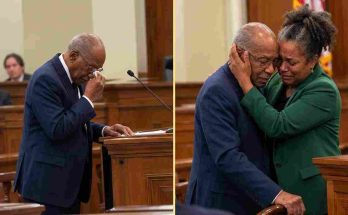
Three days afterward, the sisters met in our apartment.
Neither wanted their first real conversation to happen inside Margaret’s house, surrounded by decades of secrets.
Rebecca was sixty-eight, quiet and cautious.
Susan handed her Margaret’s letter.
Rebecca read it once, then again.
They talked for nearly four hours.
There was anger. Confusion. Grief. Long stretches of silence.
But slowly, the conversation changed.
They compared childhood photographs.
They discovered stories they had both heard from different sides of the family.
They laughed when they realized they had inherited the same habit of tapping their fingers whenever they were nervous.
Near the end of the evening, Susan pushed an envelope across the table toward Emily and me.
Inside was $10,000.
I immediately shook my head.
“No. We returned your money. We can’t take this.”
Rebecca smiled.
“You didn’t just return money.”
She looked toward Susan.
“You returned my family.”
Susan nodded.
“If you hadn’t been honest, we might never have known the truth.”
We finally accepted after they insisted.
That money repaired our car, covered the overdue rent, bought everything the kids needed for school, and left enough for a modest emergency fund.
But the part I remember most happened two months later, when Susan invited us to dinner.
Rebecca was sitting beside her at the table, laughing over an old family photo album.
The $100,000 had been divided exactly as Margaret intended, but neither sister seemed particularly interested in talking about the money anymore.
They were too busy recovering the years they had lost.
Sometimes I still think about that seventy-five-dollar couch.
We bought it because ours had broken and we couldn’t afford anything better.
At first, I thought discovering $10,000 inside it was the miracle.
I was wrong.
The real miracle was that a woman’s final secret ended up in the hands of two strangers who chose to return something that wasn’t theirs.
In the end, honesty gave my family exactly the help we desperately needed.
But it gave Susan and Rebecca something no amount of money could ever buy back—
the truth, a second chance, and each other.
THE END! THANK YOU FOR READING! ❤️